
Official statement
What you need to understand
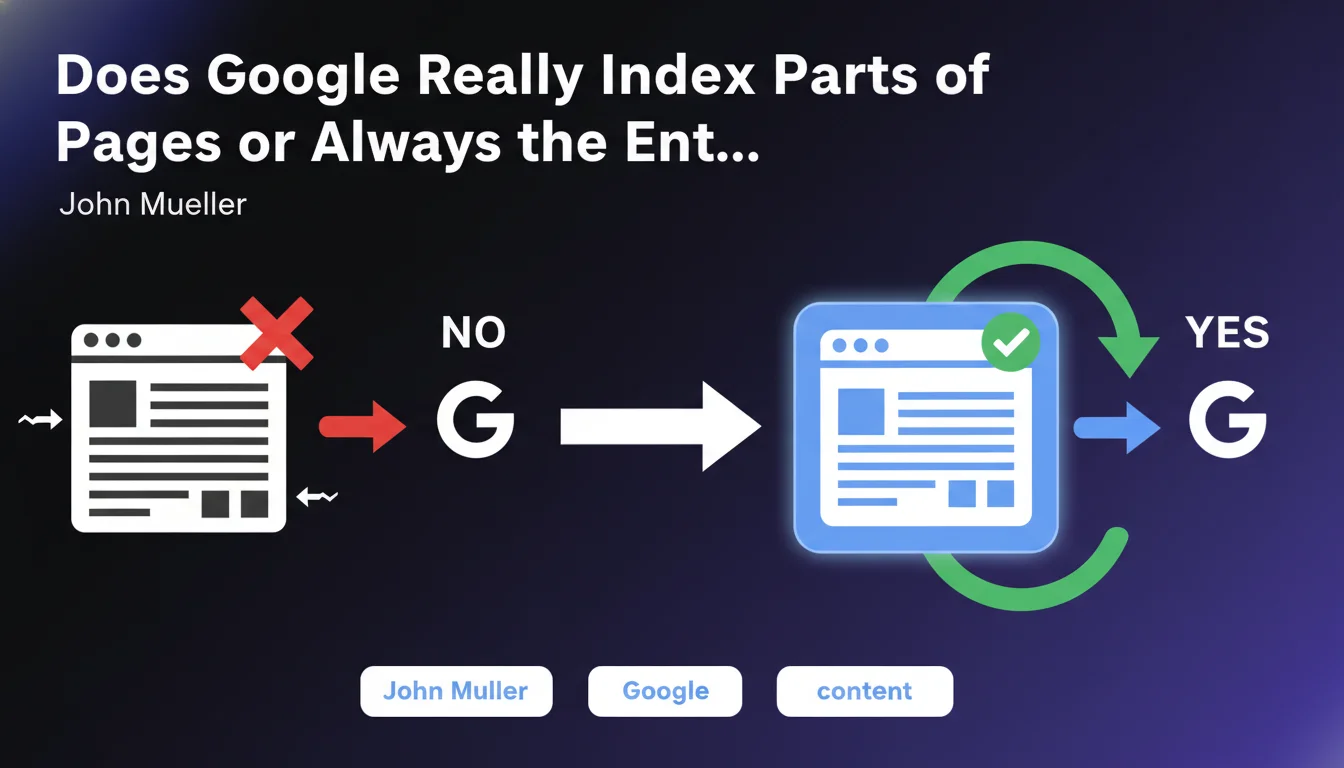
Google has officially clarified its method for indexing web pages: contrary to certain misconceptions, the search engine never selectively indexes portions or fragments of HTML code.
When a page is discovered and deemed relevant, Google performs a complete indexation of its HTML content. There is no mechanism that would carve up the code to retain only certain specific parts.
This clarification is important because it dispels a persistent myth in the SEO community according to which Google could "cherry-pick" certain sections of a page while ignoring other parts of the source code.
- Google always indexes a page in its entirety, never partially
- Complete indexation does not mean that all content will be used for ranking
- The distinction exists between "indexing" and "using for ranking"
- Crawl budget may limit the number of pages indexed, but not their content
SEO Expert opinion
This clarification is perfectly consistent with field observations. Indeed, when we analyze indexation via cache tools or site: commands, we observe that Google does store the entirety of a page's HTML content.
However, a crucial nuance must be added: while Google indexes everything, it does not treat all elements with the same importance for ranking. The engine may ignore certain sections (generic footer, sidebar), prioritize main content, or devalue areas deemed less relevant.
Furthermore, certain content loaded in asynchronous JavaScript after initial rendering can sometimes pose problems, not due to partial indexation, but because they require a second crawl wave that Google does not systematically perform.
Practical impact and recommendations
- Structure your HTML content clearly with appropriate semantic hierarchy (H1, H2, H3)
- Place your main content as high as possible in the HTML source code
- Use semantic HTML5 tags (main, article, aside) to help Google identify important zones
- Avoid diluting your main content with repetitive or less relevant blocks
- Do not rely on hidden content or complex JavaScript to escape indexation
- Optimize the total weight of your pages: even though everything is indexed, overly heavy HTML consumes crawl budget
- Implement schema.org markup to explicitly signal priority content areas
- Regularly clean up superfluous code that weighs down your pages without added value
- Monitor Google's cached version to verify that complete indexation is occurring correctly
These technical optimizations require in-depth expertise in web architecture and technical SEO. The distinction between what is indexed and what actually influences ranking requires detailed analysis of each site.
For complex sites with significant performance challenges, support from a specialized SEO agency enables precise auditing of HTML structure, identification of strategic content zones, and implementation of an optimal architecture that maximizes the efficiency of Google indexation.
💬 Comments (0)
Be the first to comment.