
Official statement
What you need to understand
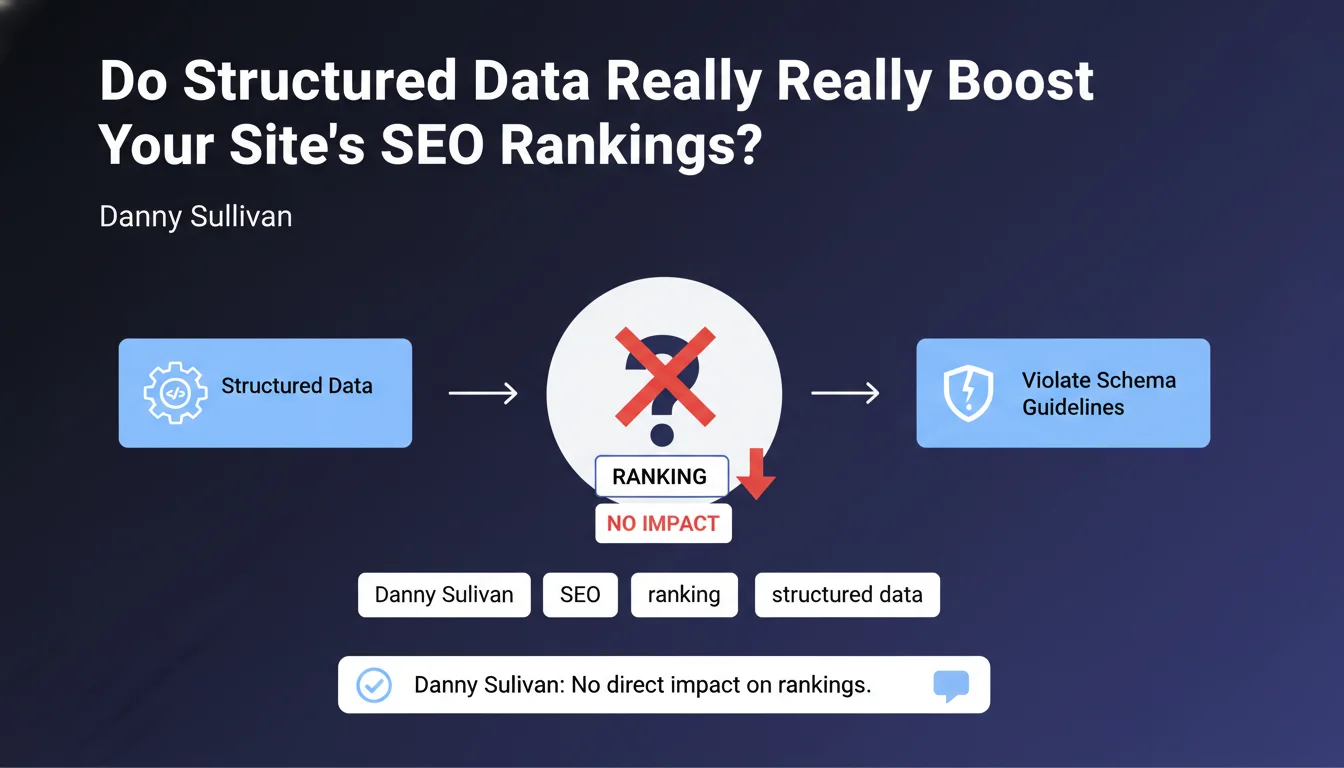
Google officially confirms that structured data is not a direct ranking factor. In other words, adding Schema markup to your pages will not mechanically improve your positions in search results.
This statement is important because it dispels a frequent misunderstanding in the SEO community. Many practitioners believe that implementing structured data will boost their rankings, when in fact their role is quite different.
Structured data primarily serves to help Google better understand the content of your pages and determine their eligibility for rich results (rich snippets, featured snippets, etc.). This is their real added value.
- No direct boost in organic ranking
- No penalty on your positions in case of Schema errors
- Possible indirect impact through CTR improvement thanks to rich snippets
- Primary function: access to special displays in the SERP
- Non-compliance with guidelines may deprive you of rich results, but won't affect your standard rankings
SEO Expert opinion
This statement is perfectly consistent with what we observe in the field. Many well-ranked sites use no structured data whatsoever, while others, perfectly marked up, stagnate in the results if their content and authority are insufficient.
The important nuance to add concerns the indirect but real impact on traffic. While structured data doesn't boost your positions, it can considerably improve your visibility and CTR through rich snippets, review stars, expandable FAQs, or enhanced breadcrumbs. A site in 3rd position with visible stars can generate more clicks than a competitor in 2nd position without enhancement.
There are also specific cases like Google Discover, Google News, or voice searches where structured data plays a more central role in content selection and display, even if technically this remains distinct from traditional organic ranking.
Practical impact and recommendations
- Prioritize Schema that generate visible rich snippets: reviews/ratings, products, recipes, FAQs, events, articles
- Don't sacrifice other SEO optimizations in favor of structured data - focus first on content, backlinks, and user experience
- Systematically test your implementations with Google's Rich Results Test to verify eligibility for rich results
- Analyze the impact on your CTR via Search Console by comparing before/after implementation performance
- Scrupulously respect the guidelines: even if errors don't penalize your rankings, they deprive you of rich displays
- Document your implementations to facilitate maintenance and future Schema updates
- Don't spam with irrelevant data just to obtain rich snippets - this can lead to manual action
- Focus your efforts on strategic pages: product pages, flagship articles, main service pages
- Regularly monitor the Enhancements report in Search Console to detect any errors
Correct and strategic implementation of structured data requires a thorough understanding of different Schema types, their JSON-LD syntax, and their interaction with Google's various rich result types. The technical complexity and need for constant monitoring of Schema.org developments can quickly become time-consuming.
For medium to large-scale sites, or those operating in highly competitive sectors where every advantage counts, engaging a specialized SEO agency can prove judicious. Expert support not only ensures flawless technical implementation, but also identifies opportunities specific to your sector and keeps your structured data up to date in the face of constantly evolving Google guidelines.
💬 Comments (0)
Be the first to comment.