
Official statement
What you need to understand
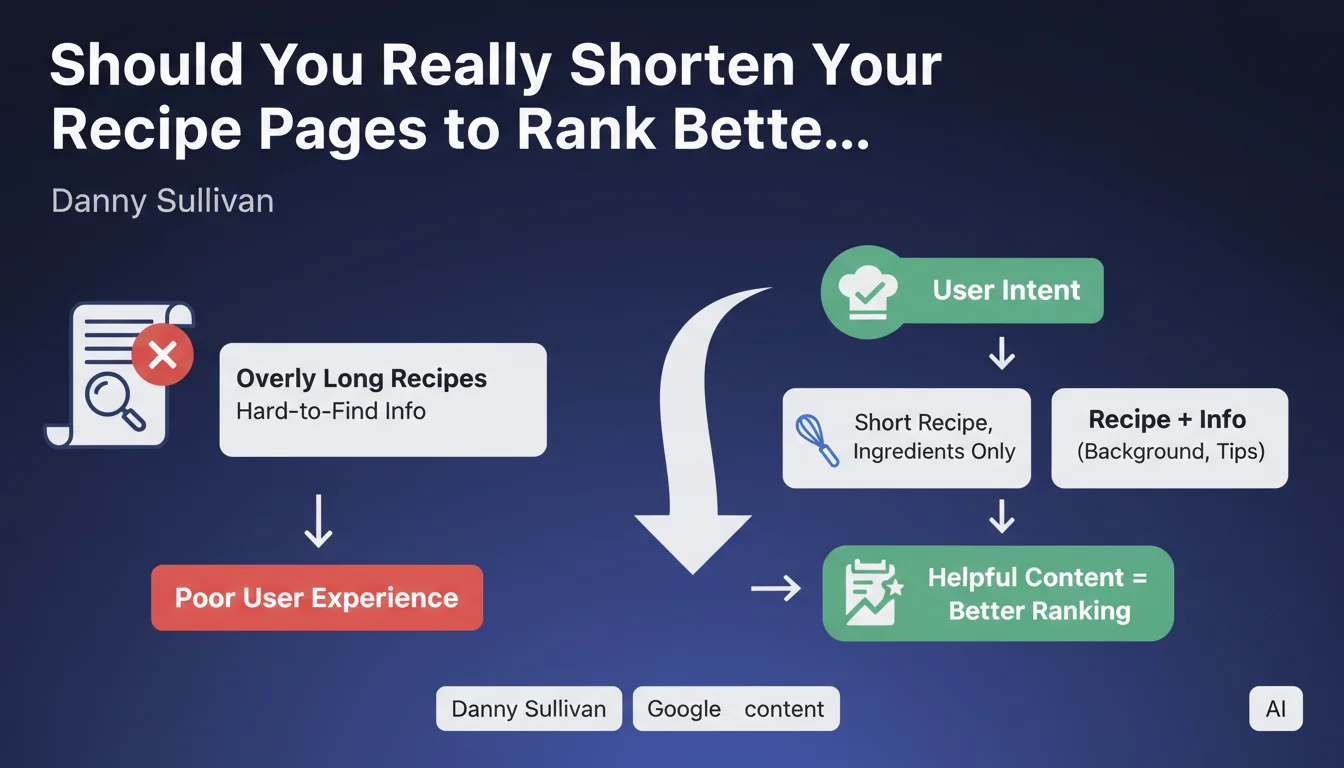
Google states that content length is not a ranking factor in itself. This official statement responds to a recurring complaint from users about endless recipe pages, stuffed with personal anecdotes and family stories before getting to the actual ingredients.
Google's key message is simple: usefulness trumps length. It's not about producing short or long content as a principle, but about precisely matching the user's search intent. A user searching for "quick cookie recipe" probably doesn't need a 2,000-word essay on the history of cookies.
This position aligns with the "helpful content" philosophy that Google has promoted since several updates. The algorithm seeks to identify whether content directly answers the need expressed in the query, without unnecessary friction.
- Length is not a direct ranking factor according to this statement
- Search intent should guide content structure and depth
- Short but relevant content can outperform long but diluted content
- Google values the match between the query and the response format
- User experience remains central to quality evaluation
SEO Expert opinion
This statement is consistent with field observations since 2022, particularly after the Helpful Content updates. We do indeed see that concise and direct pages can now outperform exhaustive but verbose content, especially for simple transactional or informational queries.
However, an important nuance is necessary: Google evaluates usefulness based on the competitive context. For highly competitive or complex queries, in-depth content is often still necessary to demonstrate expertise. The question is therefore not "short vs. long" but "appropriate vs. inappropriate" for the intent.
Another element to consider: structured formats like recipe schema allow Google to directly extract essential information. Long but well-structured content with structured data can simultaneously satisfy both types of users: those who just want the recipe and those seeking context.
Practical impact and recommendations
- Analyze the intent behind your target queries: use current SERPs to identify whether Google favors short or in-depth answers for each keyword
- Implement modular structures: place essential information (recipe, answer, solution) at the top of the page, and add additional context afterward for those who want it
- Leverage structured data: integrate appropriate schemas (Recipe, HowTo, FAQ) to allow Google to directly extract key information
- Create internal navigation anchors: add a clickable table of contents or a "Jump to recipe" button to improve user experience
- Test different versions: on a sample of pages, compare the performance of a concise version vs. a detailed version for your specific audience
- Monitor engagement metrics: bounce rate, time spent, and scroll depth will indicate whether your length is appropriate
- Avoid artificial padding: remove generic introductory paragraphs that don't provide any specific value to your content
- Segment your content: consider creating two versions (short version and detailed version) with appropriate canonicalization if your audience is mixed
This optimization of content-intent alignment represents a complex strategic undertaking, requiring careful analysis of your personas, your analytics data, and the competitive landscape. It often involves substantial editorial restructuring and delicate trade-offs between SEO and content strategy. For large-scale sites or projects with significant business stakes, support from a specialized SEO agency can prove valuable to structure this approach, prioritize actions based on their potential ROI, and avoid the pitfalls of excessive simplification that could harm your topical authority.
💬 Comments (0)
Be the first to comment.