
Official statement
Other statements from this video 7 ▾
- □ What's the real reason Google created XML Sitemaps in the first place?
- □ How did Google transform XML Sitemaps into a neutral web standard shared by all major search engines?
- □ What was Google's real hidden agenda when launching Search Console in the first place?
- □ How can you slash your support emails by 80% with SEO-friendly documentation?
- □ Does Google deliberately hide SEO information from webmasters to protect its algorithm?
- □ Are hyphens in URLs really an essential ranking factor?
- □ Why won't Google settle the subdomains vs subdirectories debate once and for all?
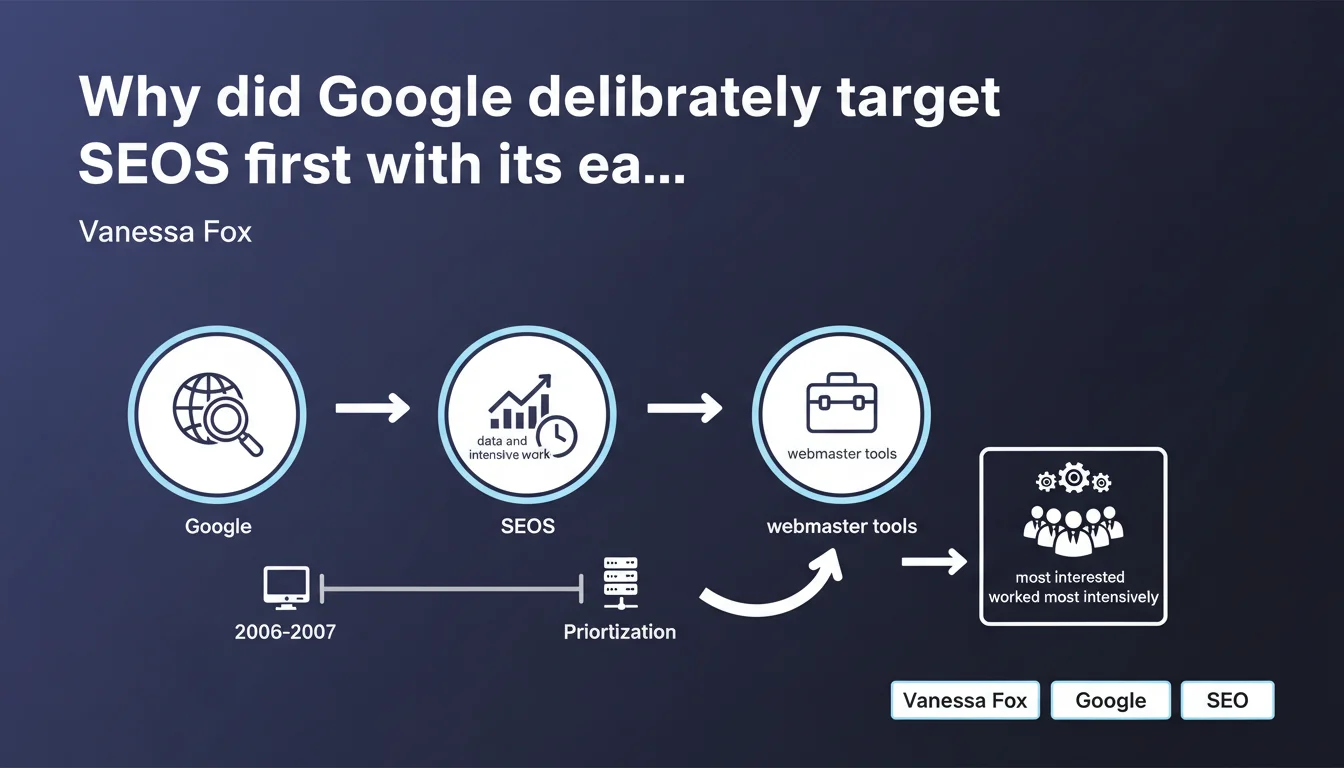
Between 2006 and 2007, Google deliberately targeted SEOs as the priority audience for its webmaster tools, not because these tools were exclusively intended for them, but because they were the most interested in this data and actively exploited it. A strategic choice that shaped the relationship between Google and the SEO industry.
What you need to understand
Did Google design its tools exclusively for SEO professionals?
No. Vanessa Fox clarifies that webmaster tools were not exclusively intended for SEOs. The initial intention was broader: to give website owners insights into how Google crawled and indexed their content.
But on-the-ground reality dictated a different strategy. SEO professionals were the only ones truly exploiting this data intensively. They analyzed, tested, and iterated. Meanwhile, the vast majority of webmasters were unaware these tools even existed.
Why was this audience deemed a priority?
Because SEOs were the most engaged users. They didn't just consult the data — they transformed it into concrete action. Google needed field feedback, use cases, and bug reports.
Targeting SEOs also allowed for creating a direct communication channel with those who influenced the quality of the indexed web. Training SEO professionals meant indirectly improving the quality of the sites they optimized.
What are the implications of this initial choice?
This decision shaped the Google-SEO relationship for the next fifteen years. Tools like Search Console became essential references for practitioners, but their complexity often makes them inaccessible to non-specialists.
Google also created a strategic dependency: SEOs rely heavily on these tools for their daily diagnostics. This gives Google considerable leverage to control industry practices.
- Webmaster tools were not exclusive to SEOs but these professionals were their most active users
- Google made a pragmatic choice in targeting those who actually exploited the data
- This strategy created an ecosystem where SEOs depend heavily on Google's tools
- Tool complexity reflects their initial design for a technical and specialized audience
SEO Expert opinion
Is this statement consistent with observed practices?
Absolutely. Look at Search Console today: the interface, terminology, data granularity — everything is designed for seasoned professionals. An average webmaster gets lost within two clicks.
This initial bias explains why so many features remain underutilized outside the SEO sphere. Google never really tried to democratize these tools beyond our industry. [To verify] whether Google measured actual adoption rates among non-SEOs — the numbers would probably be eye-opening.
What nuances should be applied to this logic?
Saying SEOs were the priority audience doesn't mean Google was giving them gifts. This proximity also allowed Google to frame practices and impose its vision of "good SEO". The tools became instruments of normalization.
Another rarely discussed point: by targeting SEOs, Google created a biased feedback channel. Field reports came almost exclusively from professionals obsessed with rankings, not publishers concerned with readability or accessibility. This shaped product priorities.
In what cases does this strategy show its limitations?
When Google wants to push mass-market initiatives — like Core Web Vitals or mobile compatibility. There, evangelization needs to go far beyond SEOs. And that's where it stalls: tools remain intimidating, messages technical, educational resources written for insiders.
Practical impact and recommendations
What should you do concretely with this information?
Understand that Search Console and Google resources are designed for you, the SEO professional. Exploit them fully — you're the target audience. But never assume your clients or their internal teams have the same comfort level.
Systematically translate raw data into actionable insights. A raw Search Console report has no value for an uninitiated client. Your added value lies in interpretation, not just data extraction.
What mistakes should you avoid?
Don't fall into the SEO bubble trap. What seems obvious to you — a 404 error, a 301 redirect, a poorly formatted sitemap — remains opaque jargon for 95% of website owners.
Also avoid treating Google tools as gospel. They're useful, certainly, but incomplete and sometimes misleading. Crawl data doesn't always reflect ranking reality. Core Web Vitals improvement suggestions are often generic.
How can you capitalize on this historical knowledge?
- Train your clients on Search Console basics, but adapt your teaching approach — what took you years to master shouldn't be crammed into a one-hour session
- Create simplified dashboards that extract essentials without drowning in technical complexity
- Use Google tools as a starting point, not as your sole source of truth — cross-reference with third-party tools and qualitative analysis
- Document your recommendations in plain language, not Search Console jargon — translate "5xx error" as "inaccessible page that drives away users and Google"
- Anticipate naive questions rather than dismiss them — they often reveal fundamental misunderstandings that need addressing
❓ Frequently Asked Questions
Les outils Google étaient-ils vraiment inutilisables pour les non-SEO en 2006-2007 ?
Cette stratégie a-t-elle changé depuis ?
Pourquoi Google ne crée-t-il pas des outils vraiment grand public ?
Cela signifie-t-il que Google favorise les SEO dans son algorithme ?
Est-ce que d'autres moteurs de recherche ont fait le même choix ?
🎥 From the same video 7
Other SEO insights extracted from this same Google Search Central video · published on 22/09/2022
🎥 Watch the full video on YouTube →
💬 Comments (0)
Be the first to comment.