
Official statement
Other statements from this video 7 ▾
- □ What's the real reason Google created XML Sitemaps in the first place?
- □ How did Google transform XML Sitemaps into a neutral web standard shared by all major search engines?
- □ What was Google's real hidden agenda when launching Search Console in the first place?
- □ How can you slash your support emails by 80% with SEO-friendly documentation?
- □ Does Google deliberately hide SEO information from webmasters to protect its algorithm?
- □ Why did Google deliberately target SEOs first with its early webmaster tools?
- □ Are hyphens in URLs really an essential ranking factor?
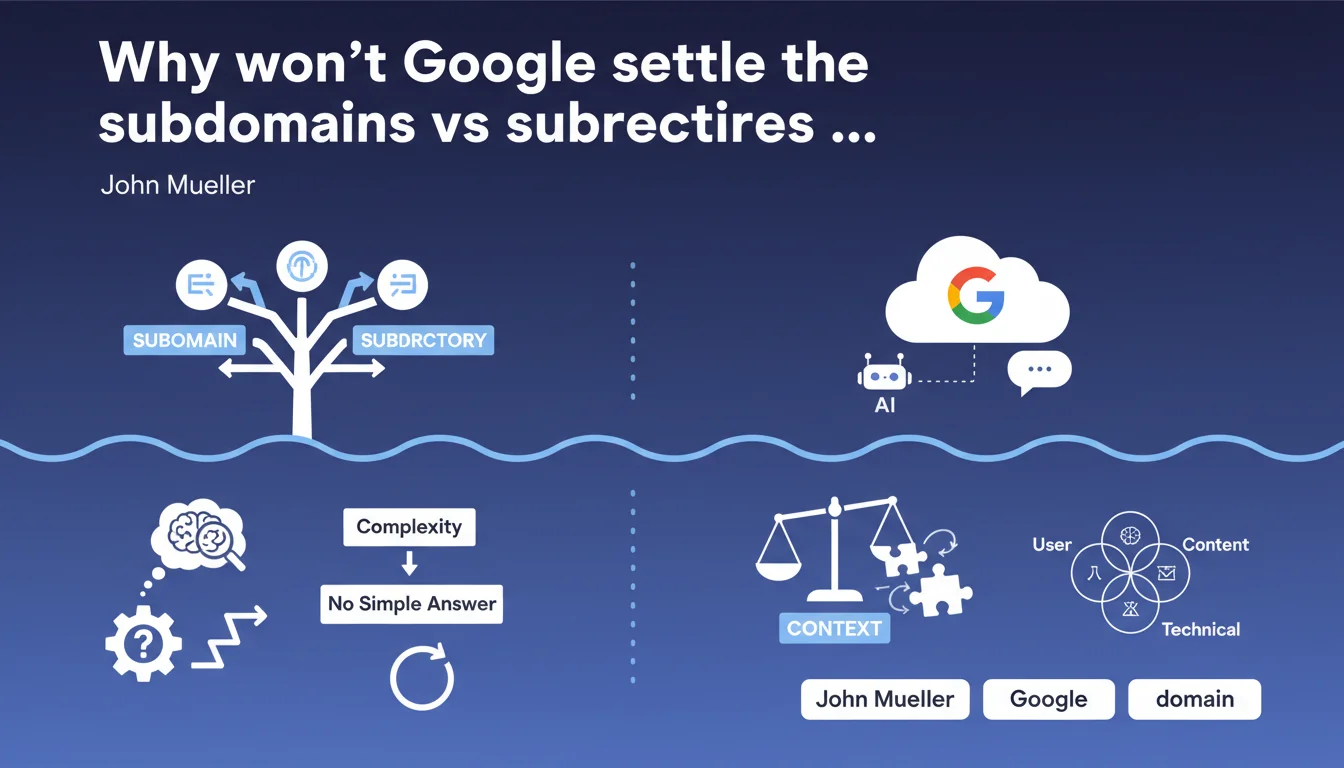
Google maintains that there is no definitive answer between subdomains and subdirectories. This ambiguous stance reflects a ground reality: both structures can work, but the factors influencing the choice vary depending on the project context. What truly matters is consistency in implementation, not the binary choice itself.
What you need to understand
John Mueller's statement confirms what many of us have observed for years: Google does not favor any architecture by default. The search engine treats both structures according to its own criteria, which do not depend solely on URL structure.
The ambiguity maintained by Google is no accident. It reflects the real complexity of algorithmic processing, where crawl budget, authority perception, and thematic segmentation all come into play.
Why does this debate keep persisting?
Because SEO practitioners seek absolute rules where Google applies contextual logic. A subdomain can benefit from algorithmic autonomy useful for a distinct project, while a subdirectory directly inherits the authority of the main domain.
The problem? These theoretical advantages don't systematically materialize. Poorly configured subdomains end up isolated, overloaded subdirectories dilute their thematic focus.
What does "no definitive answer" really mean?
Mueller implicitly acknowledges that other factors carry more weight than URL structure itself: content quality, internal linking, editorial consistency, crawl depth.
This position forces us to think in terms of overall architecture rather than miracle recipes. An isolated technical choice never compensates for a shaky content strategy.
In which cases does this distinction really have an impact?
Impact is most measurable during migrations or new section launches. A subdomain for a corporate blog can cleanly segment traffic and metrics, but complicates authority transfer.
Conversely, a subdirectory for a B2B service distinct from B2C can create semantic confusion if internal linking mixes target audiences.
- No absolute rule: Google adapts its treatment according to site context
- Authority does not transfer automatically between subdomain and main domain
- Internal linking and thematic consistency matter more than URL structure
- Migrations between structures remain risky operations requiring thorough documentation
SEO Expert opinion
Is this position consistent with field observations?
Yes and no. Google oversimplifies by saying "both work," but reality shows measurable behavioral differences. Subdomains often require more time to accumulate their own authority signals, which isn't always made explicit.
I've observed cases where a blog migrated from a subdomain to a subdirectory gained 30% visibility in three months—with no other changes. Hard to chalk that up to chance. [To verify] whether Google truly applies the same weighting to both structures across all sectors.
What nuances should be added to this statement?
Mueller doesn't mention crawl budget, which remains a discriminating factor. A subdomain consumes its own crawl budget, which can be an advantage (isolation) or a handicap (limited resources) depending on project size.
Another point: user perception. A subdomain like "blog.brand.com" communicates editorial separation that "brand.com/blog" doesn't express. This UX aspect indirectly influences SEO through behavioral signals.
Let's be honest: Google maintains this ambiguity because it has no interest in freezing a rule that its algorithm doesn't follow binarily itself.
In which cases does this rule not apply?
For multi-country sites, the discussion changes completely. A subdomain per country (fr.brand.com) facilitates geographic targeting via Search Console, where a subdirectory (/fr/) can create ambiguities with hreflang.
Multi-tenant SaaS platforms often use subdomains by technical necessity (client1.platform.com). In this case, the SEO question becomes secondary to application architecture constraints.
Practical impact and recommendations
What should you concretely do to choose between the two?
Start by defining the strategic objective of the new section: complete editorial autonomy or extension of the main site? If you want to isolate a project with strong independent identity (media, community platform), the subdomain makes sense.
If the goal is to capitalize on existing authority to accelerate positioning of a new section, the subdirectory remains the default choice. It's simpler to manage technically and monitor.
Which mistakes should you avoid during implementation?
Never create a subdomain "by default" without prior reflection. I've seen sites launch blog.brand.com then struggle for months building dedicated backlinks, when /blog/ would have instantly inherited domain authority.
Another classic mistake: underestimating inter-structure internal linking. A subdomain poorly connected to the main domain remains a disconnected satellite, regardless of published content.
Avoid incoherent hybrid architectures (blog on subdomain + resources on subdirectory). Google might not care, but it unnecessarily complicates SEO governance.
How do you verify that your chosen structure is working?
Monitor the crawl rate via server logs or Search Console. A subdomain receiving too few Googlebot visits signals a budget or internal linking problem.
Analyze organic traffic distribution: a subdomain stagnating after 6 months despite solid content likely indicates an authority deficit. At that point, seriously consider subdirectory migration.
Check average rankings by structure in Search Console. If your subdirectory pages consistently rank better at equal quality, you have your answer.
- Define strategic objective before choosing structure (autonomy vs authority capitalization)
- Favor subdirectory by default, unless specific technical or editorial need
- Ensure robust internal linking regardless of chosen structure
- Monitor crawl budget and traffic distribution after implementation
- Document any migration with exhaustive 301 redirects and Search Console monitoring
- Test hreflang if multi-country, regardless of adopted architecture
Choosing between subdomain and subdirectory relies more on editorial and technical strategy than pure SEO optimization. Google treats both, but operational constraints differ.
Concretely? Stick with subdirectory unless you have valid reason otherwise, document your choices, and focus on content and linking. These architecture decisions can quickly become complex when integrated into a multi-site or multi-language digital ecosystem. If you hesitate about the best approach or anticipate structural overhaul, consulting a specialized SEO agency lets you avoid costly mistakes and build sustainable architecture aligned with your business objectives.
❓ Frequently Asked Questions
Un sous-domaine bénéficie-t-il de l'autorité du domaine principal ?
Peut-on migrer un sous-domaine vers un sous-répertoire sans perte de trafic ?
Les sous-domaines consomment-ils leur propre crawl budget ?
Quel impact pour un site multilingue : sous-domaines ou sous-répertoires ?
Google Search Console différencie-t-il sous-domaines et sous-répertoires ?
🎥 From the same video 7
Other SEO insights extracted from this same Google Search Central video · published on 22/09/2022
🎥 Watch the full video on YouTube →
💬 Comments (0)
Be the first to comment.