
Official statement
Other statements from this video 7 ▾
- □ Pourquoi Google a-t-il vraiment créé les XML Sitemaps ?
- □ Pourquoi Google a-t-il voulu faire des XML Sitemaps un standard web partagé entre moteurs ?
- □ Pourquoi Google a-t-il vraiment lancé Search Console à l'origine ?
- □ Comment réduire de 80% vos emails de support grâce à une documentation SEO-friendly ?
- □ Pourquoi Google a-t-il ciblé les SEO en priorité avec ses premiers outils pour webmasters ?
- □ Les tirets dans les URLs sont-ils vraiment un critère de ranking essentiel ?
- □ Sous-domaines vs sous-répertoires : pourquoi Google refuse-t-il de trancher ?
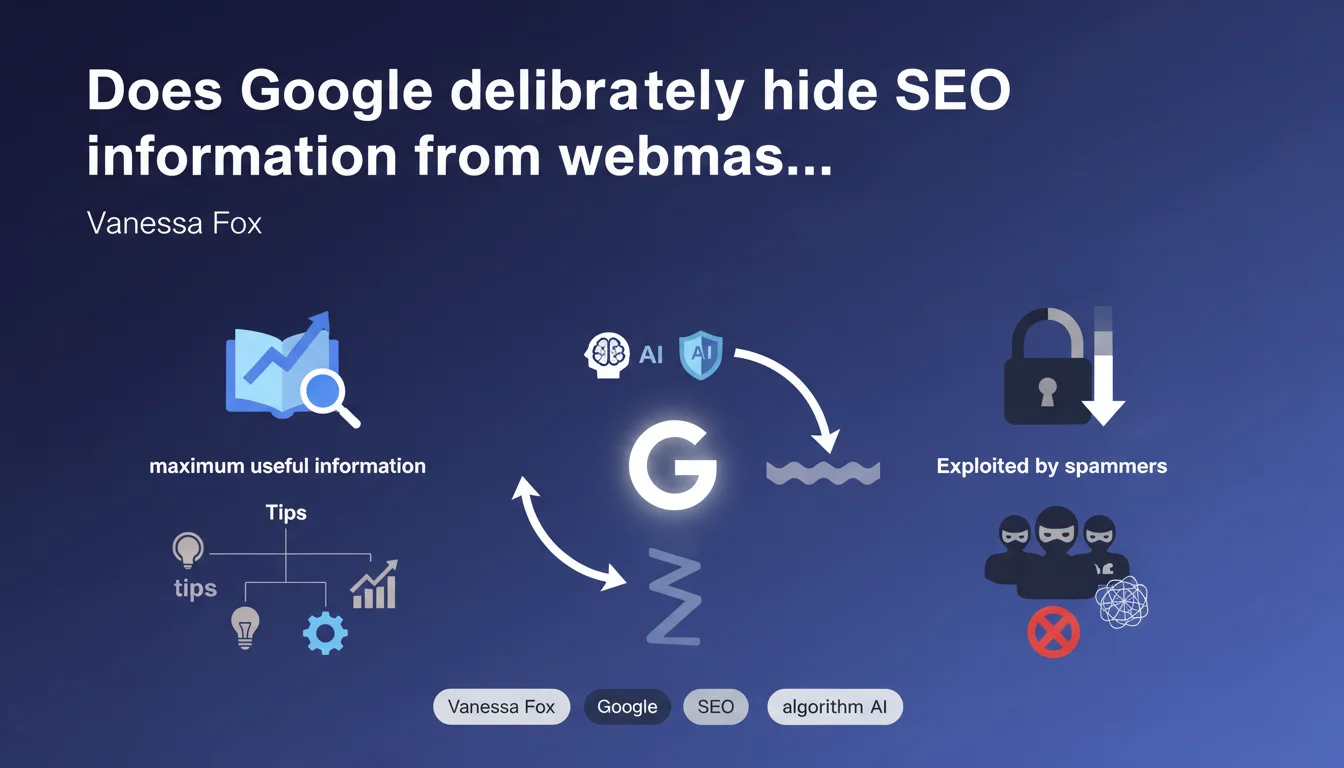
Google officially acknowledges that it deliberately calibrates transparency: certain information remains unclear to avoid arming spammers. This structural tension between helping webmasters and fighting spam explains why so many SEO questions remain unanswered. Understanding this logic makes it easier to interpret Google's official communications.
What you need to understand
What is this tension Google is talking about?
Vanessa Fox, former head of Webmaster Central, acknowledges that Google operates a permanent trade-off: every piece of information published is weighed to measure its actual usefulness for legitimate webmasters against the risk that manipulators will exploit it.
This official statement confirms what many suspected — Google doesn't tell everything. Not out of malice, but as a defensive strategy. Revealing certain mechanisms would amount to providing a manual for circumventing them.
How does this policy impact official communications?
Google's public statements are therefore filtered by design. Some answers remain intentionally vague, others are oversimplified, and certain sensitive topics are simply never addressed.
This creates a gray zone where field experimentation becomes more reliable than official recommendations. SEO professionals must learn to read between the lines and cross-reference sources rather than waiting for comprehensive answers.
What types of information remain hidden?
Everything related to precise thresholds, exact weightings of ranking signals, or detailed anti-spam mechanisms generally remains opaque. Google can say a factor is important, but rarely how it's calculated or what weight it carries.
- Acknowledgment of the dilemma: Google publicly admits it deliberately limits its transparency
- Strategic reason: protecting the algorithm against large-scale manipulation
- Direct consequence: webmasters must work with partial and sometimes contradictory information
- Structural gray zone: certain SEO questions will never have a clear official answer
SEO Expert opinion
Is this position consistent with observed practices?
Absolutely. For years, SEO professionals have noticed a systematic gap between what Google says and what field tests reveal. This statement confirms that this gap is not a bug — it's a feature.
Take algorithm updates: Google communicates about general principles (quality content, user experience) but remains silent on the specific technical signals that changed. SEO professionals must reverse-engineer patterns from massive observations.
What are the consequences for SEO methodology?
This institutionalized tension means a good SEO professional cannot simply follow the guidelines. They must test, measure, compare — and accept that certain areas will remain gray.
Let's be honest: this also creates fertile ground for myths and false certainties. When Google says nothing, theories proliferate. Hence the importance of methodological rigor in testing rather than relying on anecdotes.
Should you stop following official recommendations?
No, but you must contextualize them. Public guidelines remain useful for avoiding gross errors and understanding Google's general philosophy. They set the framework.
On the other hand, for advanced optimizations, controlled experimentation and large-scale correlation analysis become essential. Official communications are a starting point, not gospel. [Verify] systematically on your own sites before generalizing.
Practical impact and recommendations
How do you adjust your strategy given this assumed opacity?
First rule: diversify your sources. Never rely on a single Google statement. Cross-reference with field experience feedback, correlation studies, and A/B tests documented by the community.
Second rule: prioritize robust best practices that work independently of algorithmic fluctuations — solid architecture, genuinely useful content, smooth user experience. These fundamentals resist gray areas better.
What mistakes should you avoid in this context?
Don't fall into the over-interpretation trap. When Google is vague, it's often deliberate — no need to hunt for a hidden message that doesn't exist. Stay pragmatic.
Avoid wholesale rejection of official communications on the grounds that they're incomplete. They still draw limits of acceptability — practices Google explicitly targets remain risky, even if the exact detection mechanisms stay secret.
What should you implement concretely?
- Establish an SEO testing framework with recurring tests to empirically validate hypotheses rather than relying solely on guidelines
- Document the patterns you observe across your projects: which optimizations produce which results, independent of what Google claims
- Develop active monitoring of correlation studies published by recognized players (universities, established SEO tools)
- Adopt a risk-based approach: identify gray zones where you're making calculated bets vs non-negotiable fundamentals
- Train teams on critical thinking: systematically question assertions, even official ones, and ask "how can we verify this?"
❓ Frequently Asked Questions
Google cache-t-il volontairement des informations SEO importantes ?
Peut-on encore faire confiance aux guidelines officielles de Google ?
Pourquoi Google ne donne-t-il jamais de seuils précis ou de pondérations exactes ?
Comment savoir si une information officielle de Google est complète ou filtrée ?
Cette opacité avantage-t-elle les gros acteurs SEO au détriment des petits ?
🎥 From the same video 7
Other SEO insights extracted from this same Google Search Central video · published on 22/09/2022
🎥 Watch the full video on YouTube →
💬 Comments (0)
Be the first to comment.