
Official statement
Other statements from this video 13 ▾
- □ Are stock images really hurting your search rankings?
- □ Should you really prioritize strategy over technical implementation when optimizing images?
- □ Does adding context to alt attributes really boost your image SEO rankings?
- □ Should you really stop writing 'image of' in alt attributes?
- □ Should you really choose between accessibility and SEO in your alt tags?
- □ Should you really fill the alt attribute for every single image on your site?
- □ Do you really need to rename all your image files for SEO?
- □ Why does Google crawl your images far less often than your HTML pages?
- □ Is it really worth risking a major image URL overhaul if Google will penalize you with months of reduced visibility?
- □ Does the text surrounding your images really carry more weight than the alt attribute?
- □ Do you really need rel="canonical" for multiple image versions?
- □ Should you optimize ALL your images or just the ones on high-traffic pages?
- □ Are your logos and clickable buttons sabotaging your accessibility and SEO performance?
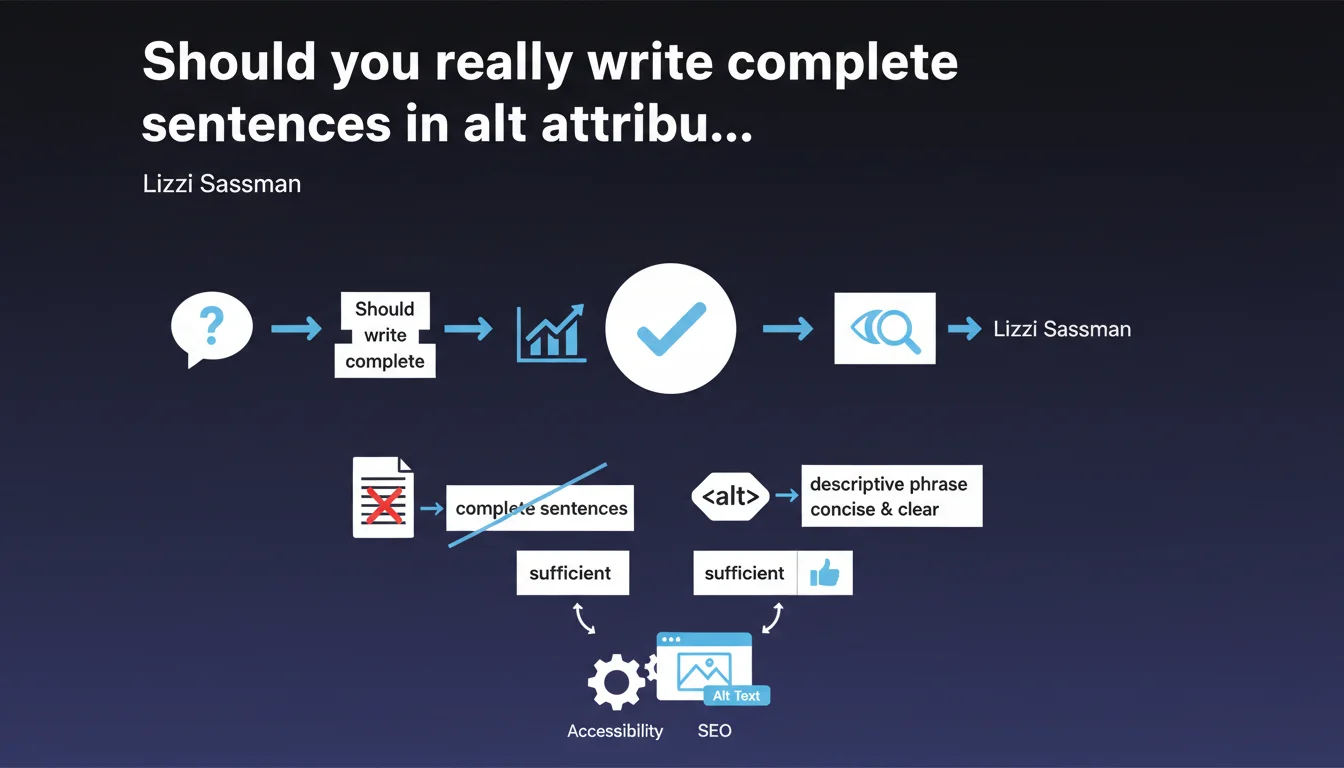
Google confirms that alt text doesn't need to be grammatically perfect or a complete sentence. A concise and clear description is more than enough to help search engines understand visual content. The focus should be on descriptive accuracy rather than syntactic form.
What you need to understand
Why this clarification about alt text syntax?
For years, the SEO community has debated how formal alt text needs to be. Some believed that you absolutely had to construct complete sentences with subject-verb-object structure for Google to properly understand images.
Lizzi Sassman ends this debate: a clear descriptive phrase is worth more than perfect but verbose grammatical construction. What matters is the text's ability to convey essential visual information — no more, no less.
What does a concise and clear description look like in practice?
A concise description gets straight to the point. Instead of writing "This is a photograph showing a businessman in a suit shaking hands with a woman," you'd prefer "Handshake between two professionals."
The goal is to convey the semantic content of the image without unnecessary flourishes. If the image illustrates a specific concept in your content, the alt text should reflect this contextual connection.
Does this approach really change anything in practice?
Yes and no. For those already optimizing their alt text with common sense, nothing fundamentally changes. But this official confirmation frees SEOs from an unnecessary constraint: sacrificing clarity for the sake of academic grammar.
Concretely, you can adopt a more direct style, closer to natural search language. "Red Nike running shoes" works perfectly — no need to force it with "Photograph of red-colored Nike brand running shoes."
- Alt text can be a simple descriptive phrase, not necessarily a grammatically complete sentence
- Clarity and conciseness take priority over syntactic formalism
- The goal remains to accurately describe visual content for search engines and visually impaired users
- The image's context on the page should guide the alt text formulation
SEO Expert opinion
Is this statement consistent with what we observe in the field?
Absolutely. Sites that perform best in Google Images already use concise alt text extensively, sometimes even without verbs. What matters is the information density per character.
A/B tests conducted on e-commerce sites show that an alt text "Gray convertible corner sofa" generates as much — if not more — image traffic than verbose alt text "This is a corner L-shaped sofa that is convertible and is colored gray anthracite." The machine understands both perfectly, but the first one is more effective.
What nuances should we add to this directive?
Be careful: concise doesn't mean incomplete. "Product photo" is concise but useless. "Gray convertible sofa" is concise AND informative. The distinction is crucial.
Another pitfall is keyword stuffing in disguise. Under the guise that the sentence doesn't need to be perfect, some people pile up keywords: "running shoes nike red men's sport performance marathon competition." This is exactly what you shouldn't do — Google detects this pattern and considers it spam.
In what cases doesn't this rule apply?
For complex images (infographics, charts, diagrams), ultra-concise alt text often isn't enough. In these cases, it's better to combine short descriptive alt text with a longer description via the longdesc attribute or adjacent visible text.
Decorative images should keep empty alt text (alt="") — not alt="decorative image" or alt="spacer." That remains valid. And for images containing text (which is already bad practice), the visible text must absolutely appear in the alt, even if it produces unnatural wording.
Practical impact and recommendations
What should you concretely do with your existing alt texts?
Don't panic: if your current alt texts are complete sentences but relevant, there's no need to rewrite everything. The marginal gain would be almost zero. Focus your efforts on future optimizations and priority pages.
However, if you have verbose alt text like "This is an image showing...", then yes, optimization is needed. Eliminate redundant formulas and get to the essentials. A quick audit with Screaming Frog will help you identify alt text that's too long (>125 characters) or containing unnecessary patterns.
What errors should you avoid when writing new alt texts?
Error #1: confusing concise with vague. "Product" adds nothing. "Immersion blender stainless steel 600W" adds value.
Error #2: repeating your page title or H1 verbatim in all alt texts. Each image has a specific role — its alt text should reflect that role, not mechanically paraphrase the title.
Error #3: neglecting context. A photo of "MacBook Pro" in an article about productivity should have different alt text than in a price comparison. The semantic context of the page should shine through in the alt text.
How can you verify that your alt texts are optimal?
- Every image has an alt attribute (except decorative images with alt="")
- Alt texts are descriptive and provide precise information about visual content
- No alt text exceeds 125 characters — beyond that, it's probably too verbose
- No alt text contains "image of", "photo of", "illustration of" — these formulas are redundant
- Strategic keywords appear naturally in relevant alt texts, without forcing
- Complex images have complementary description, either visible or accessible
- No alt text repeats verbatim the adjacent text (caption, title) — provide complementary information
❓ Frequently Asked Questions
Un texte alt peut-il se limiter à un ou deux mots ?
Faut-il mettre des majuscules ou de la ponctuation dans les textes alt ?
Les textes alt ont-ils un impact direct sur le positionnement en recherche classique ?
Doit-on traduire les textes alt dans un site multilingue ?
Peut-on utiliser des émojis dans les attributs alt ?
🎥 From the same video 13
Other SEO insights extracted from this same Google Search Central video · published on 06/10/2022
🎥 Watch the full video on YouTube →
💬 Comments (0)
Be the first to comment.