
Official statement
Other statements from this video 13 ▾
- □ Les images de stock pénalisent-elles vraiment votre référencement ?
- □ Faut-il vraiment penser stratégie avant technique pour l'optimisation des images ?
- □ Faut-il vraiment contextualiser les attributs alt pour améliorer le référencement des images ?
- □ Faut-il vraiment arrêter d'écrire 'image de' dans les attributs alt ?
- □ Faut-il vraiment rédiger des phrases complètes dans les attributs alt ?
- □ Faut-il choisir entre accessibilité et SEO dans vos balises alt ?
- □ Faut-il vraiment remplir l'attribut alt de toutes vos images ?
- □ Faut-il vraiment renommer tous vos fichiers images pour le SEO ?
- □ Faut-il vraiment redouter un changement massif d'URLs d'images pour votre SEO ?
- □ Le texte autour de vos images pèse-t-il vraiment plus lourd que l'attribut alt ?
- □ Faut-il vraiment utiliser rel="canonical" pour les images multiples ?
- □ Faut-il optimiser TOUTES vos images ou seulement celles des pages à fort trafic ?
- □ Pourquoi vos logos et boutons cliquables sabotent-ils votre accessibilité et votre SEO ?
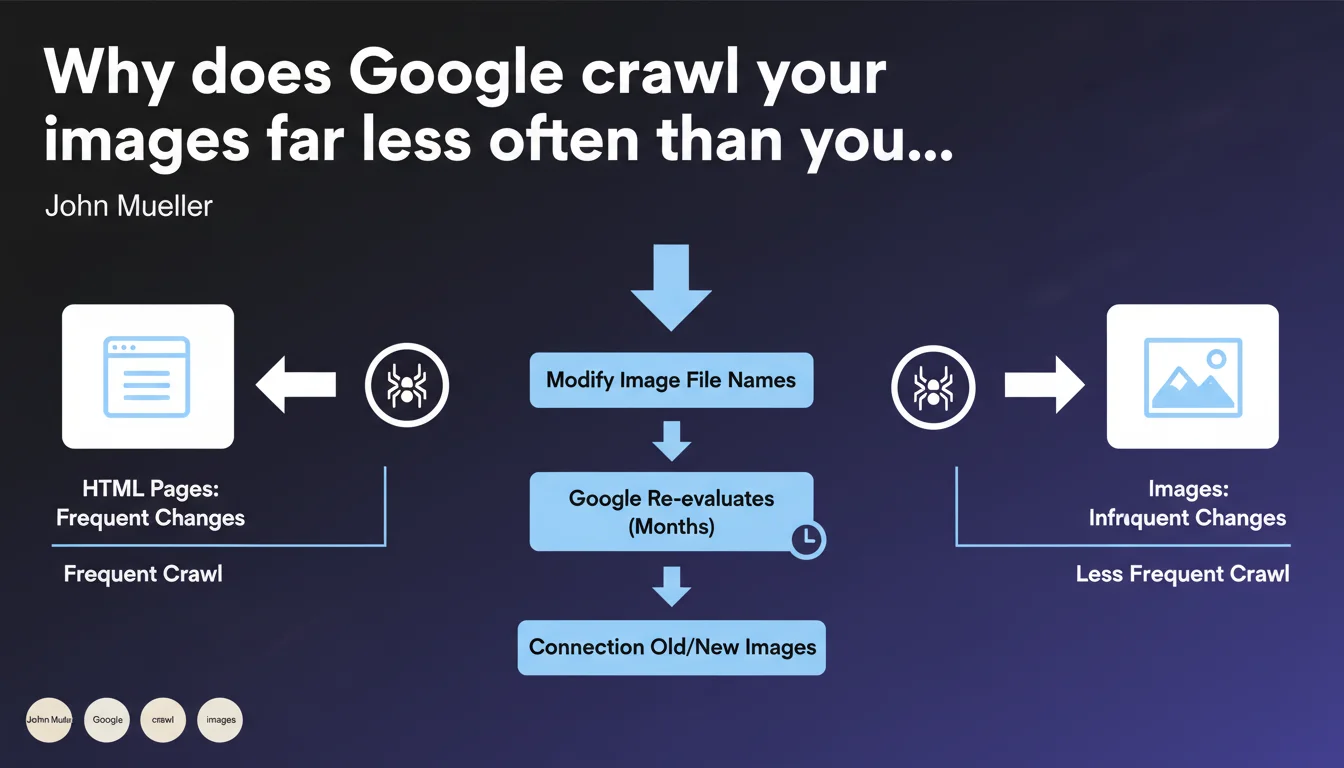
Google crawls images far less frequently than web pages, assuming they rarely change. If you rename all your image files in bulk, it will take several months for Google to recrawl, reindex, and reestablish the connection between old and new URLs. Direct implication: any technical redesign involving images requires significant anticipation.
What you need to understand
How often does Google actually crawl images?
John Mueller confirms that images are crawled significantly less frequently than HTML pages. Google's logic is straightforward: an image rarely changes after its initial publication, unlike text content which evolves regularly.
In practice, while an important page might be recrawled several times a day, an image can wait weeks or even months between Googlebot visits. This delay extends further for images hosted on low-crawl-budget sites or unpopular websites.
What happens when you rename all your image files in bulk?
Mueller warns about a common scenario: bulk renaming of image files during a technical redesign. If you switch from image-123.jpg to red-shoe-product.jpg for all your visuals, Google will take several months to understand that the new URL replaces the old one.
During this transition period, you lose the accumulated SEO benefit from the old image — backlinks, positions in Google Images, authority. The new URL starts from scratch until Google has crawled and analyzed it. And since crawling is rare, the delay stretches out.
What levers can accelerate the process?
301 redirects work for images exactly as they do for HTML pages. If you rename a file, systematically redirect the old URL to the new one. Google will gradually transfer authority, even if crawling remains slow.
The image sitemap can help, but guarantees nothing. It signals to Google that an image exists, but doesn't force immediate crawling. In other words: useful, but not magical.
- Image crawl ≠ page crawl: much lower frequency for image files
- Renaming = partial SEO reset without proper 301 redirects
- Delay of several months for Google to understand the connection between old and new URLs
- Image sitemap useful but not a priority for Googlebot
- Stability of image URLs is strategic for maintaining their visibility
SEO Expert opinion
Is this statement consistent with real-world observations?
Let's be honest: this claim matches exactly what we observe in practice. Images change little in Google Images SERPs once well-positioned, precisely because crawling is rare and they maintain their status for a long time.
The problem is that Mueller remains vague about the exact frequency. "Less often" tells us nothing concrete. Are we talking weekly crawling? Monthly? Quarterly? This probably depends on the site, its overall crawl budget, and image popularity. [To be verified] — Google never gives precise timing, which complicates planning.
What nuances should be considered based on image type?
An ecommerce product image on a high-traffic site won't be crawled at the same rate as a blog illustration on a small site. The popularity of the host page directly influences the crawl frequency of associated resources, including images.
Similarly, an image that generates traffic from Google Images, receives direct backlinks, or appears in rich snippets will likely be recrawled more often. But Mueller doesn't specify this — and that's a limitation of this statement, which presents a general rule without nuance for different contexts.
Should you really avoid renaming images altogether?
No. If your image URLs are poorly structured (e.g., IMG_1234.jpg), renaming them remains relevant for semantic SEO and accessibility. But you need to anticipate the transition delay and accept temporary visibility loss.
The key is implementing solid 301 redirects, never leaving old URLs as 404s, and avoiding successive renamings in series that further disrupt Googlebot. A well-planned redesign = one definitive renaming, not three iterations over six months.
Practical impact and recommendations
What should you concretely do before a redesign affecting images?
Audit all image URLs indexed in Google Images via Search Console, Images segment. Identify those generating traffic — these are the ones you must absolutely preserve via 301 redirects.
Plan the renaming in a single phase, never through successive iterations. If you must rename, do it properly from the start with permanent final nomenclature. Document each old URL and its new destination in a rigorous mapping file.
What errors must you absolutely avoid?
Never leave old image URLs as 404s after renaming — that's the worst mistake. Google takes months to recrawl, so your old URLs will continue appearing in Image SERPs for a long time, generating clicks to dead links.
Also avoid renaming "on the fly" without global coherence. An image redesign = a structured project, not a succession of ad-hoc micro-adjustments that blur signals sent to Google.
How do you monitor impact after renaming?
Track image traffic evolution in Search Console, segment by segment. Closely monitor 404s on old image URLs — if they persist for weeks after redirects are implemented, that means Google hasn't recrawled yet.
Use server logs to verify actual Googlebot crawl frequency on your new image URLs. If after two months there's no trace of crawling, force a refresh via image sitemap or by regenerating pages containing these visuals.
- Map all image URLs indexed before redesign
- Implement systematic 301 redirects old → new URL
- Rename in a single phase, never through successive iterations
- Submit an updated image sitemap immediately after migration
- Monitor image 404s in Search Console for at least 6 months
- Analyze server logs to verify actual crawling of new URLs
- Avoid any new renaming for at least 12 months post-redesign
❓ Frequently Asked Questions
Combien de temps faut-il pour que Google recrawle une image renommée ?
Les redirections 301 fonctionnent-elles pour les images comme pour les pages ?
Le sitemap images accélère-t-il vraiment le crawl ?
Faut-il éviter tout renommage d'images pour ne pas perdre le SEO acquis ?
Comment savoir si mes anciennes URLs images sont toujours crawlées par Google ?
🎥 From the same video 13
Other SEO insights extracted from this same Google Search Central video · published on 06/10/2022
🎥 Watch the full video on YouTube →
💬 Comments (0)
Be the first to comment.