
Official statement
Other statements from this video 13 ▾
- □ Les images de stock pénalisent-elles vraiment votre référencement ?
- □ Faut-il vraiment penser stratégie avant technique pour l'optimisation des images ?
- □ Faut-il vraiment arrêter d'écrire 'image de' dans les attributs alt ?
- □ Faut-il vraiment rédiger des phrases complètes dans les attributs alt ?
- □ Faut-il choisir entre accessibilité et SEO dans vos balises alt ?
- □ Faut-il vraiment remplir l'attribut alt de toutes vos images ?
- □ Faut-il vraiment renommer tous vos fichiers images pour le SEO ?
- □ Pourquoi Google crawle-t-il vos images beaucoup moins souvent que vos pages HTML ?
- □ Faut-il vraiment redouter un changement massif d'URLs d'images pour votre SEO ?
- □ Le texte autour de vos images pèse-t-il vraiment plus lourd que l'attribut alt ?
- □ Faut-il vraiment utiliser rel="canonical" pour les images multiples ?
- □ Faut-il optimiser TOUTES vos images ou seulement celles des pages à fort trafic ?
- □ Pourquoi vos logos et boutons cliquables sabotent-ils votre accessibilité et votre SEO ?
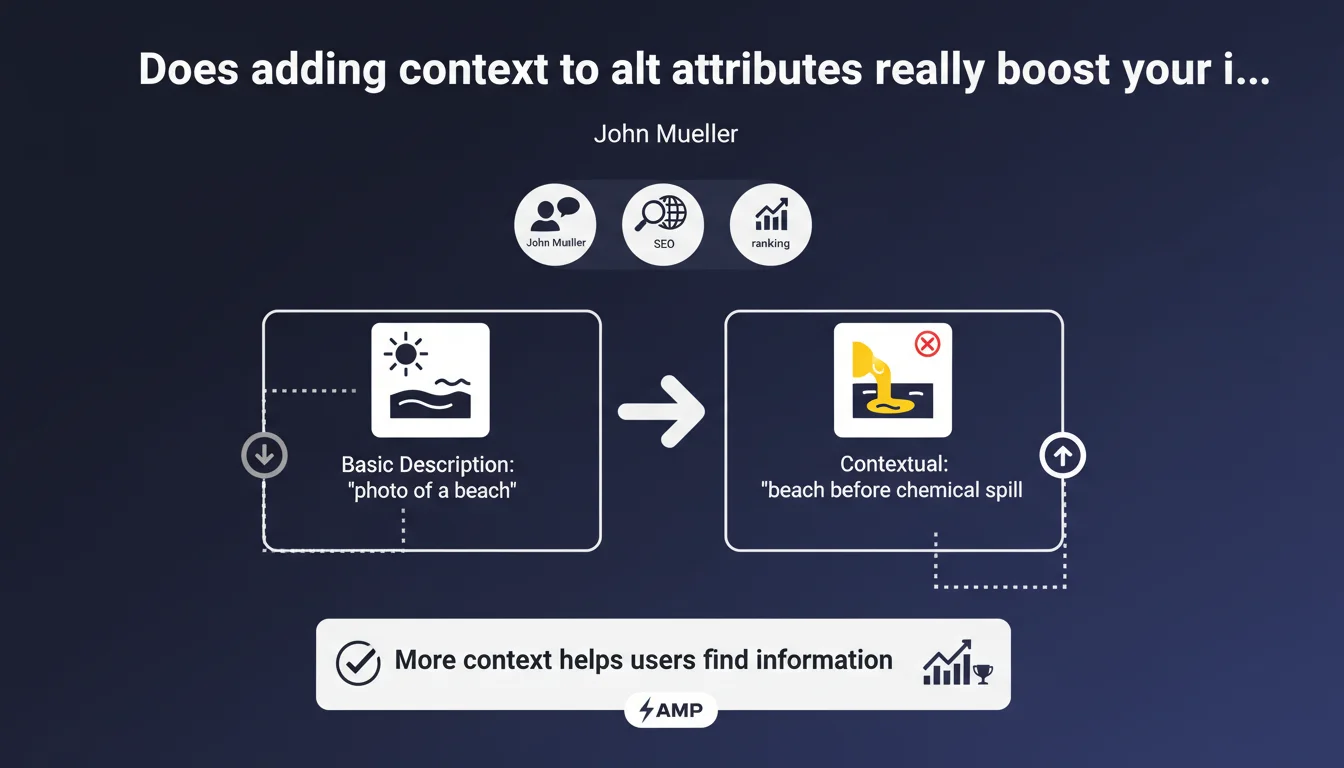
Google recommends going beyond simple factual descriptions in image alt attributes. The example is clear: prefer 'beach before chemical spill' over 'photo of a beach'. The goal? Help users find exactly the information they're looking for, not just generic images.
What you need to understand
Why does Google emphasize context over simple description?
The alt attribute has always had two functions: accessibility for screen reader users and SEO to help Google understand visual content. Until now, the recommendation was to describe what you see. That's it.
Except Google is refining its position. Mueller explicitly states that context trumps basic description. Why? Because an image without context is interchangeable with thousands of others. A beach is a beach. But a beach before an ecological disaster? That's a specific search intent, a precise informational need.
What's the difference between description and contextualization?
Description is what you see: 'a black cat sitting on a couch'. Contextualization is why this image exists in your content. If your article discusses the impact of pets on mental health, your alt should reflect that: 'black cat providing comfort to its owner'.
Google wants the alt attribute to serve as a semantic bridge between the image and the search intent. Not just a visual inventory. It's a subtle but important paradigm shift for anyone seriously optimizing Google Images.
Does this apply to all images?
No. Purely decorative images can keep empty alt text (alt=""). Logos, navigation icons, interface elements don't need narrative context — just clear functional description.
But for editorial images, illustration photos, infographics, screenshots — basically anything that conveys information — contextualization becomes a full SEO lever.
- Context outweighs factual description for informationally valuable images
- Alt attributes must reflect search intent and the image's role in your content
- Decorative or functional images don't require this approach
- Google seeks to refine Google Images relevance by leveraging semantic context
SEO Expert opinion
Is this recommendation consistent with observed practices?
Yes and no. On paper, it makes sense — Google Images increasingly prioritizes contextual relevance over simple keywords. Tests show that rich, specific alt attributes can improve Google Images rankings, especially for niche queries.
But — and here's where it gets tricky — the line between 'relevant context' and 'keyword stuffing' is blurry. Mueller gives a clear example, but what about edge cases? How verbose should you be? Is a 15-word alt text too long? [Needs verification] because Google doesn't provide a character limit.
What are the risks of over-optimizing context?
First risk: degrading accessibility. An overly contextualized alt can become unnecessarily verbose for screen reader users who just want to know what's in the image. You need to find balance.
Second risk: falling into the keyword-stuffing trap disguised as context. If your alt becomes 'tropical paradise beach Thailand before pollution catastrophic ecological disaster responsible tourism', you're out of context and into manipulation territory. Google isn't stupid — and its algorithms detect these abuses.
In what cases doesn't this approach apply?
E-commerce product images: here, factual description reigns supreme. 'Black Nike Air Zoom Pegasus 40 running shoe' is more relevant than 'shoe worn by an athlete preparing for a marathon'. Unless your content is specifically about marathon training — then yes, contextualize.
Technical or scientific images: a network architecture diagram doesn't need storytelling. 'Star topology network with central switch' is perfectly sufficient. Context here means technical precision, not narrative.
Practical impact and recommendations
What should you do concretely to contextualize alt attributes?
Start by identifying each image's role in your content. Ask yourself: why is this image here? What information does it provide that text alone doesn't? That answer is your starting point for the alt text.
Then, connect the image to the search intent of the page. If you're writing about climate change consequences, your beach image shouldn't just say 'beach' but clarify the link to your subject — coastal erosion, rising sea levels, coral bleaching, etc.
What mistakes should you avoid when writing alt attributes?
Don't turn your alt into an SEO keyword phrase. 'Best Thailand beach cheap vacation deals' is neither contextual nor descriptive — it's just spam. Alt text must sound natural when read by a human without seeming odd.
Also avoid unnecessary redundancy. If your image comes right after a paragraph saying exactly the same thing, your alt adds nothing. Google can connect surrounding text and image — don't just repeat mindlessly.
How do you verify that your alt attributes are properly optimized?
Use a screen reader (NVDA, JAWS, or even VoiceOver on Mac) to listen to your pages. If the alt sounds natural and informative, that's a good sign. If it sounds like a keyword list, start over.
Also analyze your performance in Google Search Console, 'Performance > Images' section. Look at which queries generate impressions and clicks. If your images aren't ranking for relevant contextual queries, your alts might lack specificity.
- Identify the informational role of each image in your content
- Connect alt attributes to the page's search intent, not just what's visible
- Stay concise: aim for 10-15 words maximum to maintain clarity and accessibility
- Test with a screen reader to verify readability
- Avoid repetition between alt text and immediately adjacent text
- Monitor performance in Google Search Console > Images
- Never sacrifice accessibility for SEO gains
Contextualizing alt attributes is a subtle endeavor requiring fine understanding of user intent and semantic positioning. If you manage a site with hundreds or thousands of images, auditing and optimization can quickly become time-consuming — and requires proven methodology to avoid missteps. In that case, partnering with a specialized SEO agency can accelerate the process and guarantee optimal balance between accessibility and performance. Personalized support also helps you avoid errors that degrade user experience while pursuing optimization.
❓ Frequently Asked Questions
Quelle est la longueur idéale d'un attribut alt contextualisé ?
Est-ce que contextualiser l'alt améliore vraiment le positionnement dans Google Images ?
Faut-il modifier les attributs alt de toutes les anciennes images d'un site ?
L'attribut alt doit-il reprendre les mots-clés de la page ?
Comment éviter le keyword stuffing dans les attributs alt ?
🎥 From the same video 13
Other SEO insights extracted from this same Google Search Central video · published on 06/10/2022
🎥 Watch the full video on YouTube →
💬 Comments (0)
Be the first to comment.