
Official statement
Other statements from this video 13 ▾
- □ Les images de stock pénalisent-elles vraiment votre référencement ?
- □ Faut-il vraiment contextualiser les attributs alt pour améliorer le référencement des images ?
- □ Faut-il vraiment arrêter d'écrire 'image de' dans les attributs alt ?
- □ Faut-il vraiment rédiger des phrases complètes dans les attributs alt ?
- □ Faut-il choisir entre accessibilité et SEO dans vos balises alt ?
- □ Faut-il vraiment remplir l'attribut alt de toutes vos images ?
- □ Faut-il vraiment renommer tous vos fichiers images pour le SEO ?
- □ Pourquoi Google crawle-t-il vos images beaucoup moins souvent que vos pages HTML ?
- □ Faut-il vraiment redouter un changement massif d'URLs d'images pour votre SEO ?
- □ Le texte autour de vos images pèse-t-il vraiment plus lourd que l'attribut alt ?
- □ Faut-il vraiment utiliser rel="canonical" pour les images multiples ?
- □ Faut-il optimiser TOUTES vos images ou seulement celles des pages à fort trafic ?
- □ Pourquoi vos logos et boutons cliquables sabotent-ils votre accessibilité et votre SEO ?
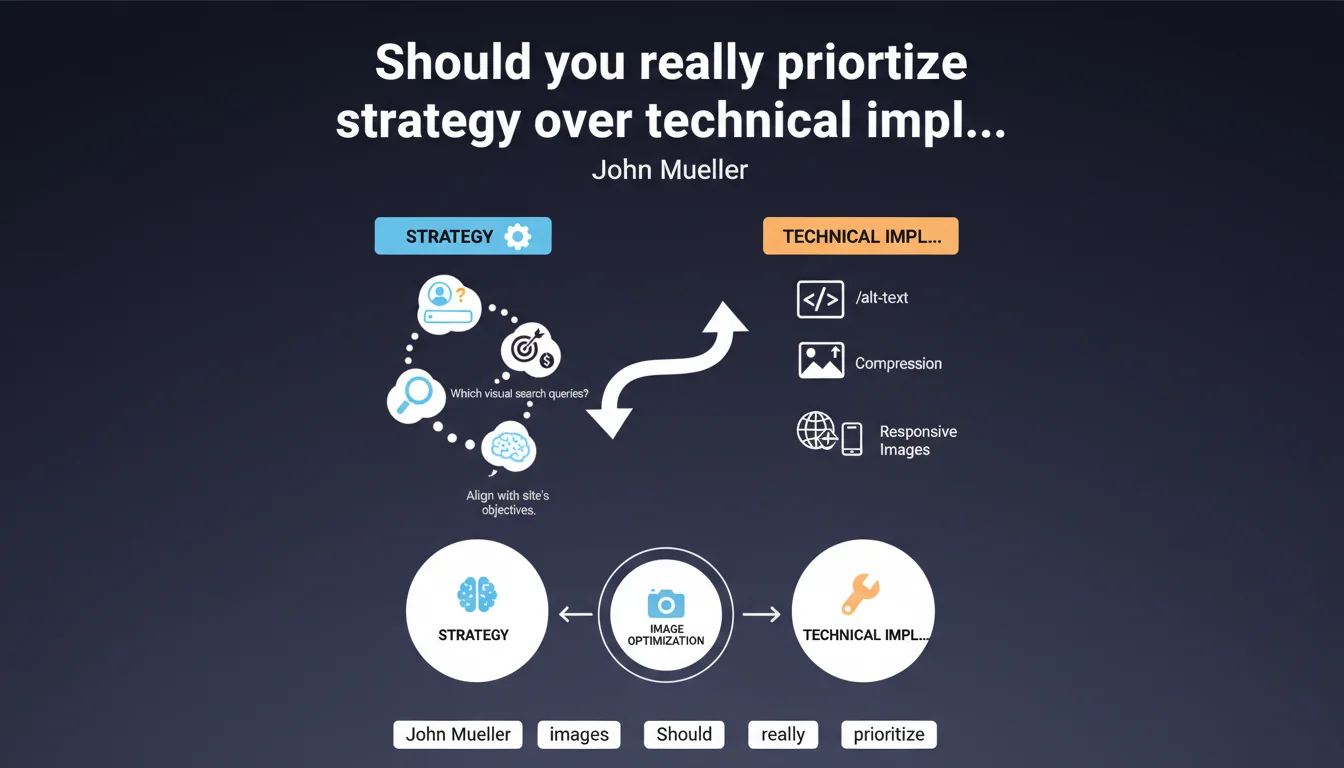
Google is clear: before compressing, renaming, or adding alt tags, ask yourself which visual search queries your images should rank for. Technical optimization without visual search strategy = wasted effort. Align your images with your business goals and actual search intent.
What you need to understand
Why does Google put strategy before technique?
Because most sites optimize images on autopilot: compression, generic alt text, standardized file names. All without asking if anyone is actually searching for these visuals.
Mueller flips conventional logic. Before touching any technical parameter, you must map out relevant visual search queries for your business. A furniture e-commerce site should target "gray modern corner sofa," not just "sofa." A tech blog should aim for "microservices architecture diagram," not "computer."
What does "site objectives" mean in this context?
If your site sells products, your images must match visual purchase intent. If you're building a brand, aim for discovery and inspiration. If you educate, prioritize explanatory visuals that answer specific questions.
Concretely? A recipe site should optimize for "fudgy chocolate cake overhead shot," not just "dessert." An architecture site for "contemporary house with bay windows," not "building." The specificity of the search query should guide the choice and treatment of each image.
How do you identify these strategic visual queries?
Three main sources: Google Images in incognito mode to see what already ranks, visual search suggestions, and competitor analysis of those performing well in image search. Also check your Search Console data in the "Performance" section filtered to "Image Search."
Then cross-reference with your buyer persona: what visual problems is he or she trying to solve? An interior architect seeks specific inspiration, not generic stock photos. A DIY enthusiast wants assembly diagrams, not product photos.
- Identify relevant visual queries before any technical optimization
- Align your images with actual search intent, not generic standards
- Map queries by objective type: purchase, inspiration, education, comparison
- Leverage Search Console to spot your current performance in image search
- Think specificity: a precise visual query always beats a generic one
SEO Expert opinion
Is this strategic approach really new?
No. SEOs doing serious work on Google Images have been doing this for years. The novelty is that Mueller officially endorses it and positions it as a prerequisite.
What's interesting is the timing. Google is increasingly pushing enriched visual results into mainstream SERPs — image carousels, shopping, Discover. Saying "think strategy first" amounts to saying: stop treating images as an afterthought to text SEO.
When isn't this strategic approach enough?
When your technical foundation is broken, strategy won't save you. Non-crawlable images, outdated formats, catastrophic load times — no strategy compensates for that. Mueller isn't saying to ignore technique; he's saying don't start there.
Another limitation: some sectors have ultra-competitive visual queries where even perfect strategy hits a wall against sites with 10 years of authority. In that case, strategy must include niche angles, not just obvious keywords. [To verify]: Google never really detailed how domain authority impacts image ranking — but field observations show it matters.
What nuance should you add to this statement?
"Site objectives" remains vague. The same site can have multiple contradictory goals: drive SEO traffic, convert, build brand image. Images that perform for each goal aren't the same.
Concrete example: an e-commerce site might want to rank for "women's running shoes" (traffic) AND "Nike Air Zoom Pegasus 40" (conversion). Optimal images for each query differ — white background vs. lifestyle context. Mueller doesn't say how to prioritize when objectives conflict.
Practical impact and recommendations
What exactly should you do before technical optimization?
Start with a visual query audit. List 20-30 image queries your target audience might use. Check their volume (even approximate) and current rankings. Identify gaps: relevant queries where you could rank.
Next, map your existing images to these queries. How many actually match an identified search intent? Often the answer is less than 30%. The rest is decoration serving no clear SEO objective.
Which strategic mistakes must you avoid?
Don't create images "for SEO" without verifying that someone searches for them. I've seen sites produce hundreds of "optimized" visuals on phantom queries — zero traffic, zero conversion.
Another trap: copying competitors' visual strategy without understanding why they chose it. Their objectives may not be yours. A large marketplace can afford ultra-generic, low-conversion queries — you probably can't.
How do you measure if your visual strategy works?
Search Console, "Performance" section, filtered to Image Search. Watch impressions, clicks, CTR by query. Cross-reference with Analytics to see if that traffic converts or bounces at 90%.
Also monitor visual Featured Snippets and image carousels in mainstream SERPs. If your images never appear there despite correct technical optimization, your query strategy probably misses the mark.
- Audit 20-30 strategic visual queries in your sector before any optimization
- Map existing images to these queries — identify gaps and useless decoration
- Verify each image answers a documented search intent
- Don't blindly copy competitors' visual strategy without grasping their objectives
- Regularly measure in Search Console (Image Search) + Analytics to validate your approach
- Prioritize queries by business potential, not just search volume
❓ Frequently Asked Questions
Dois-je refaire toutes mes images existantes si je n'ai pas pensé stratégie avant ?
Comment savoir si une requête visuelle a du volume de recherche ?
La stratégie visuelle doit-elle différer entre Google Images et les résultats enrichis classiques ?
Faut-il créer de nouvelles images si aucune image existante ne matche mes requêtes stratégiques ?
Cette approche stratégique s'applique-t-elle aussi aux vidéos ?
🎥 From the same video 13
Other SEO insights extracted from this same Google Search Central video · published on 06/10/2022
🎥 Watch the full video on YouTube →
💬 Comments (0)
Be the first to comment.