
Official statement
Other statements from this video 13 ▾
- □ Les images de stock pénalisent-elles vraiment votre référencement ?
- □ Faut-il vraiment penser stratégie avant technique pour l'optimisation des images ?
- □ Faut-il vraiment contextualiser les attributs alt pour améliorer le référencement des images ?
- □ Faut-il vraiment arrêter d'écrire 'image de' dans les attributs alt ?
- □ Faut-il vraiment rédiger des phrases complètes dans les attributs alt ?
- □ Faut-il choisir entre accessibilité et SEO dans vos balises alt ?
- □ Faut-il vraiment remplir l'attribut alt de toutes vos images ?
- □ Faut-il vraiment renommer tous vos fichiers images pour le SEO ?
- □ Pourquoi Google crawle-t-il vos images beaucoup moins souvent que vos pages HTML ?
- □ Le texte autour de vos images pèse-t-il vraiment plus lourd que l'attribut alt ?
- □ Faut-il vraiment utiliser rel="canonical" pour les images multiples ?
- □ Faut-il optimiser TOUTES vos images ou seulement celles des pages à fort trafic ?
- □ Pourquoi vos logos et boutons cliquables sabotent-ils votre accessibilité et votre SEO ?
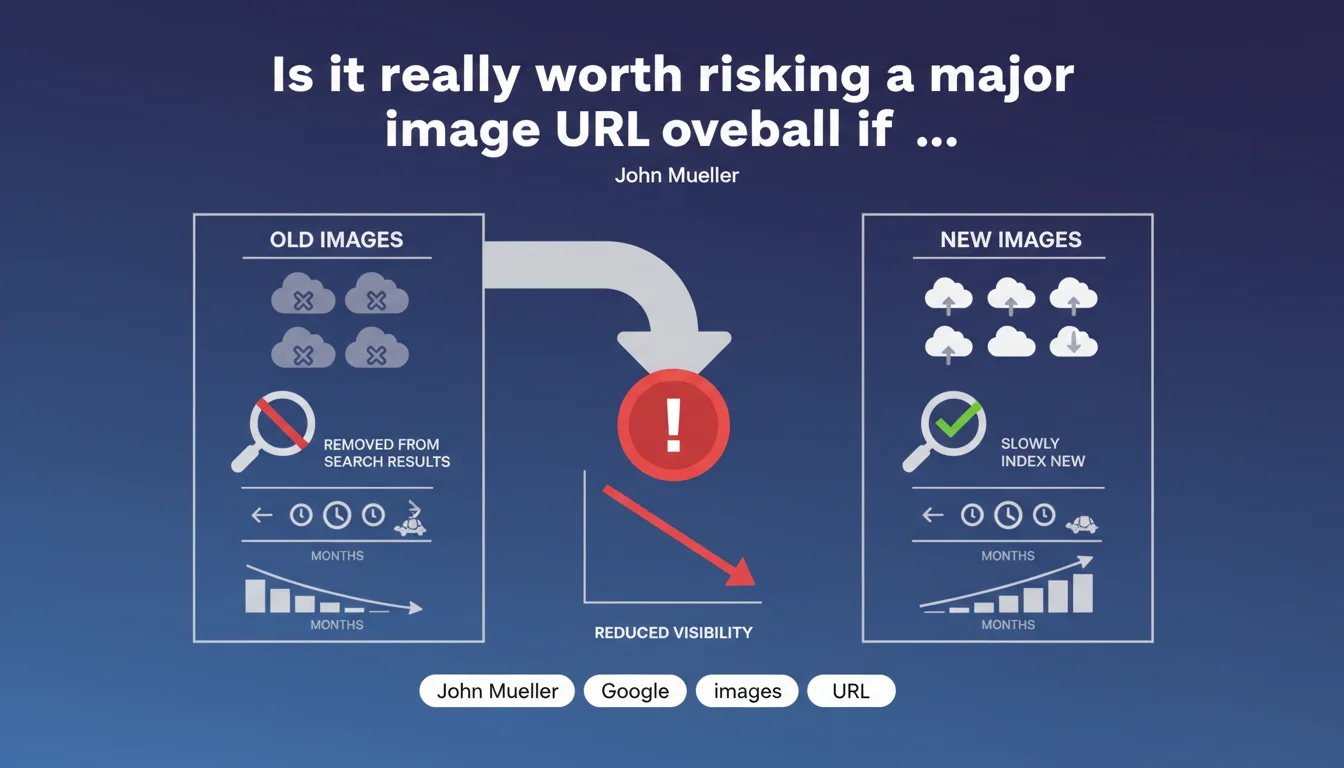
Modifying all image URLs on a site at once triggers immediate removal of old URLs from Google Images, followed by gradual reindexing of new ones over several months. This transition creates an inevitable period of reduced visibility, regardless of how well your redirect strategy is implemented.
What you need to understand
Why does Google remove old images first before indexing the new ones?
When you make massive changes to your image URLs, Google handles this change in two distinct phases. The first phase involves removing the old URLs from its index — a quick process that can happen within days or weeks.
The second phase, indexing new URLs, follows a much slower pace. Google crawls and evaluates new images progressively, with no guarantee of immediately recovering the same visibility level. That's where the real problem lies.
Does this logic still apply even with properly configured 301 redirects?
Mueller's statement doesn't explicitly clarify whether 301 redirects reduce or prevent this effect. In the context of traditional web pages, a properly implemented 301 generally transfers most of the PageRank and preserves rankings.
For images, the behavior appears different. Google seems to treat image URLs as distinct entities, with their own crawl cycle and indexing process within Google Images. [To be verified]: the actual effectiveness of 301 redirects on image URLs remains unclear in this statement.
How long does this period of reduced visibility actually last?
Mueller mentions several months without providing a specific timeframe. Based on real-world experience, some sites see recovery in 3-4 months, while others wait 6 months or longer.
This variable duration likely depends on image volume, site crawl frequency, and overall SEO signal quality. The stronger your site's authority and freshness, the faster Google should reindex your new URLs — in theory.
- Phase 1: Rapid removal of old URLs (days to weeks)
- Phase 2: Progressive reindexing of new URLs (several months, variable duration)
- Impact: Temporary loss of visibility in Google Images during transition
- Gray area: Effectiveness of 301 redirects not explicitly confirmed by Mueller
SEO Expert opinion
Is this statement consistent with real-world observations?
Yes, broadly speaking. Feedback from SEO practitioners confirms that a massive change in image URLs systematically causes a traffic dip in Google Images results. Even with impeccable 301 redirects, the reindexing delay remains significant.
What's surprising is the lack of nuance in Mueller's statement. He mentions no strategy to mitigate impact — batch migration, prioritizing critical images, nothing. Either these tactics don't work, or Google prefers not to elaborate.
Why doesn't Google treat image redirects like traditional page redirects?
Google's image indexing system operates semi-independently from the main web index. Images have their own crawl pipeline, analysis, and ranking process, with different priorities.
Concretely, the issue is that Google must re-download each image, re-analyze its context (alt text, surrounding text, host page), and recalculate relevance scores. This is resource-intensive and Google does it on its own schedule, not yours.
In what cases does this rule not apply or could be circumvented?
If you change URLs for only dozens of images, the impact will be negligible and reindexing fast. The problem concerns massive migrations — complete redesigns, URL structure changes, CMS migrations.
A batch approach (gradual migration by categories or priority pages) could theoretically smooth the impact, but [To be verified]: no official confirmation that Google treats staggered migration differently. My hypothesis? It might work, but nobody has solid data to prove it.
Practical impact and recommendations
What should you do concretely before changing your image URLs?
Anticipate traffic loss and prepare stakeholders (leadership, clients, marketing teams). If Google Images represents a significant portion of your acquisition, schedule this migration during a slow period, never before peak season.
Document the baseline: impression and click volume in Google Search Console (Performance tab > Images), top images driving traffic, associated landing pages. You'll need this data to monitor recovery.
What mistakes should you absolutely avoid during migration?
Don't delete old URLs without implementing clean 301 redirects, even if their effectiveness for Google Images isn't 100% guaranteed. It's the bare minimum to signal to Google that the image moved, not disappeared.
Avoid changing URL structure AND file format simultaneously (switching from JPEG to WebP, for example). Multiply variables and you'll complicate diagnosis if something goes wrong. One migration at a time.
- Audit your current Google Images traffic (Search Console > Performance > Images tab)
- Identify strategic images generating the most clicks and conversions
- Implement 301 redirects from each old image URL to the new one
- Verify your image sitemaps are updated with new URLs
- Keep old URLs accessible via redirects for at least 6-12 months
- Monitor impressions/clicks weekly in Search Console after migration
- Prepare a backup plan if traffic loss exceeds expectations (boost SEO on other channels, paid campaigns, etc.)
A massive image URL change is never trivial. If you can avoid it, avoid it. If it's unavoidable (technical redesign, CMS migration), prepare for several months of reduced Google Images visibility and compensate with other acquisition channels.
Complex migrations like this require rigorous planning and expert monitoring to minimize losses and accelerate recovery. If your internal team lacks capacity or experience with this type of project, engaging a specialized SEO agency could make the difference between a controlled transition and several quarters of diminished traffic.
❓ Frequently Asked Questions
Les redirections 301 sur les URLs d'images sont-elles vraiment utiles si Google réindexe tout lentement ?
Peut-on accélérer la réindexation des nouvelles URLs d'images dans Google ?
Faut-il migrer les URLs d'images par batch pour limiter l'impact SEO ?
Combien de temps faut-il garder les redirections 301 sur les anciennes URLs d'images ?
Google Images représente moins de 5 % de mon trafic SEO, dois-je quand même m'inquiéter ?
🎥 From the same video 13
Other SEO insights extracted from this same Google Search Central video · published on 06/10/2022
🎥 Watch the full video on YouTube →
💬 Comments (0)
Be the first to comment.