
Official statement
Other statements from this video 13 ▾
- □ Les images de stock pénalisent-elles vraiment votre référencement ?
- □ Faut-il vraiment penser stratégie avant technique pour l'optimisation des images ?
- □ Faut-il vraiment contextualiser les attributs alt pour améliorer le référencement des images ?
- □ Faut-il vraiment arrêter d'écrire 'image de' dans les attributs alt ?
- □ Faut-il vraiment rédiger des phrases complètes dans les attributs alt ?
- □ Faut-il choisir entre accessibilité et SEO dans vos balises alt ?
- □ Faut-il vraiment remplir l'attribut alt de toutes vos images ?
- □ Pourquoi Google crawle-t-il vos images beaucoup moins souvent que vos pages HTML ?
- □ Faut-il vraiment redouter un changement massif d'URLs d'images pour votre SEO ?
- □ Le texte autour de vos images pèse-t-il vraiment plus lourd que l'attribut alt ?
- □ Faut-il vraiment utiliser rel="canonical" pour les images multiples ?
- □ Faut-il optimiser TOUTES vos images ou seulement celles des pages à fort trafic ?
- □ Pourquoi vos logos et boutons cliquables sabotent-ils votre accessibilité et votre SEO ?
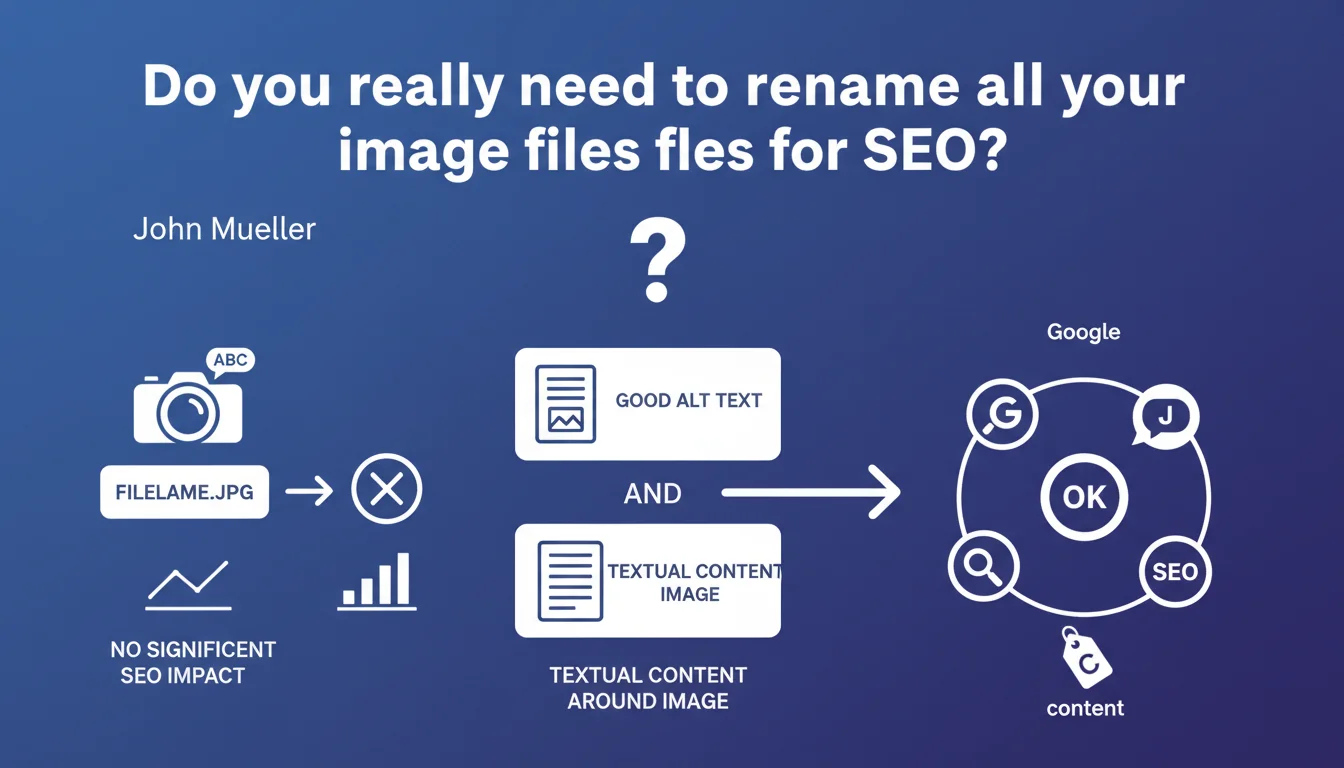
According to Mueller, image filenames have negligible SEO impact if you already have relevant alt text and contextual content around the image. Massive renaming of existing files probably isn't worth the effort. However, for new images, it makes sense to adopt good naming habits from the start.
What you need to understand
Why does Google downplay the importance of filenames?
Mueller is repositioning a practice that has been embedded in guidelines for years. The descriptive filename remains an official recommendation, but Google clarifies that its SEO weight is marginal compared to two other, more robust signals: alt text and surrounding context.
In concrete terms? If your image is called "IMG_4523.jpg" but the alt text precisely describes the content and the adjacent paragraph clarifies the subject, Google will understand the image without difficulty. The filename becomes redundant, even anecdotal.
What does Google mean by "contextual text"?
Context is everything surrounding the image: page title, subheadings (<h2>, <h3>), captions (<figcaption>), adjacent paragraphs. Google analyzes these elements to understand the subject and intent of the image, especially in Google Images.
A file named "red-nike-shoes.jpg" adds nothing more if the H2 already says "Red Nike Shoes" and the alt text says "Pair of red Nike Air Max 90 sneakers". Redundancy doesn't create added value — it just confirms what Google has already understood.
Does this statement contradict the official guidelines?
No. Google continues to recommend descriptive filenames in its SEO documentation. But Mueller introduces a prioritization nuance: if you have hundreds of images with generic names already online, renaming everything probably isn't a worthwhile project.
On the other hand, for new images you upload, you might as well follow best practices from the start. It's a matter of SEO hygiene, not urgent fixing.
- The filename remains a good practice, but its SEO impact is low if alt text and context are present
- Renaming thousands of existing images probably doesn't justify the technical effort and risk of breaking URLs
- For new images, getting into the habit of using descriptive names remains recommended
- Textual context and alt text are the two priority signals for image SEO
SEO Expert opinion
Is this statement consistent with real-world observations?
Yes, very much so. For years, we've observed that images with generic names ("image1.jpg", "photo.png") rank perfectly in Google Images if the alt text and context are solid. Conversely, a file named "red-nike-mens-running-shoes.jpg" with empty alt text or vague context won't take off.
What really matters is overall semantic understanding: Google crosses all available signals (alt, caption, title, paragraph, potential structured data). The filename is just one signal among others — and not the strongest.
What nuances should be applied to this rule?
Caution: Mueller is talking about images that already have good context in place. If your image is isolated on a thin page with no alt text or caption, then yes, the filename can become the only available signal. In that specific case, it regains weight by default.
Another edge case: images used as internal link anchors (e.g., clickable banners). If alt text is missing and the link points to a target page, a descriptive filename can help Google understand the destination. But honestly, you might as well improve the alt text.
So what about the official guidelines?
Google's guidelines remain valid, but you need to read them pragmatically. A descriptive filename is recommended, not critical. It's a level-2 optimization, not a blocking factor.
In practice: if you're creating new images, you might as well name them properly from the start ("nike-air-max-90-red.jpg" rather than "DSC_0234.jpg"). But if you have 10,000 images online with generic names and everything's working well traffic-wise, spending weeks renaming them is a false economy. [To verify] on sites heavily focused on Google Images (fashion e-commerce, recipes, portfolios): the impact could be slightly higher, but no official data confirms this.
Practical impact and recommendations
What should you concretely do on an existing site?
Quick audit: check that your important images (products, key illustrations, infographics) have relevant alt text and textual content around them. If so, the filename becomes secondary. No need to launch a massive renaming project.
If you spot orphaned images (no alt text, no context, isolated on thin pages), improve the alt text and context first before touching the filename. It's simpler, less risky, and more effective.
What mistakes should you absolutely avoid?
Never rename image files in production without setting up 301 redirects on the old URLs. Breaking image URLs can lose you Google Images traffic, backlinks, and generate 404s in Search Console.
Another trap: thinking a keyword-stuffed filename compensates for weak alt text. It's the opposite that works. Precise alt text with a generic filename outperforms vague alt text with an optimized filename.
- Audit the alt text of your priority images (products, hero visuals, infographics)
- Verify that each important image is surrounded by relevant textual content (caption, paragraph, title)
- For new images, get into the habit of naming files descriptively from upload
- Don't launch massive renaming on an existing site without cost/benefit analysis
- If you do rename, set up 301 redirects on old image URLs
- Use tools like Screaming Frog to identify images missing alt text or poorly contextualized
How should you prioritize your image SEO efforts?
Order of priority: 1. Descriptive and unique alt text for each image. 2. Textual content around the image (captions, paragraphs). 3. Structured data if relevant (e.g., Product, Recipe). 4. Descriptive filename for new images. 5. Renaming existing images only if none of the previous signals are present.
In practice, most sites gain more from improving alt text and context than from renaming files. It's less time-consuming, less technically risky, and the SEO impact is superior.
❓ Frequently Asked Questions
Dois-je renommer toutes mes images existantes si elles ont des noms génériques ?
Un nom de fichier descriptif peut-il compenser un alt vide ?
Est-ce que les tirets ou underscores dans les noms de fichiers ont un impact ?
Le nom de fichier influence-t-il le ranking dans Google Images ?
Faut-il renommer les images lors d'une migration de site ?
🎥 From the same video 13
Other SEO insights extracted from this same Google Search Central video · published on 06/10/2022
🎥 Watch the full video on YouTube →
💬 Comments (0)
Be the first to comment.