
Official statement
Other statements from this video 13 ▾
- □ Should you really prioritize strategy over technical implementation when optimizing images?
- □ Does adding context to alt attributes really boost your image SEO rankings?
- □ Should you really stop writing 'image of' in alt attributes?
- □ Should you really write complete sentences in alt attributes?
- □ Should you really choose between accessibility and SEO in your alt tags?
- □ Should you really fill the alt attribute for every single image on your site?
- □ Do you really need to rename all your image files for SEO?
- □ Why does Google crawl your images far less often than your HTML pages?
- □ Is it really worth risking a major image URL overhaul if Google will penalize you with months of reduced visibility?
- □ Does the text surrounding your images really carry more weight than the alt attribute?
- □ Do you really need rel="canonical" for multiple image versions?
- □ Should you optimize ALL your images or just the ones on high-traffic pages?
- □ Are your logos and clickable buttons sabotaging your accessibility and SEO performance?
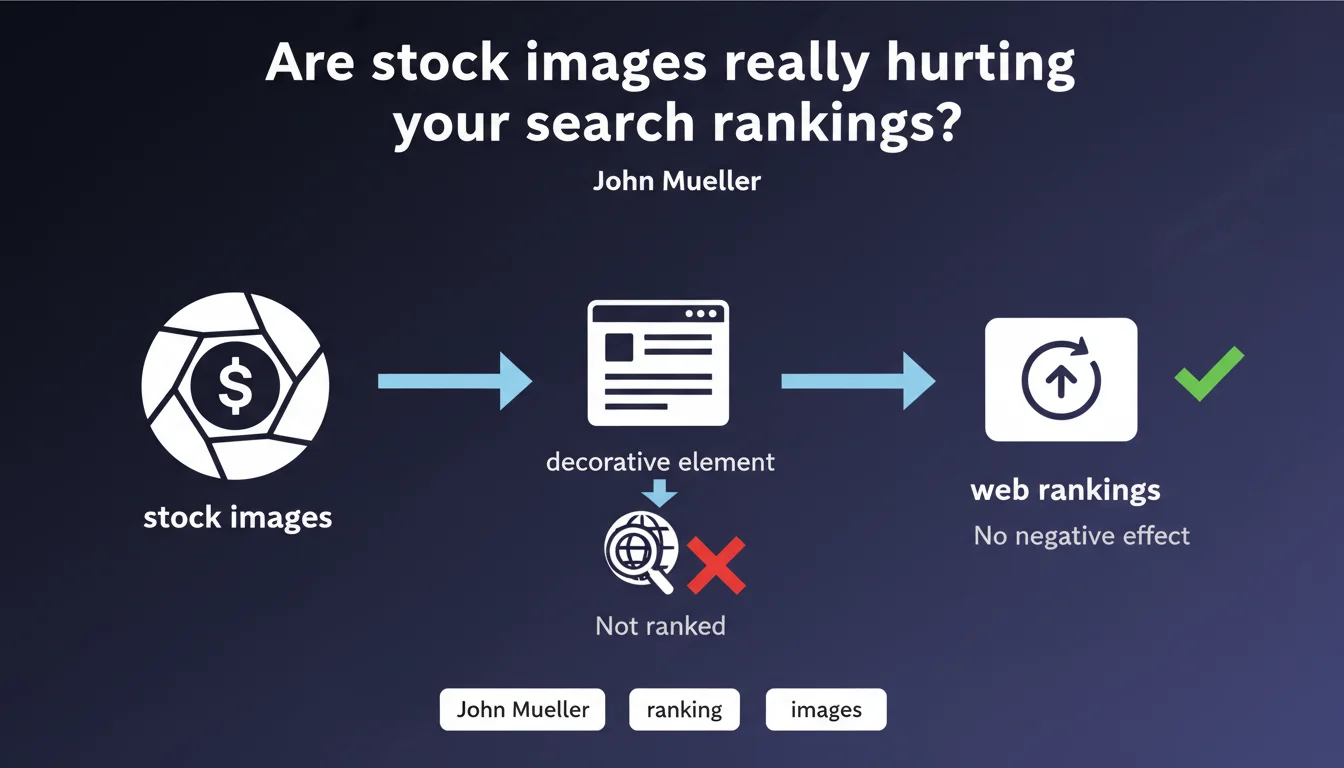
Google confirms that stock images used for decorative purposes do not negatively impact rankings in web search results. These generic visuals simply won't be ranked in Google Images, but they are in no way a ranking demotion factor for your pages.
What you need to understand
Why is this Google clarification necessary?
For years, a belief has taken hold in the SEO community: using stock images would harm your search visibility. The argument? Google would prioritize unique and original content, including visuals.
John Mueller's statement sets the record straight. No, a Shutterstock or Unsplash photo as an article banner won't torpedo your rankings. Google distinguishes between decorative images and visual content with high added value.
What's the difference between a penalty and lack of benefit?
Mueller is precise: these images will likely not be ranked in Google Images. That makes sense — thousands of sites use the same visuals. But the absence of benefit doesn't equate to a sanction.
Your page won't be demoted because you chose a stock photo. It simply won't benefit from potential traffic from image search for that specific visual.
What does Google mean by "decorative images"?
A decorative image serves to illustrate without providing unique information. A blog article banner, an ambiance photo in a service page, a generic photo of a smiling team.
Conversely, an original infographic, a proprietary technical diagram, or an exclusive product photo constitute differentiating visual content — and there, originality matters.
- Stock images cause no penalty on web rankings
- They will likely not be indexed in Google Images
- Google distinguishes between decorative visuals and visual content with added value
- This rule applies to regular web searches, not specifically to Google Images
SEO Expert opinion
Is this Google position consistent with real-world observations?
Yes, and it's even reassuring. In practice, we've never observed a negative correlation between stock image usage and SEO performance on otherwise well-optimized sites. Sites that rank poorly with generic visuals generally have other structural issues.
What really impacts rankings is the overall quality of text content, site architecture, E-E-A-T signals, and loading speed. Not whether a photo comes from Getty or an in-house photographer.
What nuances should be added to this statement?
Mueller is talking about impact on web rankings, not user experience. And that's where things get tricky for many sites. A page stuffed with generic and interchangeable visuals might not be algorithmically penalized, but it will underperform on engagement metrics.
High bounce rate, low time on page, low CTR — all behavioral signals that can indirectly affect your visibility. [To verify]: Google states these metrics aren't direct ranking factors, but their correlation with performance remains undeniable.
Another point: this statement concerns decorative images. For an e-commerce site using stock photos instead of authentic product visuals, the impact would be catastrophic — not from algorithmic penalty, but from conversion rate collapse.
In what cases does visual originality become a real SEO lever?
Let's be honest: if your strategy relies on Google Images traffic, stock visuals are useless. Typically for recipe sites, decoration, fashion — sectors where Google Images generates significant volume.
Similarly, if you're targeting featured snippets or rich results that integrate visuals (like how-to or enriched FAQs), invest in original, optimized images. Google prioritizes differentiating content for these premium positions.
Practical impact and recommendations
Should you continue using stock images on your site?
Yes, if they serve a purely decorative purpose and producing original visuals would cost disproportionately more than the expected benefit. A corporate blog publishing technical analyses doesn't need exclusive photos for each article.
However, as soon as an image carries information — a tutorial, before/after, product comparison — invest in original content. The ROI will be much higher.
How do you optimize stock images to limit their invisibility in Google Images?
Practically speaking? You can't do much. These images are already present on hundreds or thousands of sites. Google won't multiply identical results in its image search.
What you can do is carefully craft your alt, title attributes and textual context around the image. Not to rank that specific image, but to strengthen the overall semantic relevance of your page.
What mistakes should you avoid with generic visuals?
First mistake: stuffing your pages with heavy, unoptimized stock photos. That won't algorithmically penalize you, but it will massacre your Core Web Vitals — and that has a direct impact on rankings.
Second mistake: using visuals completely out of context just to "have an image". A smiling team photo on an article about crawl budget optimization doesn't add anything and degrades user experience.
- Systematically compress your stock images (WebP, lazy loading)
- Fill alt attributes with relevant contextual descriptions
- Prioritize original visuals for strategic pages (landing pages, product sheets)
- Invest in proprietary infographics or diagrams for your pillar content
- Regularly audit your visual weight and its impact on speed metrics
- Never sacrifice technical performance for the sake of image quantity
❓ Frequently Asked Questions
Les images de stock peuvent-elles déclencher un filtre Panda ou une pénalité qualité ?
Si j'utilise une image de stock, dois-je quand même remplir l'attribut alt ?
Vaut-il mieux une image de stock optimisée ou une image originale lourde ?
Les images générées par IA sont-elles considérées comme des images de stock par Google ?
Un site e-commerce peut-il utiliser des images de stock pour ses catégories ?
🎥 From the same video 13
Other SEO insights extracted from this same Google Search Central video · published on 06/10/2022
🎥 Watch the full video on YouTube →
💬 Comments (0)
Be the first to comment.