
Official statement
What you need to understand
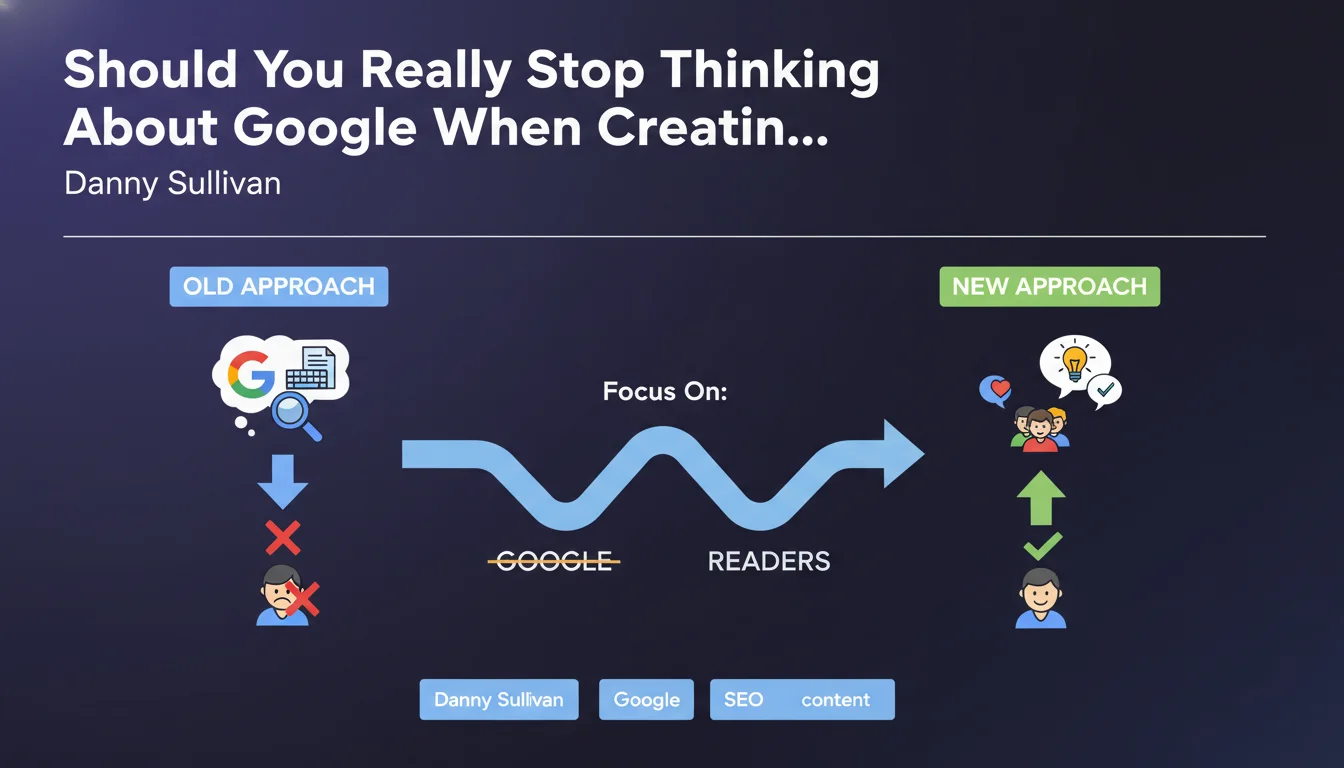
Danny Sullivan, official spokesperson for Google Search, published a statement that may seem paradoxical for SEO professionals. He explicitly recommends no longer focusing on Google when creating content, but rather prioritizing readers' needs.
This position reflects the major evolution of Google's ranking algorithms over recent years. With updates like Helpful Content, the search engine has strengthened its ability to identify content created primarily to manipulate search results versus content genuinely useful to users.
Concretely, Google claims that its ranking systems are now sophisticated enough to naturally reward content that truly serves readers' interests. The "Google-first" approach would therefore have become counterproductive.
- Prioritize user experience rather than pure technical optimization
- Google's systems are designed to identify and reward useful content
- Excessive focus on the search engine can create artificial content
- User intent should guide editorial strategy
SEO Expert opinion
This statement is partially true but requires significant nuance. In practice, the best-performing sites are those that manage to combine editorial excellence AND appropriate technical optimizations. Completely ignoring Google would be naive.
Real-world evidence shows that technical structure, semantic architecture, and on-page optimizations remain crucial for visibility. Excellent content that's invisible in search results won't serve anyone. Google still has limitations in its content understanding, particularly for complex queries or specialized niches.
The right approach is to create content for users while respecting SEO fundamentals: relevant keyword research, optimized structure, coherent internal linking, and technical optimizations. These elements don't contradict user experience—they serve it.
Practical impact and recommendations
- Do: Always start by clearly defining your target audience's needs and questions before writing
- Do: Structure your content according to natural reading logic with descriptive headings and clear hierarchy
- Do: Naturally integrate relevant keywords without forcing them, favoring semantic fields and synonyms
- Do: Measure real engagement (reading time, bounce rate, interactions) rather than just rankings
- Avoid: Artificially stuffing your texts with keywords hoping to rank better
- Avoid: Creating superficial content solely because an SEO tool indicates high search volume
- Avoid: Artificially fragmenting a topic into multiple short pages to "multiply" ranking opportunities
- Avoid: Copying competitors' structure without considering what would truly be useful to your audience
- Strategic recommendation: Maintain regular technical SEO audits to ensure indexability and performance while developing a user-centered editorial line
The balance between editorial excellence and technical optimization requires sharp expertise and constant monitoring of algorithmic developments. The growing complexity of Google's ranking signals makes this dual competency increasingly difficult to master in-house, particularly for teams with limited resources.
To effectively implement this balanced approach, many companies choose to rely on specialized support that provides both strategic SEO vision and editorial expertise. An experienced agency can audit your existing content, define optimal architecture, and train your teams in best practices, while adapting to the specifics of your sector and audience.
💬 Comments (0)
Be the first to comment.