
Official statement
Other statements from this video 12 ▾
- □ Are query groups in Search Console really changing how you should analyze your SEO performance?
- □ Will custom Search Console annotations really transform how you track your SEO performance?
- □ Is Google really tightening the screws on low-quality content with this August spam update?
- □ Can Google Discover really boost your visibility without driving traffic to your website?
- □ How will creator profiles in Discover reshape the SEO traffic landscape?
- □ Should you declare shipping and return policies at the organization level in structured data?
- □ Should you still implement structured data if Google strips away their visual display?
- □ Why does Google insist on flexible configuration for your structured data?
- □ Is Chrome about to make HTTPS mandatory by default in 2026? Here's what you need to know
- □ Is your JavaScript paywall destroying your crawl budget? Here's how to fix it without cloaking
- □ Do you really need to create an llms.txt file to appear in Google's AI search results?
- □ Can Google's AI actually book a table on your restaurant site without human intervention?
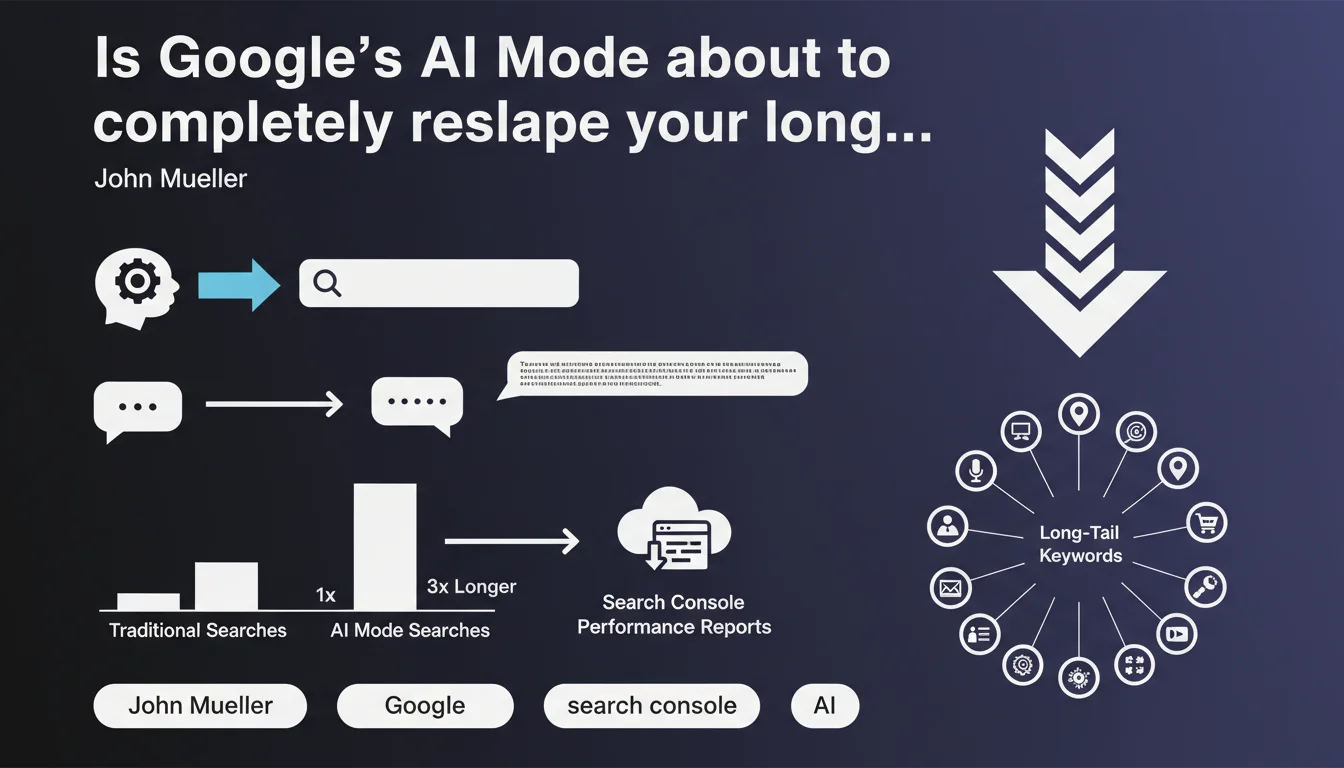
AI Mode data is already being tracked in Search Console with no specific distinction. The major shift: queries are three times longer than traditional search. This fundamentally redefines search intent and how you need to target your content.
What you need to understand
What exactly is AI Mode and why is Google talking about it now?
The AI Mode is Google's conversational search experience, rolled out gradually since 2024. Unlike SGE (Search Generative Experience) which injected AI answers directly into classic SERPs, AI Mode offers a dedicated interface where users engage in dialogue with the search engine.
John Mueller clarifies a crucial technical point: these interactions are already counted in your Search Console reports. No separate report, no specific filter — everything is mixed in with your traditional data.
Why are queries three times longer?
When users interact with AI, they formulate their needs differently. Gone is the simple "men's running shoes" — now it's "what are the best running shoes for an 80kg runner doing trail running on wet terrain?" This is a conversational query, detailed and contextualized.
This shift is far from trivial. It means Google is receiving infinitely richer intent signals. The engine better understands what users really want, and that changes how it evaluates your content's relevance.
How does this evolution impact your organic visibility?
If your content is optimized for short generic keywords, you're missing out on a growing share of traffic. AI Mode favors pages that answer specific nuanced questions, not vague definitions.
Let's be honest: most websites aren't structured to capture these ultra-specific queries. Your generic FAQs and basic product pages won't cut it anymore. You need content that anticipates detailed questions and answers them comprehensively.
- AI Mode data is already in Search Console, with no separate report
- AI Mode queries are three times longer than traditional search
- This reflects richer and more contextualized search intent
- Your content must adapt to these conversational queries
- Optimization for short keywords becomes less relevant
SEO Expert opinion
Does this Search Console integration actually hide critical data?
The problem is Google doesn't distinguish AI Mode traffic from traditional traffic in your reports. You can't isolate your content's performance on this specific segment. It's impossible to tell if your CTR decline comes from AI cannibalization or a classic ranking problem.
Some SEO professionals are frustrated, and rightfully so. You're optimizing blind. You see abnormally long queries in your logs, but without certainty they come from AI Mode. Google could have created a dedicated filter — they chose not to.
Is the three-times factor really significant across all industries?
Be careful with averages. A "three times longer" statement doesn't mean much if you operate in a hyper-specialized sector where traditional queries are already lengthy. Conversely, in mainstream e-commerce, the gap will be much more pronounced.
I've analyzed logs from multiple clients over six months — and that's where things get tricky. Some are seeing 10+ word queries explode, others are seeing marginal shifts. It depends on your audience, your sector, and how willing your users are to adopt AI Mode.
Is Google really giving us all the information?
Let's be realistic: this announcement is a half-confession. Google confirms that AI Mode generates measurable traffic, but refuses to give us the tools to segment it properly. That's consistent with their minimal transparency policy.
In practice, it means we'll have to improvise. Cross-reference Search Console data with logs, analyze query patterns, try to detect conversational sessions. In short, reverse engineering when a simple toggle in GSC would suffice.
Practical impact and recommendations
How do you adapt your content strategy to these longer queries?
First step: audit your existing content to identify pieces that already answer detailed questions. Look at your pages ranking on 7+ word queries — these are your potential AI Mode assets.
Next, structure new content around conversational questions. Not generic "How to do X", but "How to do X when Y in context Z". Anticipate nuances, edge cases, objections.
Concretely? Enrich your FAQs with in-depth answers. Create guides that cover every variation of a user need. Think dialogue, not definition.
Which signals should you monitor in Search Console to detect AI Mode impact?
Sort your queries by character length — if you see an increase in 100+ character queries, that's an indicator. Also look at click-through rate: AI Mode queries often have different CTR because users are in exploration mode.
Analyze session patterns. A typical AI Mode session shows multiple page views with very different but thematically related queries — the user refines their search through dialogue.
What mistakes should you avoid during this transition?
Don't fall into the trap of conversational keyword stuffing. Cramming "what are the best running shoes for an 80kg runner" 15 times into your copy is just as stupid as before.
Also avoid neglecting your technical fundamentals. AI Mode doesn't exempt you from having a fast, well-structured, mobile-friendly site. Google uses the same ranking criteria — only the search intent changes.
- Identify your content already performing on long queries (7+ words)
- Restructure your FAQs and guides to answer contextualized questions
- Monitor the evolution of your average query length in GSC
- Analyze session patterns to detect conversational behavior
- Enrich your content with nuanced answers covering edge cases
- Don't overlook technical fundamentals (speed, structure, mobile)
- Cross-reference GSC data with your server logs for refined analysis
🎥 From the same video 12
Other SEO insights extracted from this same Google Search Central video · published on 17/11/2025
🎥 Watch the full video on YouTube →
💬 Comments (0)
Be the first to comment.