
Official statement
Other statements from this video 12 ▾
- □ Is Google's AI Mode about to completely reshape your long-tail keyword strategy?
- □ Are query groups in Search Console really changing how you should analyze your SEO performance?
- □ Will custom Search Console annotations really transform how you track your SEO performance?
- □ Is Google really tightening the screws on low-quality content with this August spam update?
- □ Can Google Discover really boost your visibility without driving traffic to your website?
- □ How will creator profiles in Discover reshape the SEO traffic landscape?
- □ Should you declare shipping and return policies at the organization level in structured data?
- □ Should you still implement structured data if Google strips away their visual display?
- □ Why does Google insist on flexible configuration for your structured data?
- □ Is Chrome about to make HTTPS mandatory by default in 2026? Here's what you need to know
- □ Is your JavaScript paywall destroying your crawl budget? Here's how to fix it without cloaking
- □ Can Google's AI actually book a table on your restaurant site without human intervention?
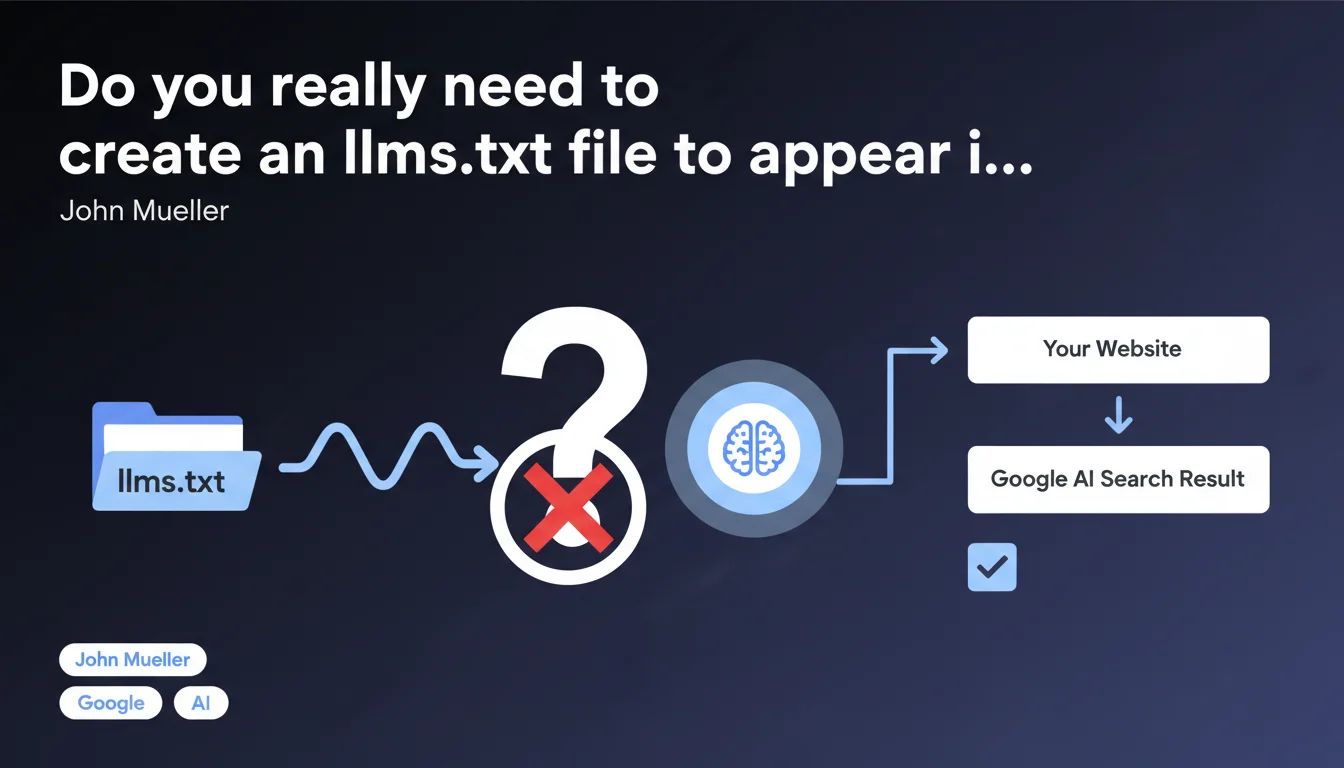
Google states it does not support the llms.txt file and indicates that no specific action is necessary to appear in its AI-powered search features. This statement from John Mueller aims to clarify that standard indexing is sufficient to be eligible for AI Overviews and similar features. SEO practitioners can therefore disregard this file in their Google optimization strategy.
What you need to understand
What is the llms.txt file and why is everyone talking about it?
The llms.txt file is a relatively recent proposal designed to provide language models (LLMs) with structured information about a website's content. Some industry players have suggested that this file could become a standard for optimizing visibility in AI-generated search results.
The underlying idea? To give conversational agents a kind of privileged access plan — much like sitemap.xml for traditional crawlers. Except Google just put an end to that analogy.
What does Google's statement really mean in practical terms?
Mueller is categorical: Google does not use llms.txt to power its AI Overviews or any other AI-based search feature. The message is crystal clear — you have nothing special to do beyond what already guarantees your standard indexing.
This means Google's current infrastructure (crawling, indexation, quality evaluation) is sufficient to determine which content is eligible for AI-generated answers. No parallel channel, no magic file.
What are the implications for AI indexing in general?
This stance reveals something essential: Google wants to unify its systems. No separate treatment for generative AI — the same quality, authority, and relevance signals apply.
That said, not all search engines and LLMs work like Google. Other actors could adopt llms.txt — creating a fragmented ecosystem where optimization practices diverge depending on the platform.
- Google does not implement llms.txt for its AI search features
- Standard indexation remains the only prerequisite to be eligible for AI Overviews
- Other search engines or AI agents could adopt this file — the evolution of the standard needs monitoring
- No urgency to create this file if your strategy focuses on Google Search
SEO Expert opinion
Is this position consistent with what we observe in practice?
Absolutely. Since the launch of AI Overviews, analyses show that cited websites are those already performing well in traditional organic search. No surprises, no mysterious newcomers who benefited from an llms.txt file.
Google leverages its existing infrastructure — its Knowledge Graph, its E-E-A-T signals, its relevance algorithms. Introducing a new file would be redundant and unnecessarily complicate the technical stack for publishers.
Should we completely ignore llms.txt then?
Let's be honest: if your traffic depends predominantly on Google, yes, you can ignore it. But if you're playing in a multi-platform ecosystem (ChatGPT, Perplexity, enterprise conversational agents), the stakes change.
Some non-Google actors could adopt this standard. If you have the resources, creating a clean, well-structured llms.txt file can be future insurance — provided it doesn't divert your efforts from optimizations with proven impact today.
What nuances should we add to this official statement?
Mueller speaks about Google Search and its integrated AI features. This doesn't necessarily cover all Google products — though it likely does. The distinction is subtle, but a rigorous practitioner always notes the exact scope of a statement.
Moreover, this position is dated. The AI ecosystem evolves quickly. If industry consensus emerges around llms.txt and users expect this format, Google could revise its stance. Keep an eye on future announcements — but don't anticipate an imminent change.
Practical impact and recommendations
What should you actually do after this announcement?
Nothing new. Keep optimizing for standard indexation: quality content, solid technical structure, reinforced E-E-A-T signals. These fundamentals are what determine your eligibility for AI Overviews.
If you had planned to create an llms.txt file solely for Google, you can reallocate that time. Instead focus on structured markup (schema.org), improving your Core Web Vitals, and creating content that directly answers search intent.
What mistakes should you avoid in this context?
Don't fall into the trap of speculative over-optimization. Some tools or agencies might sell you llms.txt implementation as an urgent necessity for AI — it's false for Google.
Also avoid completely neglecting the topic if you operate on other platforms. The mistake would be to generalize Google's position to the entire ecosystem. Conduct an audit of your traffic channels and adjust accordingly.
- Verify that your site is properly indexed by Google (Search Console, index coverage)
- Ensure your important pages aren't blocked by robots.txt or noindex
- Strengthen your E-E-A-T signals — they matter for AI just as much as for standard search
- Monitor analytics to detect if traffic comes from other AI agents (Perplexity, ChatGPT, etc.)
- If you have a multi-platform ecosystem, educate yourself on emerging standards outside Google
- Don't divert budget from optimizations with proven ROI toward unvalidated hypotheses
How do you ensure your strategy stays aligned with AI evolution?
The key lies in active monitoring. Official Google statements, case studies on AI Overviews, competitor analyses — all of this should feed your decisions. Implement a quarterly review process to adjust your strategy.
In parallel, test and measure. If you implement llms.txt for other platforms, track the impact. If you strengthen your structured markup, quantify visibility changes. SEO remains an empirical discipline — intuition alone isn't enough.
🎥 From the same video 12
Other SEO insights extracted from this same Google Search Central video · published on 17/11/2025
🎥 Watch the full video on YouTube →
💬 Comments (0)
Be the first to comment.