
Official statement
Other statements from this video 12 ▾
- □ Is Google's AI Mode about to completely reshape your long-tail keyword strategy?
- □ Will custom Search Console annotations really transform how you track your SEO performance?
- □ Is Google really tightening the screws on low-quality content with this August spam update?
- □ Can Google Discover really boost your visibility without driving traffic to your website?
- □ How will creator profiles in Discover reshape the SEO traffic landscape?
- □ Should you declare shipping and return policies at the organization level in structured data?
- □ Should you still implement structured data if Google strips away their visual display?
- □ Why does Google insist on flexible configuration for your structured data?
- □ Is Chrome about to make HTTPS mandatory by default in 2026? Here's what you need to know
- □ Is your JavaScript paywall destroying your crawl budget? Here's how to fix it without cloaking
- □ Do you really need to create an llms.txt file to appear in Google's AI search results?
- □ Can Google's AI actually book a table on your restaurant site without human intervention?
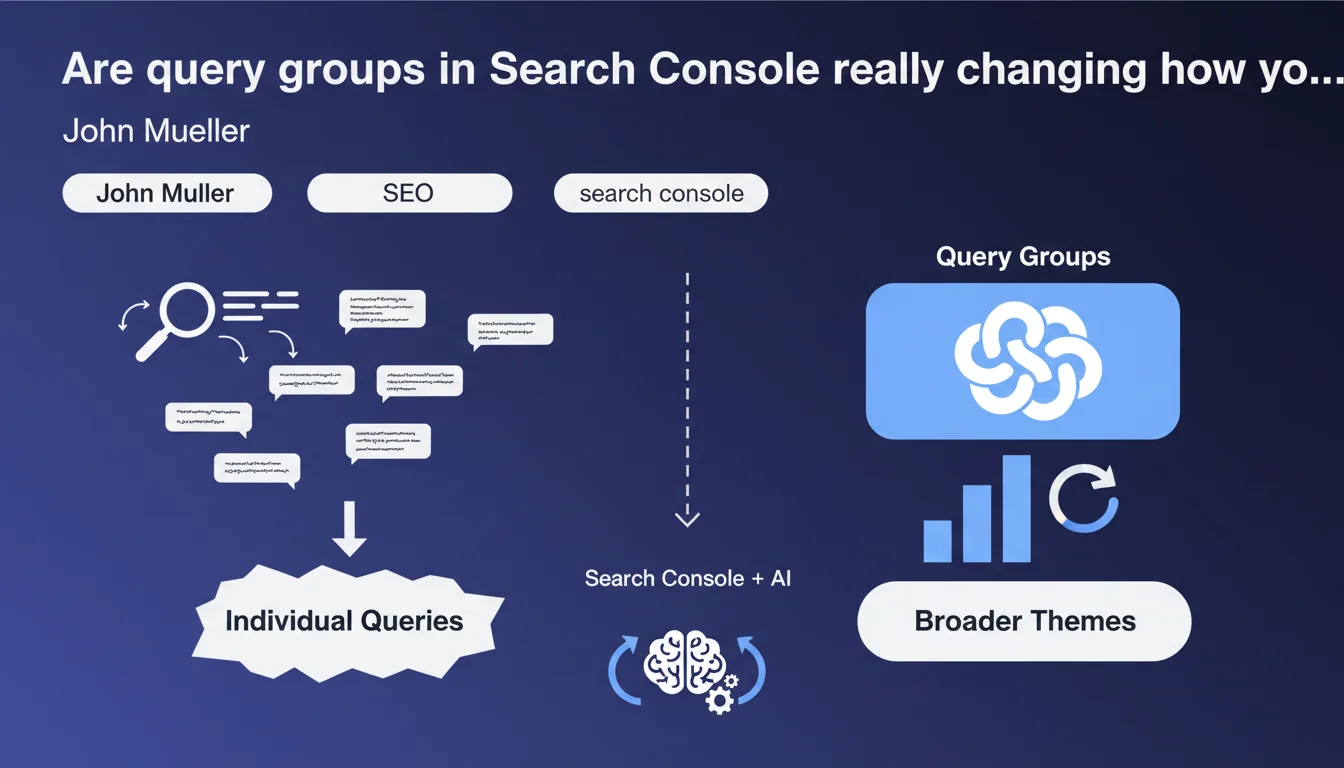
Google Search Console now groups similar searches into thematic clusters. Goal: simplify analysis by shifting from a micro-query view to macro-thematic logic. In practice, this reshuffles the deck for those still optimizing keyword by keyword.
What you need to understand
What exactly does Google mean by "query groups"?
Google automatically aggregates similar queries into thematic clusters. Instead of displaying separately "SEO agency Paris", "Paris SEO services", "Paris search expert", Search Console groups them under the same theme.
The idea: focus on search intent rather than syntactic variations. It's a logical evolution for an engine that's been claiming to understand natural language since BERT.
Why is this evolution happening now?
Because the multiplication of long-tail queries and voice searches makes individual analysis unmanageable. Google records 15% of never-before-seen queries every day — impossible to run a strategy on that level of granularity.
By grouping variants, Google is pushing you toward strategic thinking: which topics perform, which intent converts, which theme deserves more content. Goodbye to query-by-query tinkering.
How does Search Console determine these groups?
Google stays vague on the exact algorithm. Likely a mix of semantic similarity, SERP analysis, and behavioral patterns. If two queries generate the same results and click-through rate, they end up in the same bucket.
The problem? You have zero control over these groupings. Impossible to customize, split, or manually merge them. You accept Google's vision — or you miss out.
- Query groups are gradually replacing individual query analysis in GSC
- This approach reflects the semantic understanding logic that Google applies to rankings
- Aggregation is automatic and non-customizable — you're subject to Google's choices
- Stated objective: simplify management by focusing on broad themes rather than variations
- Direct consequence: micro-optimized strategies on specific queries lose analytical visibility
SEO Expert opinion
Does this approach actually match ranking reality?
Yes and no. On informational queries and broad topics, Google does rank by theme more than exact keyword. A well-structured article on "mobile optimization" will rank on 50 variants without precise targeting.
But on transactional or local queries, nuances still matter enormously. "Divorce lawyer Paris 16th" vs "Divorce lawyer Paris 17th": similar intent, radically different results. Grouping these under "divorce lawyer Paris" loses critical information.
What risks does this thematic view pose to your strategy?
The main danger: hiding niche opportunities. A specific query with 20 monthly searches might convert at 40% where the overall theme converts at 2%. Burying it in a group means missing these gems.
Another pitfall: you might optimize for a theme while your actual traffic comes from two precise variants within that group. Aggregation creates an illusion of uniform relevance that doesn't exist.
Is Google pushing this approach for another reason?
Let's be honest: it also simplifies Google's job. Less detailed data to transmit, less load on GSC servers, fewer complaints about "not provided".
And it reinforces their narrative: "Make quality content on topics, we'll handle the rest". Convenient for discouraging the overly-fine tactical approaches they can't control. The message aligns with their broader communication — but your job remains navigating between their rhetoric and ground reality.
Practical impact and recommendations
How do you adapt your performance analysis with these groups?
First, enable the query groups view in GSC to compare with your old method. Identify themes performing well overall — that's your strategic foundation.
Next, systematically cross-reference with Google Analytics 4 or third-party tools. Dive into individual queries within each group to spot anomalies: a query outperforming, another tanking your average CTR, etc.
Don't shift 100% of your strategy onto these groups. Use them as macro radar to detect trends, but keep micro-level analysis for tactical decisions. Both levels complement each other.
What mistakes should you avoid with this feature?
Don't settle for aggregated metrics alone. A group with 5% average CTR might hide one query at 15% and ten others at 2%. Averaging is lying.
Avoid restructuring your entire content architecture based on these groups. Google can change its grouping criteria overnight — and you're left with obsolete structure.
Don't ditch your in-house semantic clusters. Google's groups don't replace your editorial strategy or internal linking. They inform, they don't dictate.
What do you need to set up right now?
- Enable the "query groups" view in Search Console and compare with the classic view over 3 months
- Identify the 10 thematic groups generating the most impressions on your site
- Analyze performance spread within each group (star queries vs zombie queries)
- Cross these insights with GA4 conversions to validate the business relevance of identified themes
- Adjust your content production by prioritizing high-potential, under-exploited themes
- Maintain granular tracking via third-party tools (Semrush, Ahrefs, etc.) to keep detailed visibility
- Document gaps between Google's groups and your own semantic clustering to spot inconsistencies
- Test the impact of broad thematic optimization vs specific query targeting on a sample of pages
🎥 From the same video 12
Other SEO insights extracted from this same Google Search Central video · published on 17/11/2025
🎥 Watch the full video on YouTube →
💬 Comments (0)
Be the first to comment.