
Official statement
Other statements from this video 12 ▾
- □ Is Google's AI Mode about to completely reshape your long-tail keyword strategy?
- □ Are query groups in Search Console really changing how you should analyze your SEO performance?
- □ Will custom Search Console annotations really transform how you track your SEO performance?
- □ Is Google really tightening the screws on low-quality content with this August spam update?
- □ Can Google Discover really boost your visibility without driving traffic to your website?
- □ How will creator profiles in Discover reshape the SEO traffic landscape?
- □ Should you declare shipping and return policies at the organization level in structured data?
- □ Why does Google insist on flexible configuration for your structured data?
- □ Is Chrome about to make HTTPS mandatory by default in 2026? Here's what you need to know
- □ Is your JavaScript paywall destroying your crawl budget? Here's how to fix it without cloaking
- □ Do you really need to create an llms.txt file to appear in Google's AI search results?
- □ Can Google's AI actually book a table on your restaurant site without human intervention?
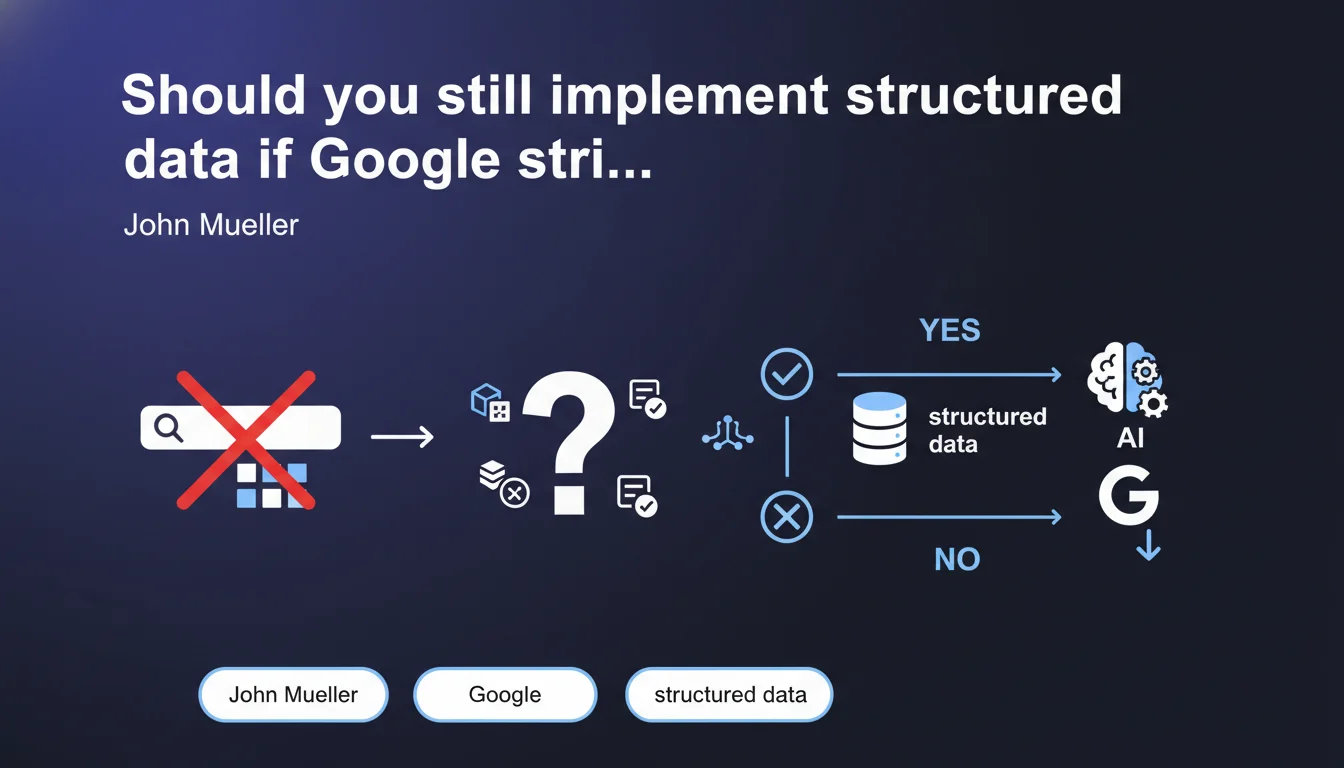
Google has removed the visual display of certain types of structured data from its search results. The schemas remain technically valid and can be preserved, but they no longer generate rich snippets or distinctive visual elements. In concrete terms: some development hours have just lost their visible ROI.
What you need to understand
Which types of structured data are affected by this removal?
Google doesn't provide an exhaustive list, but field observations point to secondary schemas like HowTo, certain FAQ schemas in specific contexts, or less strategic Review types. The big ones — Product, Article, Recipe, Event — appear to be spared for now.
The ambiguity Google maintains around the exact scope creates a gray area. It's impossible to know with certainty whether your PreparationType schema or your ItemList will continue to display without testing it live.
Why is Google removing these displays now?
Officially: user experience optimization. Unofficially: too much structured data spam, too many sites abusing it to artificially inflate their visibility. Google is cleaning house, as it does periodically when an SEO lever gets overexploited.
Another credible hypothesis — monetization. Fewer organic rich snippets = more potential clicks toward ads. Coincidence? Maybe. But the timeline coinciding with the intensification of visual ad formats raises questions.
Do structured data without visual display still serve any purpose?
Yes, but not in the way we've been told. Structured data remains a signal of semantic understanding for Google's algorithms. It helps the engine classify content, even if it no longer triggers carousels or star ratings.
It's invisible SEO: useful for crawling and indexing, but without direct impact on CTR. Suffice it to say that for a client watching their monthly metrics, the argument becomes difficult to sell.
- Some visual schemas disappear without us knowing exactly which ones until we test
- Structured data remains technically valid and can be maintained
- It retains a role as a semantic signal for the algorithm, but without visual impact
- The ROI of implementing it becomes harder to justify to decision-makers
- Google doesn't provide an exhaustive list of affected types, creating operational uncertainty
SEO Expert opinion
Is this decision consistent with Google's historical strategy?
Completely. Google has always alternated between opening phases ("implement schemas, we'll reward you") and restriction phases ("actually, we're taking back what we gave"). Authorship photos in 2014, oversized HowTo rich cards in 2019 — same cycle.
The pattern repeats: Google tests a visual format, SEOs exploit it to the max, spam rates explode, Google shuts off the tap. We're just in another iteration. And it calls into question the stability of investments on these levers.
Should you delete schemas that no longer display?
No, unless you have a vital need to clean up your code. The maintenance cost is nearly zero once they're in place. Removing them sends an ambiguous signal to Google — "I'm no longer structuring my content" — while the benefit of keeping them, even invisible, remains real on a semantic level.
However, stop implementing new ones until you have certainty about their display. Prioritize Product, Recipe, Article, Video schemas — those that continue to generate documented rich results. Everything else is nice-to-have, not must-have.
What's the real underlying message of this announcement?
Google is recentralizing control. Rich snippets were an accessible SEO lever, predictable, with measurable ROI. By progressively removing them, Google is taking back the reins on what shows up in the SERP. And that's a problem for our profession.
We're moving from an SEO where you can influence the appearance of your results to an SEO where you optimize in the dark, not knowing whether your efforts will have visible impact. It's a return to more opaque, less predictable SEO — and frankly, more frustrating.
Practical impact and recommendations
What should you do with structured data already in place?
Don't touch anything as long as your schema doesn't generate errors in Search Console. Existing structured data continues to play its semantic role, even without visual display. Removing it would be a net loss with no gain.
However, document precisely which schemas you use and which ones still generate rich results. Use the Rich Results Testing Tool and the Improvements report in GSC. Compare before and after to identify which types have lost their display on your site.
How should you prioritize new schema developments?
Focus your efforts on schemas with proven ROI: Product (with reviews), Recipe, Video, Article, Organization, Breadcrumb. These are the ones continuing to generate stable visual elements in the SERP.
Forget exotic or overly specific schemas for now. HowTo, certain FAQs outside medical/legal context, highly niche event schemas — their benefit has become too uncertain to justify dev time.
Should you revisit the overall structured markup strategy?
Yes, but don't panic. Markup remains fundamental for entity and semantic understanding. What changes is that you need to stop selling it as a guaranteed CTR lever. It's become a technical prerequisite, not a visual differentiator.
Redirect effort toward classic on-page optimizations that impact display: title/meta, H structure, semantic hierarchy of content. The rich snippet was a shortcut; now, you have to go back to fundamentals of SERP-oriented copywriting.
- Audit currently implemented schemas via Search Console and identify which ones no longer display rich results
- Keep schemas in place even without visual display — they remain useful for semantic signal
- Prioritize new developments exclusively on Product, Recipe, Video, Article, Organization
- Stop investing dev time on secondary schemas (HowTo, FAQ outside priority contexts)
- Document precisely the display status of each schema type to track future changes
- Redirect dev budgets toward optimizing title/meta tags and semantic content structure
- Train marketing teams not to promise guaranteed rich snippets in SEO deliverables
🎥 From the same video 12
Other SEO insights extracted from this same Google Search Central video · published on 17/11/2025
🎥 Watch the full video on YouTube →
💬 Comments (0)
Be the first to comment.