
Official statement
Other statements from this video 12 ▾
- □ L'AI Mode de Google va-t-il bouleverser votre stratégie de mots-clés longue traîne ?
- □ Les groupes de requêtes dans Search Console changent-ils la façon d'analyser vos performances SEO ?
- □ Les annotations personnalisées Search Console vont-elles vraiment changer votre analyse de performance ?
- □ Mise à jour spam d'août : Google resserre-t-il vraiment l'étau sur les contenus bas de gamme ?
- □ Discover peut-il vraiment booster votre visibilité sans passer par votre site web ?
- □ Comment les profils créateurs dans Discover vont-ils redistribuer les cartes du trafic SEO ?
- □ Faut-il déclarer ses politiques d'expédition et de retour au niveau organisation dans les données structurées ?
- □ Faut-il encore implémenter des données structurées si Google supprime leur affichage visuel ?
- □ HTTPS par défaut dans Chrome : la fin du HTTP non sécurisé en 2026 ?
- □ Comment configurer un paywall JavaScript sans ruiner votre crawl budget ?
- □ Faut-il créer un fichier llms.txt pour être visible dans les résultats IA de Google ?
- □ L'IA de Google peut-elle vraiment réserver une table sur votre site sans intervention humaine ?
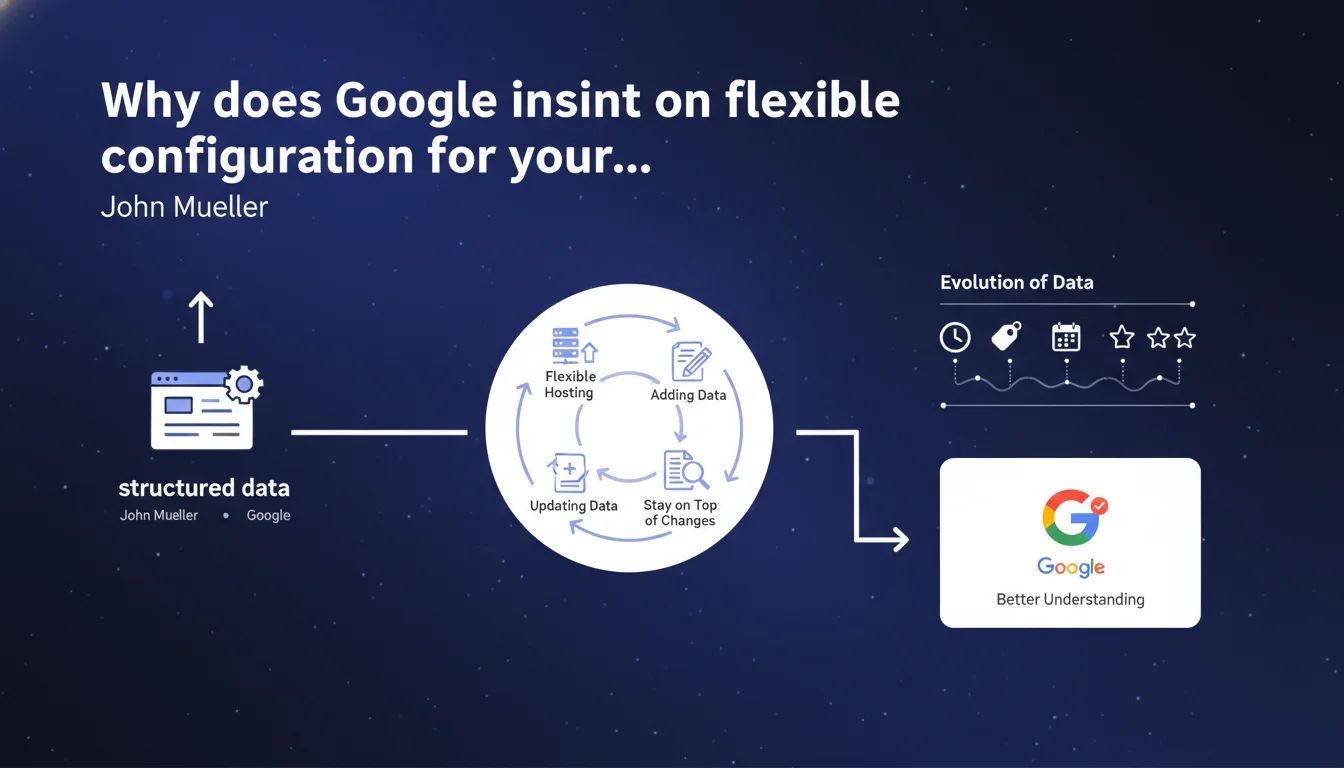
Google recommends choosing a hosting architecture that makes it easy to add and update structured data. The goal? Enable websites to quickly adapt to frequent changes in schema.org specifications and rich results. In other words: if modifying your JSON-LD tags takes three weeks of development, you've already lost.
What you need to understand
What does "flexible configuration" really mean in this context?
Google isn't talking about technical flexibility just for fun. It's referring to your operational capacity to modify, extend, or correct your structured data without going through a heavy development cycle.
Concretely: if you manage an e-commerce site with 50,000 products and Google adds tomorrow a property recommended for aggregated reviews, can you deploy this modification in a few days? Or do you have to wait for the next sprint, an update to your proprietary CMS, and an endless validation process?
Why does Google place so much emphasis on reactivity to changes?
Rich results specifications evolve constantly. An optional property becomes recommended. A new markup type emerges. An existing format gets enriched with new features.
If your technical architecture makes these adjustments complex, you fall behind the competition — and worse, you risk losing your rich snippets if critical errors accumulate without quick fixes.
Which systems offer this flexibility in the real world?
Modern CMSs with well-maintained plugins (WordPress + dedicated schema extensions, Shopify with specialized apps) generally allow quick adjustments. Custom systems with dynamically generated JSON-LD via templates also offer this flexibility.
Conversely, solutions where structured data is hard-coded into templates or generated by a poorly documented legacy system cause problems. The same goes for sites where every modification requires manual intervention on thousands of pages.
- Flexible configuration = ability to modify your schema tags without technical overhaul
- Google anticipates frequent changes in rich results specifications
- Rigid sites accumulate technical debt and lose SERP visibility
- Dynamic JSON-LD via templates or well-equipped CMSs offer the best flexibility-to-maintenance ratio
SEO Expert opinion
Does this recommendation truly reflect on-the-ground priorities?
Let's be honest: most sites don't update their structured data after the initial implementation. And many do just fine anyway, as long as required properties are present and valid.
What Mueller is pointing out is a problem that mainly affects large players or sites in competitive verticals (e-commerce, travel, recipes). There, yes, losing a star rating in the SERPs because a new property becomes critical can cost you dearly.
What are the real risks of rigid architecture?
The danger isn't immediate — it's the gradual accumulation of gaps. You implement schema.org Product in 2021 with best practices of that era. Two years later, Google hardens its requirements for product variant markup. Your competition adapts in three weeks, you in six months.
Result? During this delay, your product listings display less attractive rich results, or even disappear from carousels. And that's visible in organic CTR.
In which cases is this recommendation secondary?
If you manage a simple editorial blog with basic Article markup, or a brochure site with a few pages, frankly? It's not your priority. Structured data changes rarely there.
However, for sites that capitalize on rich results (e-commerce, marketplaces, content aggregators, event sites), ignoring this advice amounts to compromising your future agility. And in SEO, agility counts as much as pure technique.
Practical impact and recommendations
How do you evaluate if your current configuration is flexible enough?
Ask yourself this question: how long does it take to add a new schema.org property across all your product pages or articles? If the answer exceeds a week, you have a problem.
Another concrete test: go to Search Console, Enhancements section. If you see errors or warnings on your structured data, how long would it take to fix them if Google decided tomorrow to tighten its requirements? If you need to wait for an external vendor or a full development cycle, that's a red flag.
What architecture mistakes must you absolutely avoid?
First classic mistake: hard-coding structured data directly into HTML templates without a dynamic generation system. Result: every modification requires touching source code.
Second trap: using abandoned or unmaintained plugins and modules that no longer follow schema.org evolution. You end up stuck with obsolete markup.
Third frequent problem: fragmenting structured data management across multiple systems (one plugin for products, custom code for articles, another tool for FAQs). It becomes unmanageable as soon as you need to synchronize an update.
- Verify that your structured data is dynamically generated, not hard-coded into templates
- Test your ability to deploy a schema modification across your entire site in under 48 hours
- Document precisely where and how your various JSON-LD or microdata tags are managed
- Regularly audit Search Console to anticipate changes in Google's requirements
- Favor a centralized system (native CMS, single plugin, API-driven generator) over a patchwork of tools
- Plan automated tests to validate your tags after each modification
🎥 From the same video 12
Other SEO insights extracted from this same Google Search Central video · published on 17/11/2025
🎥 Watch the full video on YouTube →
💬 Comments (0)
Be the first to comment.