
Official statement
Other statements from this video 12 ▾
- □ L'AI Mode de Google va-t-il bouleverser votre stratégie de mots-clés longue traîne ?
- □ Les groupes de requêtes dans Search Console changent-ils la façon d'analyser vos performances SEO ?
- □ Les annotations personnalisées Search Console vont-elles vraiment changer votre analyse de performance ?
- □ Mise à jour spam d'août : Google resserre-t-il vraiment l'étau sur les contenus bas de gamme ?
- □ Comment les profils créateurs dans Discover vont-ils redistribuer les cartes du trafic SEO ?
- □ Faut-il déclarer ses politiques d'expédition et de retour au niveau organisation dans les données structurées ?
- □ Faut-il encore implémenter des données structurées si Google supprime leur affichage visuel ?
- □ Pourquoi Google insiste-t-il sur une configuration flexible pour vos données structurées ?
- □ HTTPS par défaut dans Chrome : la fin du HTTP non sécurisé en 2026 ?
- □ Comment configurer un paywall JavaScript sans ruiner votre crawl budget ?
- □ Faut-il créer un fichier llms.txt pour être visible dans les résultats IA de Google ?
- □ L'IA de Google peut-elle vraiment réserver une table sur votre site sans intervention humaine ?
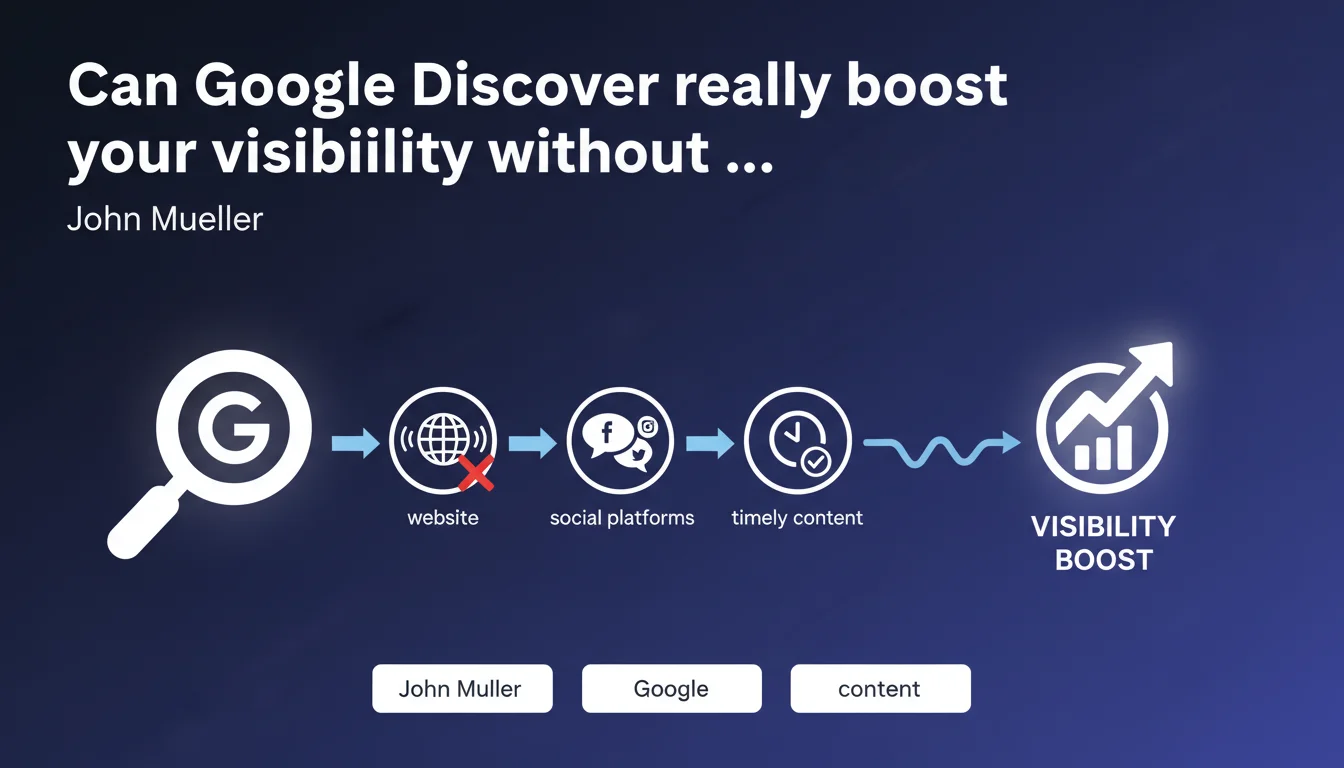
Google Discover now displays content published directly on social media platforms, not just articles from websites. Creators can gain visibility without their audience necessarily visiting their domain. For SEOs, this reshuffles the deck: the production of "timely and high-quality content" officially extends beyond the CMS.
What you need to understand
What exactly is changing in Discover?
Until now, Google Discover functioned as a personalized feed powered by articles published on indexed websites. Content had to exist on a domain to be eligible for inclusion.
Now, Google is integrating content published on social platforms — without requiring it to link to a traditional article. Concretely, an Instagram post, a YouTube short video, or a Twitter thread could appear directly in a user's Discover feed if the content is deemed relevant, timely, and high-quality.
Why is Google broadening its content sources this way?
The objective is clear: capture attention where fresh content is created. Creators publish massively on social networks, often before — or instead of — writing a blog post.
Google is seeking to maintain its relevance by serving timely content, a term that should be read as "answering an emerging interest at the right moment." If this content lives only on TikTok or LinkedIn, Google prefers to display it rather than lose the user.
Who is affected by this evolution?
All content creators who produce regularly on social networks, whether or not they own a website. Influencers, freelance journalists, and industry experts who favor short-form content stand to gain visibility.
For traditional website publishers, it's additional competition. Potential traffic from Discover can be captured by a competing social format — even if the website has an equivalent article.
- Discover becomes multi-source: websites AND social networks
- The primary criterion remains "timely and high-quality"
- Creators without websites can gain direct visibility
- Web publishers must contend with expanded competition
SEO Expert opinion
Is this opening truly new or just an officialization?
Let's be honest: Google has already been displaying YouTube videos in Discover for a long time. What's changing is the explicit extension to "various social platforms". We're probably talking about Instagram, TikTok, LinkedIn, X — ecosystems where Google has no direct technical control.
The announcement formalizes a practice that many suspected. But it raises a question: how does Google measure the "high quality" of a social post? Usual signals (backlinks, HTML structure, Core Web Vitals) don't apply. We can guess at massive reliance on engagement (likes, shares, reading time) and perhaps semantic analysis via AI.
What risks exist for traditional SEO strategies?
The main danger is cannibalization of referral traffic. If a user finds the information directly in a social post via Discover, they no longer click through to the website. Goodbye page views, time on site, and potential conversions.
For business models based on display advertising or affiliate marketing, it's a hard blow. Content generates visibility for the creator, but no direct revenue if the audience never visits a monetizable property.
Should you abandon traditional SEO then?
No. Discover remains a complementary and volatile channel. Traffic spikes there are unpredictable, tied to current events and fluctuating user interests. Classic organic search, meanwhile, generates more stable and qualified traffic.
What to remember: Google is diversifying its display surfaces, but the website remains the foundation of any sustainable strategy. A viral social post in Discover is great — but without a website to convert that audience, business impact remains limited. And that's where many creators hit a wall.
Practical impact and recommendations
What adjustments should you make to your content strategy?
First, don't put all your eggs in one basket. If you produce only for your blog, you're missing potential visibility. Conversely, if you publish exclusively on social networks, you're letting Google decide your monetization.
The winning strategy? Produce timely content on social networks to capture immediate attention, then redirect to deeper content on your site. The social post becomes the bait, the blog article the conversion.
Concretely, identify emerging topics in your niche and publish quickly in short form (carousel, video, thread). Then mention a link to a full article for those who want to dig deeper. You maximize both channels this way.
How do you optimize your social content for Discover?
Even though Google doesn't detail the criteria, several principles are clear. Prioritize high-quality visuals — Discover is a very visual feed. A post with a blurry image or amateurish thumbnail has little chance of emerging.
Next, focus on freshness and immediate relevance. "Timely" means the content addresses current events, trends, or emerging needs. A generic post published 6 months ago probably won't resurface.
Finally, nurture early engagement. Google probably observes social signals (comments, shares, saves) to evaluate quality. A post that generates quick interaction has a better chance of being amplified.
What mistakes should you absolutely avoid?
Don't treat Discover as a guaranteed traffic source. It's a bonus, not a base. Too many websites have seen traffic collapse after betting solely on this channel — Google adjusts algorithms constantly.
Second mistake: neglecting the link between your social content and your website. If you explode on Instagram via Discover but nobody knows about your website, you're working for the platform, not for yourself.
- Publish regularly timely content on 2-3 key social platforms
- Create a smooth redirection system: social post → in-depth article on site
- Optimize visuals for attractive mobile display in Discover
- Monitor emerging trends in your sector to publish quickly
- Measure social engagement as a leading indicator of Discover visibility
- Never depend on a single channel — diversify traffic sources
🎥 From the same video 12
Other SEO insights extracted from this same Google Search Central video · published on 17/11/2025
🎥 Watch the full video on YouTube →
💬 Comments (0)
Be the first to comment.