
Official statement
Other statements from this video 12 ▾
- □ Is Google's AI Mode about to completely reshape your long-tail keyword strategy?
- □ Are query groups in Search Console really changing how you should analyze your SEO performance?
- □ Will custom Search Console annotations really transform how you track your SEO performance?
- □ Is Google really tightening the screws on low-quality content with this August spam update?
- □ Can Google Discover really boost your visibility without driving traffic to your website?
- □ Should you declare shipping and return policies at the organization level in structured data?
- □ Should you still implement structured data if Google strips away their visual display?
- □ Why does Google insist on flexible configuration for your structured data?
- □ Is Chrome about to make HTTPS mandatory by default in 2026? Here's what you need to know
- □ Is your JavaScript paywall destroying your crawl budget? Here's how to fix it without cloaking
- □ Do you really need to create an llms.txt file to appear in Google's AI search results?
- □ Can Google's AI actually book a table on your restaurant site without human intervention?
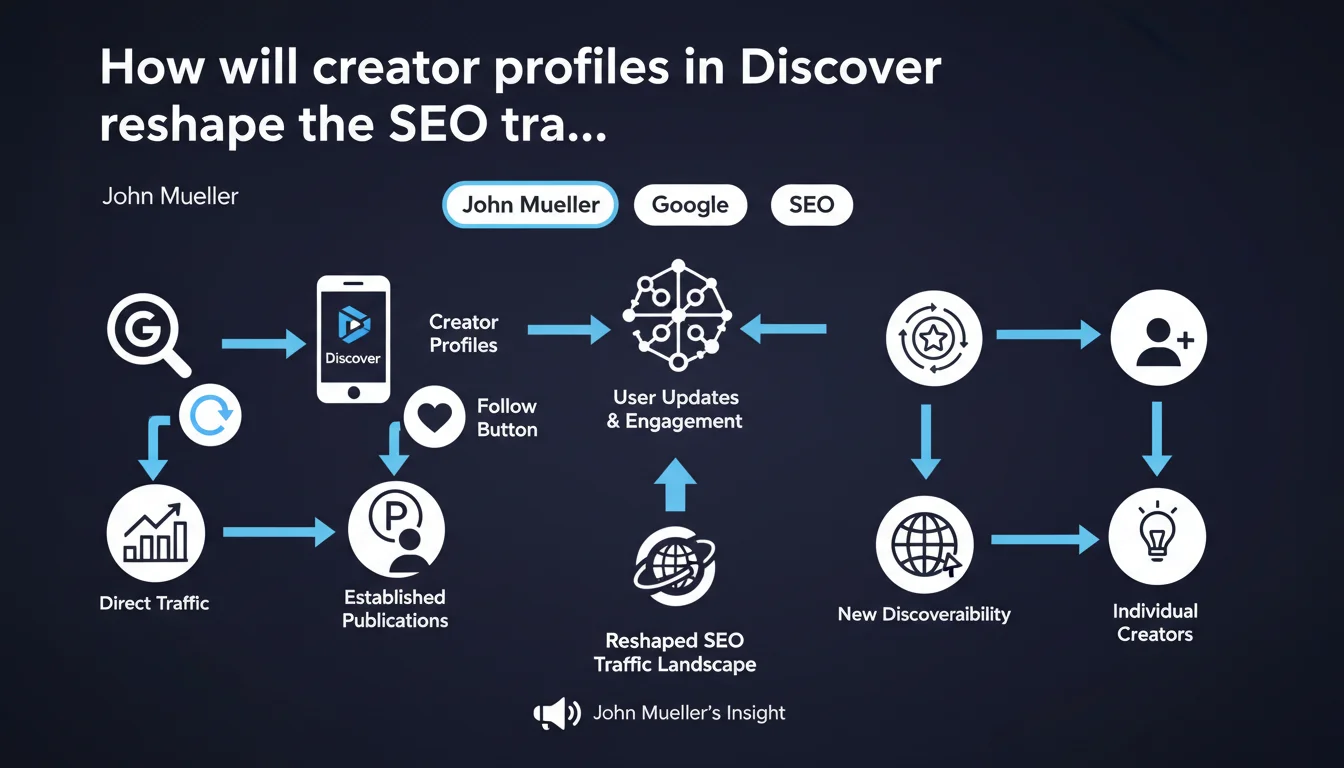
Google is rolling out creator and publisher profiles in Discover with a "Follow" button allowing users to subscribe directly to content. This feature transforms Discover from a passive algorithmic feed into a hybrid semi-personalized, semi-social experience, creating a new direct acquisition channel that partially escapes traditional SEO mechanics.
What you need to understand
How does this feature change Discover's mechanics?
Until now, Discover operated exclusively on an algorithmic model: Google decided what to show you based on your history, interests, and location. Zero direct user control.
With the addition of creator profiles and the Follow button, Google is introducing a "subscription" dimension that mirrors social networks. Users can now force certain content to appear in their feed—a departure from Discover's purely predictive philosophy.
Who can get a creator profile in Discover?
Google hasn't detailed exact eligibility criteria yet, but the usual signals likely apply: schema.org Author markup, content consistency, publishing volume, and domain authority.
News sites, specialized blogs, and regular content creators logically have better chances of accessing this feature than institutional sites or standard e-commerce platforms.
What's the difference from an RSS feed or newsletter?
Unlike a dead RSS feed from 15 years ago or a newsletter requiring an email, the Follow button lives natively in Google's ecosystem. No friction: one click and you're subscribed.
Users stay in their familiar Google app. They don't need to create an account elsewhere or manage another tool. It's this frictionlessness that makes the feature potentially powerful.
- Discover becomes partially opt-in: users actively choose certain creators to follow
- New recurring acquisition channel: subscribers can systematically receive your content
- Increased Google dependency: you're building your audience on proprietary infrastructure
- Eligibility criteria still unclear: not all sites will have access to this feature
- Impact measured in Search Console: expect to see this data appear in Discover reports
SEO Expert opinion
Is this "social" logic in a search engine really new?
Let's be honest: Google has tested this kind of mechanism for years without ever really pushing it. Remember Google+, authorship attempts with author photos in SERPs, experiments with "perspectives" and other stillborn social features?
What might make a difference this time is that Discover now represents significant traffic volume for certain publishers—sometimes 20-30% of total organic traffic. So Google has a real user base to test this subscription mechanic on, whereas Google+ started from zero.
Should you see this feature as an opportunity or a trap?
Both, obviously. On one hand, you gain a potentially stable, recurring traffic channel, less subject to daily algorithmic fluctuations. A user who actively follows you has demonstrated interest—that's valuable.
On the other, you're delegating even more control to Google. Your "subscriber list" doesn't belong to you, you can't export it, and Google can change the rules whenever it wants. If tomorrow the algorithm decides to limit the reach of followed content to prioritize other factors, you have no recourse.
How will Google arbitrate between followed content and algorithmic suggestions?
That's the real question. If a user follows 50 creators publishing 3 articles each per day, Discover can't physically display everything. Google will have to prioritize certain followed content based on criteria we don't yet know.
My hypothesis: followed content will get an initial visibility boost, but must still pass relevance and quality filters to stay in the feed. In other words—you'll have an advantage, not an automatic pass.
Practical impact and recommendations
What should you implement right now to access this feature?
Start with Author markup. If you haven't properly implemented it with schema.org yet, now's the time. Google needs to clearly identify who creates your content to build these creator profiles.
Next, make sure your content is already eligible and performing well in standard Discover. If you never appear in this feed, it's unlikely Google will give you access to creator profiles initially.
Technically: verify your site meets Core Web Vitals and provides flawless mobile experience. Discover is primarily mobile—a site that lags on smartphones won't benefit from any advanced features.
How do you measure the impact of this feature on your traffic?
Monitor Search Console, Discover tab. Google should normally segment traffic from users who follow you versus algorithmic suggestions. If this granularity doesn't appear immediately, you'll need to infer trends through volume variations.
Also compare your returning visitor rate from Discover. If the Follow button works, you should see an increase in recurring users in your analytics—a sign they're returning via subscriptions rather than algorithmic chance.
What strategic mistakes must you absolutely avoid?
Don't fall into the trap of over-optimizing for Discover at the expense of classic Search. Some publishers already tried using clickbait headlines and sensational images to capture Discover traffic—result: quality penalties and credibility loss.
Also avoid treating this feature as a substitute for your email strategy or other owned channels. As mentioned earlier: you don't own this audience, Google does. Use it as a complement, never as your sole foundation.
- Implement or verify schema.org Author markup on all editorial content
- Optimize Core Web Vitals and mobile experience across your site
- Analyze your current Discover performance via Search Console
- Produce regular, consistent content around clearly identified topics
- Monitor Discover traffic evolution and identify engagement patterns
- Test different content formats (long-form articles, rich visuals, videos) to maximize engagement
- Maintain other acquisition channels (email, social, classic SEO) to avoid depending on a single source
🎥 From the same video 12
Other SEO insights extracted from this same Google Search Central video · published on 17/11/2025
🎥 Watch the full video on YouTube →
💬 Comments (0)
Be the first to comment.