
Official statement
Other statements from this video 9 ▾
- □ Faut-il vraiment doubler les données produits entre Schema et Merchant Center ?
- □ Faut-il vraiment empiler trois couches de données produits pour plaire à Google ?
- □ Comment la Search Console détecte-t-elle réellement les erreurs dans vos données structurées produits ?
- □ Pourquoi Google veut-il que vous affichiez des prix plus élevés dans vos données structurées ?
- □ Faut-il vraiment surestimer les frais de port pour plaire à Google Shopping ?
- □ Pourquoi Google exige-t-il des identifiants produits GTIN, MPN ou marque pour le référencement marchand ?
- □ Les identifiants produits sont-ils vraiment la clé du matching multi-marchands dans Google Shopping ?
- □ Faut-il abandonner Merchant Center au profit des données structurées pour le e-commerce ?
- □ Pourquoi limiter Schema.org à Google alors que d'autres moteurs l'exploitent déjà ?
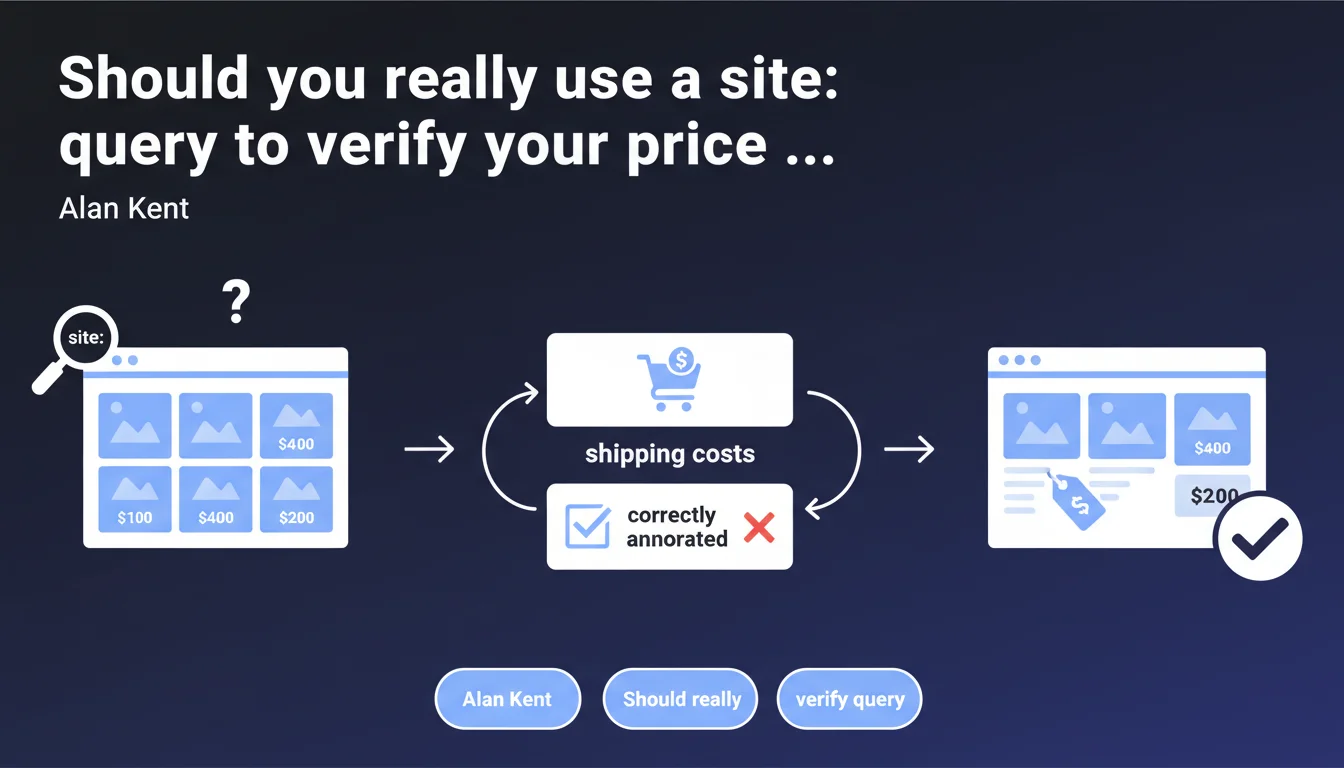
Google suggests using the site: operator to verify whether your price annotations and shipping fees are displaying correctly in search results. A simple empirical method, but one that doesn't guarantee Google is actually indexing and leveraging these structured data.
What you need to understand
Why does Google recommend using a site: query for this verification?
The site: operator allows you to visualize how your pages appear in the SERPs from Google's perspective. Alan Kent operates on the assumption that if your structured data for prices and shipping fees are correctly implemented, they should appear in the enrichments of search results.
It's a pragmatic approach: rather than relying solely on validation tools (Search Console, Rich Results Test), you verify directly the final rendering as users will see it. If price or shipping information doesn't appear in a site: query, there's likely an implementation or eligibility problem.
Is this method reliable for diagnosing indexing issues?
Not entirely. The site: query shows what Google has indexed and chosen to display, but it doesn't reveal whether Google has correctly parsed your structured data. A product can be indexed without its rich snippets appearing — for example if the markup contains minor errors, if the product doesn't meet eligibility criteria, or if Google simply decides not to display these enrichments.
Furthermore, the results of a site: query can vary depending on geolocation, browsing history, and device type. What you see isn't necessarily what all users will see.
Which structured data types are covered by this advice?
Alan Kent specifically mentions shipping costs, which suggests he's talking about Product markup with Offer and shippingDetails properties. But the logic applies to all structured data likely to generate rich snippets: prices, availability, reviews, ratings, product variants.
- Price and offer data: verify that the price displays correctly with currency, any potential promotions
- Shipping fees: confirm that delivery information appears in results (if eligible)
- Availability: ensure that in-stock/out-of-stock status is reflected in the SERPs
- Reviews and aggregated ratings: verify the display of stars and review count
SEO Expert opinion
Is this recommendation consistent with practices observed in the field?
Yes and no. The idea of visually verifying your rich snippets is sound, but the site: query is not a reliable diagnostic tool. It doesn't replace a thorough technical audit. I've seen sites whose structured data was perfectly implemented according to the Rich Results Test, but which displayed no enrichments in actual SERPs — including in site: queries.
Google algorithmically decides which enrichments to display, and this decision depends on many factors: site quality, query relevance, SERP competition, guideline compliance. A product can be technically eligible without ever benefiting from rich snippets. [To verify]: Google doesn't publish precise criteria for displaying price and shipping enrichments.
What limitations should you keep in mind with this method?
The site: query is a partial snapshot, not a complete reflection of reality. It can display different results depending on whether you're logged into your Google account or not, depending on your IP, depending on the device used. It only shows a portion of the index, often the most recent or most important pages according to Google.
Let's be honest: if you have thousands of products, browsing your results with site: isn't scalable. It's useful for a spot check on a few strategic URLs, but it doesn't replace automated monitoring via Search Console or third-party tools.
In which cases is this approach really justified?
It's relevant for a quick check after a deployment. You just added shipping structured data to your product pages? A site: query lets you verify in seconds whether Google is displaying it. It's an empirical test, not a scientific one.
On the other hand, if you notice a systematic absence of rich snippets despite valid markup, don't stop there. Analyze crawl logs, check for manual penalties, examine the competition — perhaps Google considers your site insufficiently trustworthy to deserve these enrichments.
Practical impact and recommendations
What should you actually do to verify your price and shipping data?
Run a site:yourdomain.com query in Google and identify your product pages. Visually verify whether prices, shipping fees, availability appear in the snippets. If they do, that's a good sign — but not an absolute guarantee.
Supplement this verification with Google's Rich Results Test on a few representative URLs. This tool will tell you if the markup is technically correct and eligible for enrichments. Then cross-reference with the Improvements report in Search Console, Products section, to see if Google detects any errors or warnings.
What errors should you avoid when doing this verification?
Don't rely solely on the site: query. It only shows a sample of your index, often biased toward recent or frequently crawled pages. If a page doesn't appear, it doesn't mean it's not indexed — and conversely, its appearance doesn't guarantee your structured data is being leveraged.
Also avoid assuming that the absence of rich snippets indicates a technical problem. Sometimes Google simply chooses not to display these enrichments — due to lack of trust in the site, due to algorithmic decision, or because competition on the query is too strong.
- Run a site: query on your strategic product URLs
- Visually verify the presence of prices, shipping fees, availability in snippets
- Validate the markup with Google's Rich Results Test
- Check the Improvements > Products report in Search Console
- Compare with actual SERPs (non-site: queries) to see if enrichments appear under real conditions
- Monitor click-through rates in Search Console: a drop can signal a loss of rich snippets
How do you interpret results and act accordingly?
If your rich snippets display correctly in site: and in actual SERPs, that's perfect. If the Rich Results Test validates your markup but nothing displays, two scenarios apply: either Google doesn't consider your site trustworthy enough, or there's a crawl/indexation issue (check your logs).
If the Rich Results Test detects errors, fix them immediately. Common errors: missing currency, invalid URL in the Offer, poorly formatted shippingDetails, prices inconsistent with visible page content.
❓ Frequently Asked Questions
La requête site: affiche-t-elle les mêmes résultats que les SERP normales ?
Si mes données structurées sont valides mais que je ne vois pas de rich snippets en site:, que faire ?
Dois-je vérifier chaque page produit individuellement avec site: ?
Les données de frais d'expédition sont-elles toujours affichées dans les rich snippets ?
Quelle différence entre le Rich Results Test et la requête site: ?
🎥 From the same video 9
Other SEO insights extracted from this same Google Search Central video · published on 17/01/2023
🎥 Watch the full video on YouTube →
💬 Comments (0)
Be the first to comment.