
Official statement
What you need to understand
What is Google's official recommendation for service-based websites?
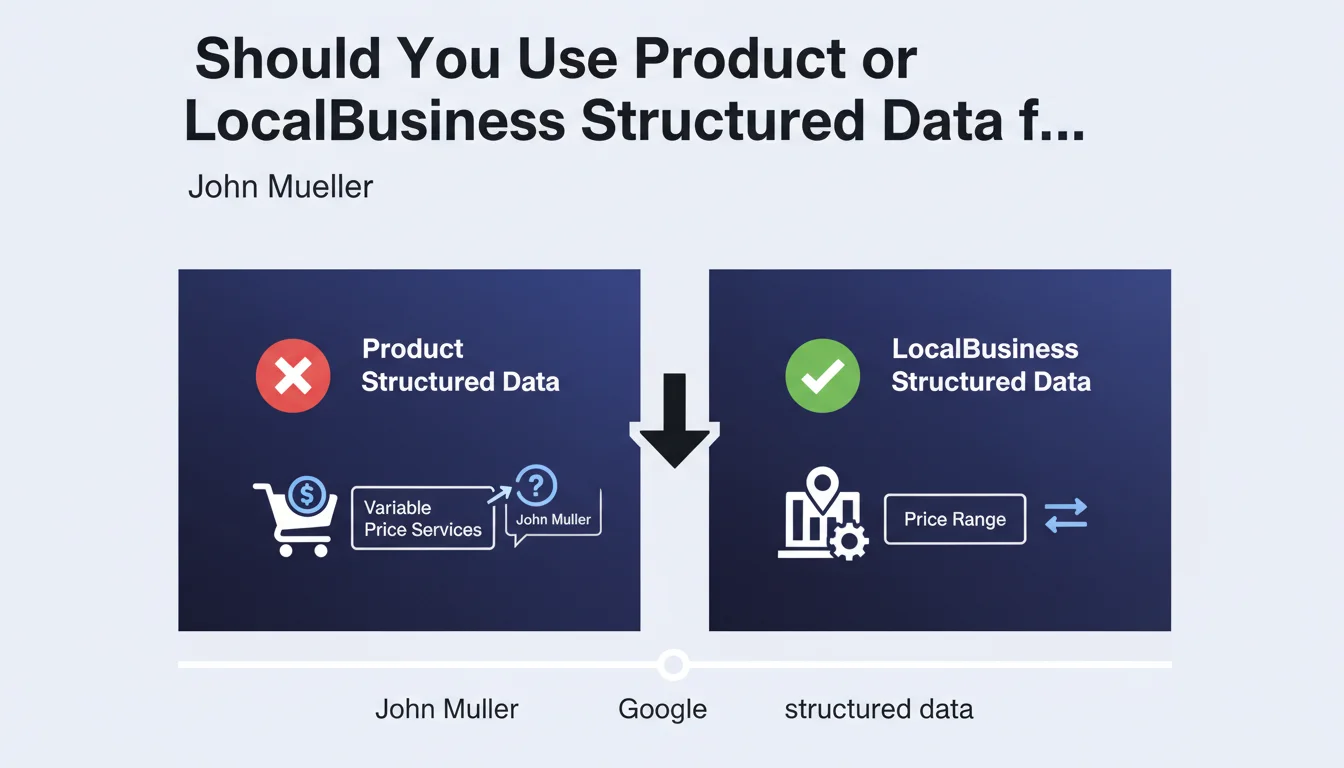
Google explicitly recommends using LocalBusiness structured data for websites offering services, not Product structured data. This position may seem surprising because Schema.org, the reference organization for structured data, suggests that Product can be used to describe services.
John Mueller's recommendation particularly concerns services with variable pricing, meaning those requiring a personalized quote. For these cases, Google advocates indicating a price range in the LocalBusiness markup rather than using Product properties.
Why does this distinction between Product and LocalBusiness matter?
Google has developed specific rich snippets for each type of structured data. Rich results for products display e-commerce information (stock, fixed price, reviews), while LocalBusiness highlights the local and relational dimension of services.
This distinction allows Google to better understand the nature of your business and display your pages in the most relevant contexts, particularly in local search results and Google Maps.
What are the key takeaways from this statement?
- Prioritize LocalBusiness for service websites, even if Schema.org suggests Product
- Use the priceRange property to indicate an approximate price range
- Avoid Product structured data which is designed for e-commerce of physical goods
- Follow Google's recommendations rather than Schema.org's broad interpretation
- This approach is particularly relevant for services requiring a personalized quote
SEO Expert opinion
Is this recommendation consistent with practices observed in the field?
In the field, many service websites do indeed use Product structured data without observing visible penalties. Google generally does not penalize this practice, but the absence of rich results can be a signal that the search engine does not value this markup.
Websites that have migrated to LocalBusiness often notice better visibility in local searches and a strengthened presence in the Knowledge Panel. This semantic coherence helps Google better contextualize the business activity.
What nuances should be added to this rule?
There is a gray area for standardized services sold online in a transactional manner. For example, a logo creation service at a fixed price with immediate payment can legitimately be considered a dematerialized product.
Similarly, online booking platforms offering services at fixed prices (courses, consultations) can benefit from a hybrid markup, combining Service with Offer elements for the transactional dimension.
Under what circumstances could this rule evolve?
Google could eventually soften its position if Schema.org strengthens its definition of the Product type to explicitly include dematerialized services. The evolution of online usage patterns, with the growth of digital service commerce, could influence this position.
It is also possible that Google will develop a new type of structured data specifically dedicated to online services, allowing better capture of their specificities (variable pricing, customization, advisory dimension).
Practical impact and recommendations
What should you do concretely to bring your site into compliance?
Start with an audit of your current structured data to identify all uses of the Product type applied to services. Use Google's Rich Results Test tool to check how your markups are interpreted.
Then replace your Product implementations with LocalBusiness or Service depending on your context. For a local business offering services, LocalBusiness is the priority choice. Add the priceRange property with an indication like "€€" or "50-200€" to give a pricing idea.
Don't forget to enrich your markup with complementary properties: areaServed for your geographic area, openingHours for your hours, and review for customer reviews.
What mistakes should you avoid during this migration?
Don't abruptly remove all your Product structured data without replacing it. A complete absence of markup is worse than imperfect markup. Proceed gradually, testing your modifications on a few pilot pages.
Also avoid mixing Product and LocalBusiness to describe the same entity on the same page. This redundancy creates semantic confusion and dilutes the clarity of your signal.
- Don't indicate fixed prices if your rates vary according to customer needs
- Don't use properties specific to e-commerce (availability, sku, gtin)
- Don't forget to update the sitemap and request reindexing
- Don't neglect structured data on individual service pages
How can you verify that the implementation is correct and effective?
Systematically use Google's Structured Data Validator and the Rich Results Test. These tools detect syntax errors and tell you if your markups are eligible for rich snippets.
Then monitor your performance in Google Search Console, particularly the "Enhancements" section which indicates problems detected in your structured data. Also track the evolution of your visibility in local searches and the Knowledge Panel.
- Validate the markup with Google's official tools
- Check for the absence of errors in Search Console
- Check the display in SERPs after a few weeks
- Monitor impressions and clicks on modified pages
- Test on mobile where rich results are particularly visible
Bringing structured data into compliance for service websites represents a significant technical undertaking, especially for sites with many pages. The initial audit, markup redesign, testing and monitoring require sharp expertise in technical SEO.
This optimization is part of a comprehensive SEO strategy where semantic coherence plays an increasing role. For businesses that want to maximize their local visibility and obtain rich results, support from a specialized SEO agency can prove judicious. An expert perspective helps avoid costly mistakes and identify opportunities specific to your industry.
💬 Comments (0)
Be the first to comment.