
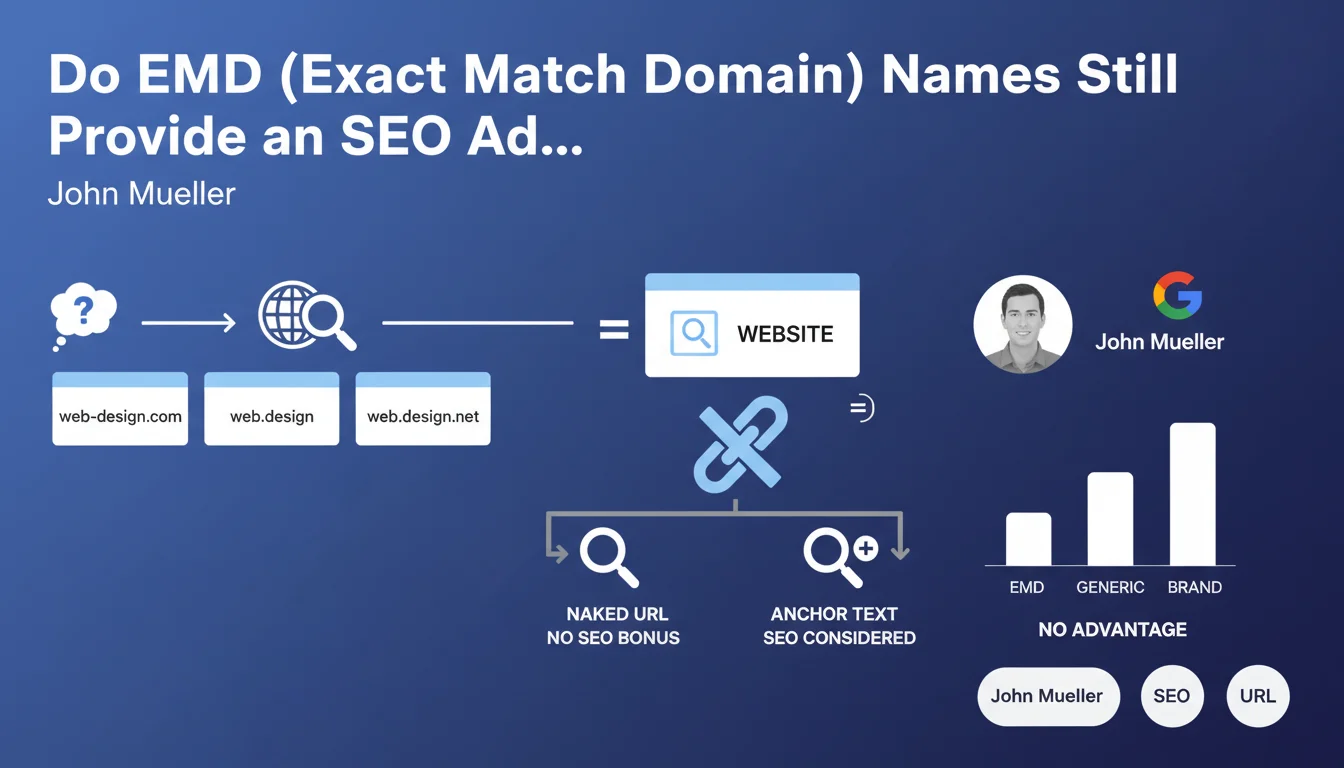
Official statement
What you need to understand
What Exactly Is an EMD and Why Was This Practice So Popular?
An EMD (Exact Match Domain) is a domain name that exactly matches a search query or contains strategic keywords. For example, "running-shoes-paris.com" for a site selling running shoes.
This practice was very widespread because it historically offered a direct SEO advantage. Google gave significant weight to keywords present in the domain name, thus facilitating ranking for those terms.
Why Is Google Questioning This Strategy Today?
Google now considers that overly optimized EMDs can be perceived as spam. The algorithm has evolved to favor authentic brands and sites offering real added value.
Beyond the algorithmic aspect, an EMD poses business sustainability problems. If your business evolves or diversifies, your domain name becomes a strategic prison that limits your development.
What Are the Concrete Risks of Using an EMD Today?
Sites based on EMDs encounter several major obstacles in their development. They face user distrust who associate them with low-quality or opportunistic sites.
From an SEO perspective, these domains are in constant competition without being able to capitalize on brand recognition. They don't benefit from direct brand name searches, a signal increasingly valued by Google.
- Negative perception: EMDs often evoke spam in the eyes of users
- Strategic rigidity: difficult to pivot or expand your offer without changing domains
- Absence of brand equity: impossible to build lasting recognition
- Low quality signal: Google favors established brands in its algorithms
- Reduced click-through rate: users prefer to click on recognized brands
SEO Expert opinion
Is This Position Consistent with Google's Algorithm Evolution?
Absolutely. Since the EMD Update of 2012, Google has been progressively penalizing low-quality exact match domains. This statement is part of a logical continuity where content relevance takes precedence over basic technical signals.
The evolution toward Search Generative Experience and the growing importance of E-E-A-T reinforce this trend. Google now values recognized entities, established brands and sites with a strong identity, not opportunistic domains.
Are There Cases Where an EMD Remains Relevant?
Let's nuance the statement: a moderate and natural EMD is not necessarily problematic. A name like "plumber-toulouse.fr" for a local craftsman remains acceptable if it corresponds to a real business with a physical presence.
The fundamental difference lies in the intention. An EMD serving as a real brand for a legitimate business is very different from a domain created solely to capture SEO traffic. The business context and site quality make all the difference.
What Are the Strategic Alternatives to EMDs?
The best approach is to create a real brand name, even if it's less obvious to position initially. Names like "Backlinko", "Moz" or "Semrush" contain no SEO keywords but have become essential references.
A distinctive brand allows you to build lasting capital, diversify your activity without constraints, and benefit from brand searches. The initial investment in awareness is quickly offset by the flexibility and credibility gained.
Practical impact and recommendations
What Should You Do If You're Launching a New Site Today?
Prioritize creating a unique and memorable brand name rather than an EMD. Think long term: your domain must be able to evolve with your business and reflect a company identity, not just keywords.
If you're targeting a local market, you can include geolocation subtly ("TechCorp Lyon" rather than "computer-repair-lyon.com"). The important thing is to create a recognizable brand that inspires trust.
Should You Migrate an Existing Site Based on an EMD?
The answer depends on several critical factors. If your EMD is already well established with significant traffic and quality backlinks, a migration presents important risks that must be carefully evaluated.
On the other hand, if your site is stagnating, suffering from a negative image or limiting your commercial development, a migration to a real brand can be the catalyst for new growth. Prepare this transition meticulously with an impeccable 301 redirect plan.
- Analyze the current performance of your EMD (traffic, conversions, authority)
- Evaluate the potential impact of a migration on your SEO in the short and medium term
- Create a distinctive brand name that is verifiable and legally protectable
- Develop a branding strategy parallel to your SEO strategy
- If migrating: plan 301 redirects, backlink updates and communication
- Invest in content marketing to build your brand authority
- Monitor brand searches as a success indicator
- For new projects: permanently ban keyword-stuffed EMDs
How Can You Optimize Your Domain Strategy for the Long Term?
Building a strong brand in SEO requires a holistic approach combining relevant domain name, expert content and awareness strategy. This consistency between all elements of your digital presence makes the difference.
Focus on creating brand signals: direct searches, citations, social media mentions, natural editorial backlinks. These indicators have become as important as traditional technical factors.
💬 Comments (0)
Be the first to comment.