
Official statement
Other statements from this video 9 ▾
- □ Do you really need to stack three layers of product data to impress Google?
- □ Why does Google Search Console actually catch errors in your product structured data that other tools miss?
- □ Does Google really want you to display higher prices in your structured data?
- □ Should you really use a site: query to verify your price data is showing up correctly?
- □ Should you really overestimate shipping fees to please Google Shopping?
- □ Does Google really require GTIN, MPN, or brand identifiers to rank your products in search results?
- □ Are strong product identifiers really the key to multi-merchant matching in Google Shopping?
- □ Should you abandon Merchant Center for structured data in e-commerce?
- □ Why settle for Google-only Schema.org when Bing, Yandex and other search engines are already exploiting it?
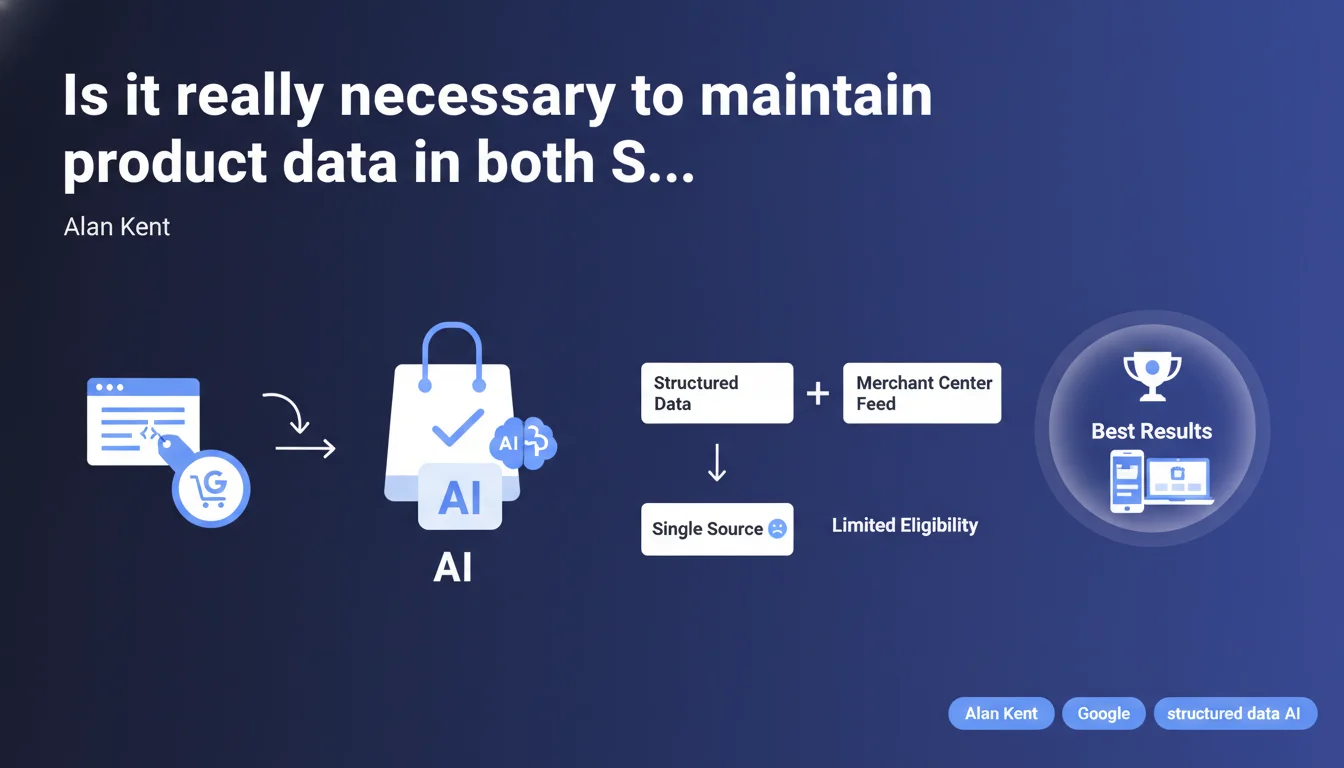
Google states that providing product data through both structured data on your pages and via Merchant Center maximizes eligibility for shopping experiences. This dual data feed is not redundant but complementary according to Google. In practical terms, this means managing two data channels in parallel to optimize e-commerce visibility.
What you need to understand
Why is Google pushing this combined approach?
Google's logic is based on the fact that structured data enriches web pages for organic snippets, while Merchant Center feeds commercial surfaces like Google Shopping, product tabs, and integrated shopping experiences. The two systems don't consume data the same way or at the same time.
The underlying idea: maximize touchpoints. A page with Schema Product markup can land a rich snippet in organic results, while the same product via Merchant Center appears in the Shopping tab. Double exposure potential.
What does Google mean by "better results for eligibility"?
Google deliberately keeps this vague. One interpretation is that certain features explicitly require Merchant Center (Shopping Ads, free product listings), while others rely on on-page structured data (star ratings in SERPs, price previews).
The combined approach prevents you from being excluded from certain experiences due to failing to feed the right channel. It's a form of insurance — but at a cost in terms of maintenance.
Are structured data and Merchant Center really independent?
Yes and no. Google can cross-reference information from both sources to validate their consistency. Flagrant discrepancies (different prices, contradictory availability) can affect the trust Google places in your data.
In practice, both feeds must reflect the same product reality at the same time. This requires technical synchronization between your CMS/PIM and your Merchant Center exports.
- Dual presence recommended: Schema on pages + active Merchant Center feed
- Goal: maximize eligibility for both organic and commercial features
- Consistency critical: data must match between both sources or risk losing trust
- Increased maintenance: two systems to manage and synchronize continuously
SEO Expert opinion
Is this recommendation really new?
No. Google has been suggesting this to e-commerce businesses for years, but Alan Kent's explicit formalization marks a hardening. We're moving from a best practice to an almost-requirement if you aim for maximum shopping visibility.
In the field, sites that only feed one channel — often Merchant Center alone — do indeed see lower performance on enriched organic snippets. On-page structured data remains the lever for star ratings in classic SERP results.
Do all e-commerce businesses really need this dual approach?
Let's be honest: it depends on your visibility strategy. If you're only playing pure organic search and have no interest in Shopping or free product listings, Merchant Center might seem unnecessary. Conversely, a pure Shopping Ads player with no SEO ambitions could skip structured data.
But in 90% of real-world cases, a high-performing e-commerce business must play on both fronts. Neglecting one means leaving visibility on the table. [To verify]: Google has never published quantified data on the performance delta between simple and combined approaches.
What are the risks of not following this recommendation?
The main risk: partial exclusion from certain features. No Merchant Center? No free product listings in the Shopping tab, no Shopping Ads obviously. No Schema Product? No star ratings or prices displayed in classic organic snippets.
However, pay attention — and Google doesn't explicitly say this — some sites have observed that structured data alone may no longer be sufficient for certain product rich results in recent months. The Merchant Center signal could become a hidden eligibility criterion for certain features. [To verify] without official confirmation.
Practical impact and recommendations
What needs to be implemented concretely?
First step: audit your current setup. Check if your product pages already include Schema Product markup (type, name, price, availability, review, etc.). Test with the Google Rich Results Test tool. On the Merchant Center side, ensure your feed is active, validated, and contains required attributes.
Second step: identify gaps. Compare a sample of products between your on-page Schema and your Merchant Center feed. Price, availability, images, and descriptions must match perfectly. Any discrepancy must be corrected at source — ideally in your product management system.
How do you maintain consistency between both channels?
Ideal scenario: a single source of truth (PIM, ERP, or centralized product database) that simultaneously feeds your page templates (for Schema) and your XML/CSV exports (for Merchant Center). This prevents manual desynchronization.
If your tech stack doesn't support this natively, set up regular control scripts. A daily cron job comparing both feeds and alerting on critical discrepancies (price, stock) can save you.
What mistakes must you absolutely avoid?
Mistake #1: Update Merchant Center but forget the Schema on-page during a price change. Result: Google shows one price in organic results and another in Shopping. Immediate loss of credibility.
Mistake #2: Use different data formats (ex: gross price in Schema, net in Merchant Center). Google may reject or lower confidence in your data.
Mistake #3: Neglect optional but valuable attributes (customer reviews, in-store availability, shipping fees). These elements differentiate your snippets from competitors'.
- Verify that all product pages contain valid and complete Schema Product markup
- Ensure the Merchant Center feed is active, validated, and updated daily
- Check consistency of price/stock/images between Schema and Merchant Center
- Implement a single data source feeding both channels
- Set up automatic alerts for detected discrepancies
- Enrich both feeds with optional attributes (reviews, shipping, brand)
- Regularly test eligibility for rich results via Google Search Console
❓ Frequently Asked Questions
Peut-on se contenter uniquement de Merchant Center sans données structurées ?
Google pénalise-t-il les sites qui n'ont que du Schema sans Merchant Center ?
Combien de temps faut-il pour synchroniser les deux flux après une mise à jour produit ?
Que se passe-t-il si Google détecte des incohérences entre Schema et Merchant Center ?
Les marketplaces type Amazon doivent-elles aussi implémenter cette double approche ?
🎥 From the same video 9
Other SEO insights extracted from this same Google Search Central video · published on 17/01/2023
🎥 Watch the full video on YouTube →
💬 Comments (0)
Be the first to comment.