
Official statement
Other statements from this video 9 ▾
- □ Is it really necessary to maintain product data in both Schema and Merchant Center?
- □ Do you really need to stack three layers of product data to impress Google?
- □ Why does Google Search Console actually catch errors in your product structured data that other tools miss?
- □ Does Google really want you to display higher prices in your structured data?
- □ Should you really use a site: query to verify your price data is showing up correctly?
- □ Should you really overestimate shipping fees to please Google Shopping?
- □ Are strong product identifiers really the key to multi-merchant matching in Google Shopping?
- □ Should you abandon Merchant Center for structured data in e-commerce?
- □ Why settle for Google-only Schema.org when Bing, Yandex and other search engines are already exploiting it?
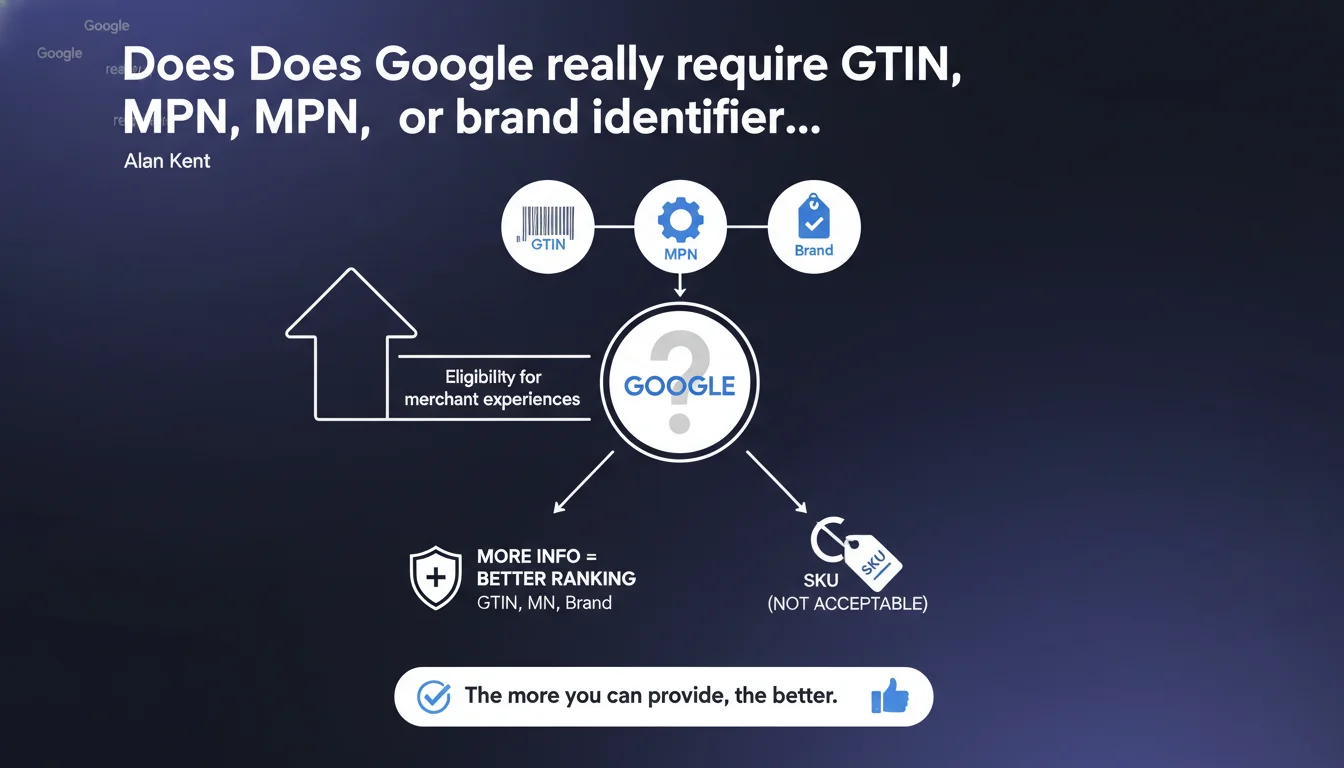
Google now mandates standardized product identifiers (GTIN, MPN, brand) to access merchant features on its search engine. Internal SKUs are not accepted because they vary from one retailer to another. The more standardized identifiers you provide, the better your chances of appearing in e-commerce rich results.
What you need to understand
What exactly are these product identifiers that Google is talking about?
The GTIN (Global Trade Item Number) encompasses international barcodes such as EAN, UPC, or JAN. It's the universal identifier that appears on the packaging of virtually all manufactured products.
The MPN (Manufacturer Part Number) is the reference number assigned by the manufacturer. The brand combined with the product name constitutes a third level of identification, less precise but acceptable to Google.
Why does Google reject internal SKUs?
A SKU is unique to each retailer — Decathlon and Amazon will have completely different SKUs for the same pair of sneakers. Google needs identifiers that allow it to group offers for the same product across all retailers.
Without a standardized identifier, Google cannot understand that three different product listings are actually talking about the same item. The search engine cannot therefore build its merchant experiences: price comparators, product rich snippets, Google Shopping.
What exactly are "merchant experiences"?
This term refers to all enriched displays in search results: product rich results, product carousels, Google Shopping cards, star ratings.
These formats capture a significant portion of clicks on commercial queries. Without correct product identifiers, your listing will never be eligible for these premium placements.
- GTIN, MPN, and brand are the only identifiers accepted by Google
- Internal SKUs don't work because they are not universal
- The more identifiers you provide, the better your eligibility for rich results
- This requirement applies to all Google merchant experiences
SEO Expert opinion
Is this requirement really new or just a reminder?
Google has been recommending GTINs for years in its documentation. The novelty lies in the tone — Alan Kent speaks of identifiers as "required", not simply recommended. In practice, we have observed for several months now that product listings without GTINs no longer have access to rich results.
The change is therefore less technical than semantic: Google is formalizing a practice already applied in its algorithm. Merchants who neglected these identifiers are seeing their search performance drop mechanically.
What happens if my catalog doesn't have GTINs?
Two scenarios — handmade products, vintage items, or products without a universal barcode can legitimately go without a GTIN. Google then accepts the combination of brand + product name, although eligibility for rich results remains uncertain. [To be verified] depending on verticals.
For standard manufactured products, the absence of a GTIN is now a critical disadvantage. Your competitors who properly fill in these identifiers will mechanically capture your qualified traffic.
Does the rule "the more you provide, the better" have a measurable impact?
It's difficult to quantify precisely. Field observations suggest that a product with GTIN + MPN + brand does indeed have a better chance of appearing in rich snippets than a product with only brand + name.
But correlation is not causation — these highly documented products often come from better structured catalogs overall. Google communicates no clear metrics on this point. [To be verified] through A/B testing on homogeneous catalogs.
Practical impact and recommendations
How can I retrieve missing GTINs in my catalog?
First source: your suppliers. Any serious manufacturer has the GTINs for its products. If you're a reseller, demand this data in your supply feeds.
Second option: public databases like GS1 (the organization that assigns barcodes), or catalog enrichment services. Watch out for costs if your catalog has several thousand references.
- Audit your catalog to identify products without standardized identifiers
- Contact your suppliers or manufacturers to obtain official GTINs/MPNs
- Implement the
gtin,mpn, andbrandfields in your schema.org Product - Verify that these identifiers are correctly sent to Google Merchant Center if you use it
- Permanently ban the use of internal SKUs as product identifiers
- Set up automatic validation on your CMS side to block any listing without a GTIN
What should I do if certain products in my catalog legitimately don't have a GTIN?
Handmade products, vintage items, or unique pieces — provide at least the brand (even if it's your own brand) and a descriptive product name. Enhance the schema.org with as many properties as possible (color, material, dimensions).
Google claims these products can access merchant experiences, but eligibility remains unclear. In practice, they are disadvantaged compared to products with complete GTINs.
Should I prioritize updating my Google Shopping feed?
If you use Google Merchant Center, it's definitely the absolute priority. A feed without GTINs now generates massive rejections, with immediate impact on your Shopping campaigns.
But don't neglect schema.org markup on your site — it's what determines access to organic rich snippets, potentially more profitable than paid ads.
❓ Frequently Asked Questions
Un produit sans GTIN peut-il quand même se positionner dans les résultats organiques classiques ?
Peut-on inventer un GTIN si le produit n'en a pas officiellement ?
Le MPN est-il aussi important que le GTIN ?
Cette exigence s'applique-t-elle aussi aux services ou produits dématérialisés ?
Où vérifier que mes GTIN sont correctement pris en compte par Google ?
🎥 From the same video 9
Other SEO insights extracted from this same Google Search Central video · published on 17/01/2023
🎥 Watch the full video on YouTube →
💬 Comments (0)
Be the first to comment.