
Official statement
Other statements from this video 9 ▾
- □ Is it really necessary to maintain product data in both Schema and Merchant Center?
- □ Why does Google Search Console actually catch errors in your product structured data that other tools miss?
- □ Does Google really want you to display higher prices in your structured data?
- □ Should you really use a site: query to verify your price data is showing up correctly?
- □ Should you really overestimate shipping fees to please Google Shopping?
- □ Does Google really require GTIN, MPN, or brand identifiers to rank your products in search results?
- □ Are strong product identifiers really the key to multi-merchant matching in Google Shopping?
- □ Should you abandon Merchant Center for structured data in e-commerce?
- □ Why settle for Google-only Schema.org when Bing, Yandex and other search engines are already exploiting it?
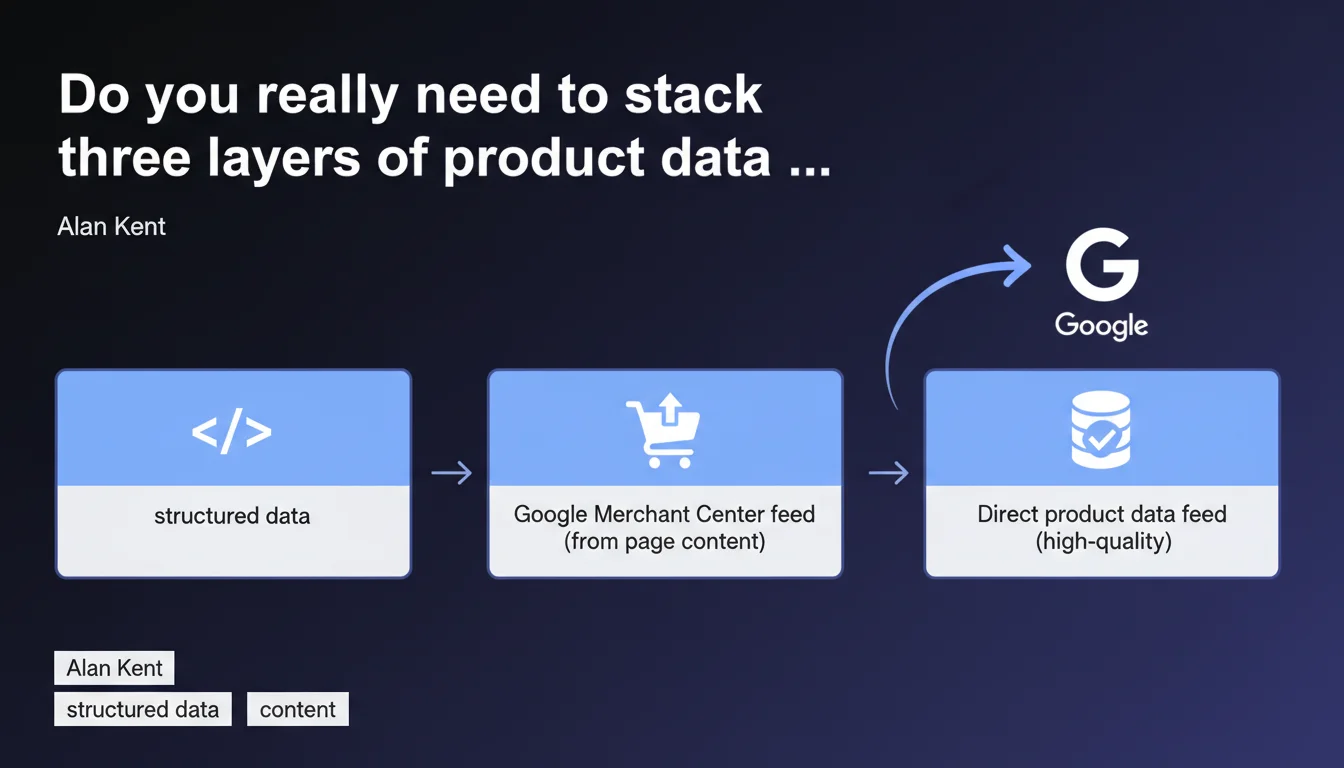
Google recommends a progressive approach to product data: start with structured data on pages, then add an automatic Merchant Center feed that creates a feed from page content, and finally migrate to a high-quality direct product data feed. This strategy aims to facilitate adoption while progressively optimizing the quality of information transmitted to Google Shopping and search merchant features.
What you need to understand
Why does Google impose this three-step progression?
The strategy proposed by Alan Kent is not a technical requirement, but a pedagogical recommendation. The underlying idea: reduce initial friction for merchants who have neither product feeds nor structured export infrastructure.
The automatic Merchant Center feed analyzes the HTML code of pages and extracts structured data (schema.org Product, in particular). It's an intermediate solution that allows you to feed Google Merchant Center without heavy backend development. But it remains limited — Google can only extract what is explicitly marked up, and parsing errors are frequent.
What's the difference between automatic feed and direct feed?
The automatic feed relies on crawling product pages and extracting structured data. Simple to implement, but vulnerable to front-end changes and synchronization issues.
The direct feed (XML file, CSV or Content API) contains raw data from the information system: price, stock, variants, enriched attributes. It's more reliable, more reactive, and above all more complete — you control exactly what is sent, without depending on HTML rendering.
Is this recommendation specific to new merchants?
Yes. For an e-commerce site already running with an ERP or PIM that exports product feeds, going through the "structured data then automatic feed" step adds nothing. You're already at level 3.
This progression is aimed at small merchants or emerging marketplaces that haven't yet set up catalog syndication infrastructure. Google gives them a ramp rather than a technical wall.
- Start with Product schema.org structured data to enrich search results
- Then enable the automatic Merchant Center feed to test Google Shopping without back-office development
- Migrate to a high-quality direct feed as soon as your volume or catalog complexity requires it
- The direct feed remains the final target — the first two steps are temporary crutches
SEO Expert opinion
Is this progressive approach really optimal?
Let's be honest: if you already have a system capable of generating a clean product feed, skip directly to step 3. Structured data on pages remains useful for organic SEO and rich snippets, but the automatic Merchant Center feed is a stopgap, not a sustainable solution.
The risk? That merchants settle into step 2 and never migrate. The automatic feed introduces an opaque parsing layer — Google interprets your HTML, and you have no guarantee that what is extracted corresponds exactly to what you want to transmit. [To verify]: no public data precisely compares error rates between automatic and direct feeds, but field experience shows frequent discrepancies.
Are structured data alone not sufficient for Google Shopping?
No. Structured data (Product, Offer, AggregateRating) improves display in organic results — stars, price, availability. But Google Merchant Center requires a separate feed to power Shopping ads, free listings, and advanced merchant features.
Concretely, you can have perfect schema.org Product markup and no visibility in the Shopping tab if you haven't configured Merchant Center. The two systems are complementary, not interchangeable.
When should you switch from automatic feed to direct feed?
As soon as one of these signals appears: your catalog exceeds 1,000 items, you manage complex variants (size, color, material), you need to synchronize stock in real time, or you notice recurring errors in Merchant Center due to approximate HTML extraction.
The direct feed gives you complete control — custom attributes, fine categorization, promotion management. The automatic feed remains a quick-start tool, not a long-term strategy.
Practical impact and recommendations
What specifically should you do to implement this strategy?
Step 1: Structured data on product pages. Add schema.org Product markup with essential properties: name, image, description, sku, brand, offers (price, priceCurrency, availability), aggregateRating if you have reviews. Test with Google's Rich Results Test.
Step 2: Automatic Merchant Center feed. In Google Merchant Center, create an automatic feed by providing the URL of your product sitemap. Google will crawl your pages and extract structured data. Monitor errors in the Diagnostics tab — extraction issues are common.
Step 3: Migration to direct feed. Export your catalog from your database or PIM in XML (RSS 2.0) or CSV format. Send it via SFTP, Google Sheets, or the Content API. You now control each attribute and each update.
What errors should you absolutely avoid?
Don't duplicate effort. If you already have an operational direct feed, adding a parallel automatic feed creates data conflicts in Merchant Center. Google no longer knows which source to prioritize.
Don't neglect the quality of initial structured data. Poorly formatted schema.org will make the automatic feed unusable — garbage in, garbage out. Validate each product page template before activating automatic extraction.
Don't get stuck at step 2. The automatic feed is a springboard, not a destination. Plan your migration to a direct feed from the start, especially if your catalog evolves quickly.
How do you verify that your implementation is correct?
- Validate your structured data with the Rich Results Test and Search Console (Enhancements > Product report)
- Verify in Merchant Center that the automatic feed correctly surfaces all your products without critical errors
- Compare extracted data (automatic feed) with your source data — price, stock, images
- Test synchronization: change a price on the site and verify the update delay in Merchant Center
- Monitor product disapprovals in the Diagnostics tab (GTIN errors, price mismatch, landing page issues)
- Plan migration to direct feed as soon as your volume exceeds 500 items or extraction errors become recurring
❓ Frequently Asked Questions
Peut-on utiliser uniquement les données structurées sans passer par Merchant Center ?
Le flux automatique Merchant Center consomme-t-il du crawl budget ?
Faut-il maintenir les données structurées si on utilise un flux direct ?
Peut-on combiner flux automatique et flux direct dans Merchant Center ?
Quel format de flux direct Google recommande-t-il ?
🎥 From the same video 9
Other SEO insights extracted from this same Google Search Central video · published on 17/01/2023
🎥 Watch the full video on YouTube →
💬 Comments (0)
Be the first to comment.