
Official statement
Other statements from this video 9 ▾
- □ Faut-il vraiment doubler les données produits entre Schema et Merchant Center ?
- □ Faut-il vraiment empiler trois couches de données produits pour plaire à Google ?
- □ Comment la Search Console détecte-t-elle réellement les erreurs dans vos données structurées produits ?
- □ Pourquoi Google veut-il que vous affichiez des prix plus élevés dans vos données structurées ?
- □ Faut-il vraiment utiliser une requête site: pour vérifier vos données de prix ?
- □ Faut-il vraiment surestimer les frais de port pour plaire à Google Shopping ?
- □ Pourquoi Google exige-t-il des identifiants produits GTIN, MPN ou marque pour le référencement marchand ?
- □ Les identifiants produits sont-ils vraiment la clé du matching multi-marchands dans Google Shopping ?
- □ Pourquoi limiter Schema.org à Google alors que d'autres moteurs l'exploitent déjà ?
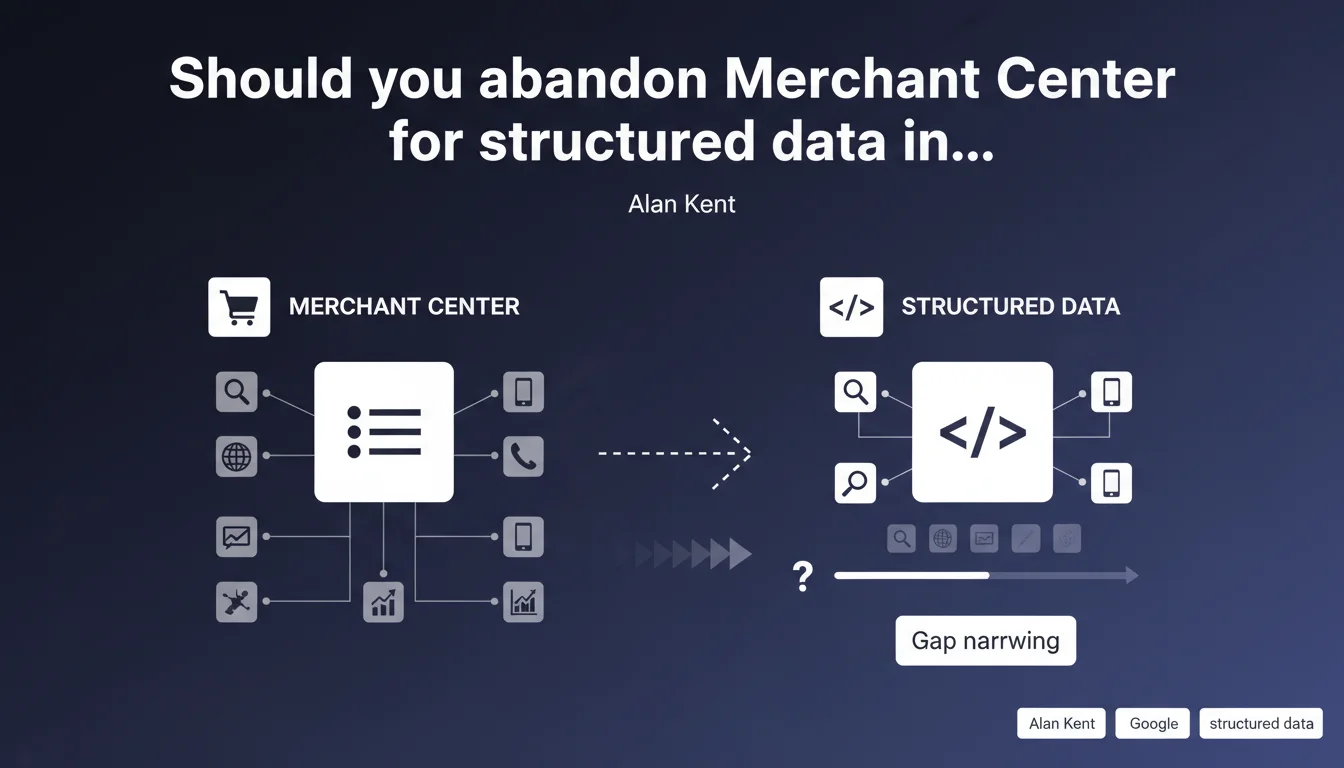
Google confirms that the functional gap between structured data and Merchant Center feeds is progressively narrowing. New capabilities are being added to structured data, but the feed remains more comprehensive for now. E-commerce businesses should monitor this evolution without rushing into migration.
What you need to understand
What's the current difference between structured data and Merchant Center?
The Google Merchant Center feed remains today the most complete tool for distributing your products across Google Shopping results, dynamic ads, and certain organic enhancements. It supports advanced attributes: promotions, store availability, variable shipping costs, multiple product identifiers.
The Product structured data (Schema.org) allows you to display rich snippets in organic results — price, availability, reviews — but doesn't cover all the commercial functionalities of the feed. Concretely? No native management of complex product variants, no support for time-limited promotions, no automatic synchronization of multi-channel inventory.
Why is Google investing in e-commerce structured data?
The objective is clear: standardize product data sources to simplify the merchant ecosystem. A site that correctly implements Schema.org Product should, eventually, no longer need a separate XML feed to be eligible for Shopping functionalities.
This fits into the semantic web logic: rather than maintaining two parallel systems (on-page markup + external feed), Google is pushing towards a single source of truth directly in the HTML code. Less technical friction, less desynchronization between what's displayed and what's declared.
Concretely, what new capabilities have been added recently?
Google has progressively enriched the properties supported in Product: shippingDetails for shipping costs, hasMerchantReturnPolicy for return conditions, sku and gtin for product identifiers. Support for ProductGroup and OfferShippingDetails improves variant management.
- Product reviews (AggregateRating) are better exploited in organic SERPs
- The availability property now displays more granular statuses (PreOrder, BackOrder)
- The MerchantReturnPolicy markup is becoming eligible for enhanced display in certain countries
- Google is testing the display of shipping estimates directly in organic snippets
SEO Expert opinion
Is this convergence really happening or just marketing talk?
Let's be honest: the evolution is real but very gradual. Yes, Google regularly adds new Schema.org properties. Yes, some clients observe richer rich snippets with Product than two years ago. But the functional gap remains significant.
Field tests show that Merchant Center remains essential to access paid and free Shopping surfaces (Free Listings). A site with only structured data, without a GMC feed, won't appear in the Shopping tab or mobile product carousels — except in rare cases on certain niche categories. [To be verified] on the exact scope of affected categories, Google publishes no clear documentation.
What risks are there in betting only on structured data?
Abandoning Merchant Center today would be premature. GMC feeds offer geographic targeting granularity (shipping, taxes) that Schema.org cannot yet handle natively. You would also lose access to e-commerce Performance Max campaigns and product competitiveness reports.
The real danger? Believing that implementing Product Schema is enough to be visible in Shopping. It simply isn't the case in practice — I've seen perfectly marked-up sites remain invisible in Shopping due to lack of an active feed.
In what cases should you prioritize one approach over the other?
If your catalog contains fewer than 100 products and you're targeting only organic rich snippets, Product Schema may suffice. But once you have hundreds of references, complex variants, or want to distribute on Shopping, the GMC feed becomes mandatory.
The real strategic question: should you invest now in exhaustive Product markup if Merchant Center remains necessary? Yes, because the two systems complement each other rather than substitute for one another. Google crosses data — a well-marked product with Schema.org reviews + a complete GMC feed will perform better than a feed alone.
Practical impact and recommendations
What should you do concretely on your e-commerce site?
Implement complete Product Schema.org markup on all your product pages — price, availability, sku, gtin, image, reviews. Don't settle for the bare minimum. The more you enrich, the more you increase your chances of future rich displays.
Maintain in parallel an up-to-date Merchant Center feed with all required and relevant optional data for your sector. Automate synchronization between your product database, your on-page markup, and your XML feed — any desynchronization degrades performance.
What mistakes should you avoid in this transition?
Don't unnecessarily duplicate data. If you send reviews via a feed and mark them up in Schema.org, make sure the numbers match exactly — Google detects inconsistencies and may disable star display.
Avoid over-marking. A product with 15 color variants shouldn't generate 15 distinct Product tags without coherent ProductGroup structure. This creates semantic noise and dilutes signals.
- Verify that each product has a unique identifier (sku or gtin) consistent between Schema.org and GMC
- Test rich snippet display with Google's Rich Results Test tool
- Monitor Merchant Center reports for product disapprovals linked to missing data
- Implement MerchantReturnPolicy and shippingDetails if eligible in your country
- Automate price and inventory updates to avoid gaps between site and feed
- Monitor organic performance before/after markup enrichment
How can you anticipate this convergence without losing visibility?
Adopt an evolvable hybrid strategy. Invest in robust Schema.org markup now, without deactivating Merchant Center. Progressively test new structured properties as they become available.
Document your observations: which enrichments trigger which displays in your sector? This allows you to adjust quickly when Google extends structured data capabilities.
❓ Frequently Asked Questions
Puis-je supprimer mon flux Merchant Center si mes données structurées sont parfaites ?
Les données structurées Product améliorent-elles directement le classement organique ?
Quelles propriétés Schema.org Product sont prioritaires à implémenter ?
Google croise-t-il automatiquement données structurées et flux Merchant Center ?
Faut-il baliser les variantes produits individuellement en Schema.org ?
🎥 From the same video 9
Other SEO insights extracted from this same Google Search Central video · published on 17/01/2023
🎥 Watch the full video on YouTube →
💬 Comments (0)
Be the first to comment.