
Official statement
Other statements from this video 9 ▾
- □ Faut-il vraiment doubler les données produits entre Schema et Merchant Center ?
- □ Faut-il vraiment empiler trois couches de données produits pour plaire à Google ?
- □ Comment la Search Console détecte-t-elle réellement les erreurs dans vos données structurées produits ?
- □ Faut-il vraiment utiliser une requête site: pour vérifier vos données de prix ?
- □ Faut-il vraiment surestimer les frais de port pour plaire à Google Shopping ?
- □ Pourquoi Google exige-t-il des identifiants produits GTIN, MPN ou marque pour le référencement marchand ?
- □ Les identifiants produits sont-ils vraiment la clé du matching multi-marchands dans Google Shopping ?
- □ Faut-il abandonner Merchant Center au profit des données structurées pour le e-commerce ?
- □ Pourquoi limiter Schema.org à Google alors que d'autres moteurs l'exploitent déjà ?
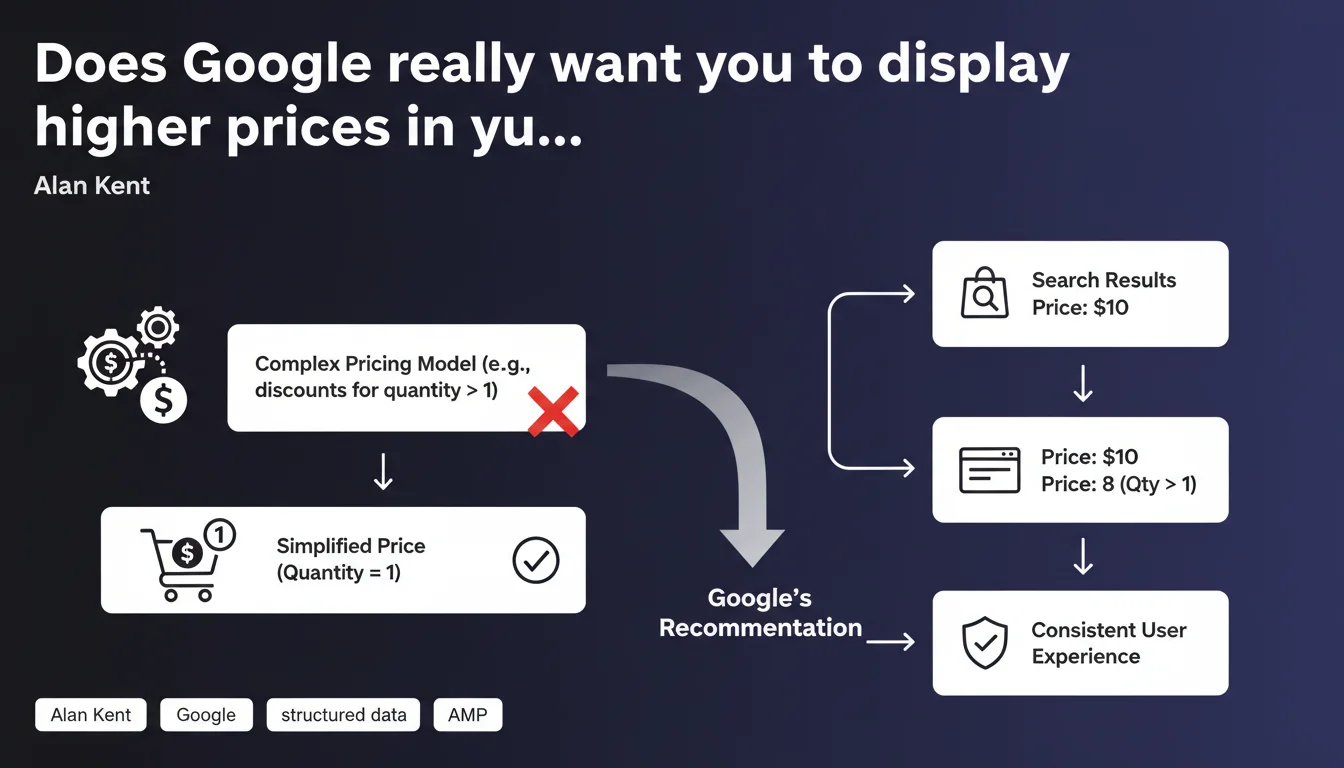
Google requires simplifying price data in rich snippets, even if it means showing a higher price than what the user will actually pay. The goal: prevent the visitor from discovering a different price upon landing on the site, which erodes trust and increases bounce rate. In concrete terms, if you sell with quantity discounts or complex pricing models, display the base unit price in your structured data.
What you need to understand
What problem is Google trying to solve?
The search engine wants to eliminate price discrepancies between what a user sees in the SERPs and what they find when landing on the page. These discrepancies create frustration, degrade user experience and — crucially — increase bounce rate.
When an internet user clicks on a result showing €45 and discovers that this price is only valid from 10 units purchased, they leave. Google records this negative signal. And that's where it gets tricky for your site.
Which pricing models are affected?
Google doesn't detail exhaustively what it considers "complex", but we can identify a few obvious cases: tiered pricing (unit price that decreases according to quantity), quote-based pricing, prices varying by options or configurations, freemium models with multiple add-ons.
The problem arises as soon as the price displayed in structured data doesn't match the price immediately visible on the landing page for a standard transaction. If the user has to click, configure, or understand a system of pricing tiers to access the advertised price, it's too complex for Google.
What does this statement really say about Google's strategy?
Alan Kent doesn't hide it: Google prioritizes short-term trust over merchant commercial optimization. Even if displaying your best price (the one from 100 units) could generate more clicks, Google prefers you show the base price — even if it's less attractive.
The underlying philosophy: better fewer clicks but better post-click satisfaction. It's consistent with Google's obsession with user engagement metrics as quality signals.
- Display the base unit price in structured data, even if it's not competitive
- Avoid any discrepancy between the price in SERPs and the price immediately visible on the product page
- Simplify pricing schemas not natively supported by Google rather than trying to force them
- Accept that trust takes priority over click-through rate optimization
SEO Expert opinion
Is this directive really applicable to all sectors?
Let's be honest: this recommendation creates difficulties for B2B sites with complex pricing, multi-vendor marketplaces, and any e-commerce relying on dynamic pricing models. Google asks you to simplify, but for certain sectors, the "base" unit price makes no commercial sense.
In SaaS, for example, displaying only the basic plan can be misleading if 80% of customers subscribe to the mid-tier plan. In industrial B2B, the unit price for 1 piece sometimes doesn't even exist — the MOQ is 50 or 100. [To verify]: Google has never clarified how to handle these edge cases.
Is the risk of competitive disadvantage real?
Yes, and that's the paradox of this directive. If you sell at €10 per unit but €7 from 10 units, and you display €10 in your structured data while your competitor displays €7 (by cheating or because they have a simpler model), you lose in competitive visibility.
But — and this is where Alan Kent's analysis holds up — if your competitor displays €7 and the user discovers it's only from 10 units, Google will gradually degrade that result. Is the game worth the candle in the long term? Probably not.
Should you sacrifice rich snippets if the model is too complex?
In some cases, yes. If your pricing model is fundamentally incompatible with what Google supports, forcing approximate structured data does more harm than good. Better to display no price than a price that generates confusion and bounce-backs.
I've seen e-commerce sites completely remove the "offers" markup on certain categories after noticing that the price discrepancy created a 70%+ bounce rate from Google Shopping. Result: less traffic, but better conversion rate and — hypothesis — fewer negative signals sent to Google.
Practical impact and recommendations
What should you audit as a priority on your site?
Start by systematically comparing the prices displayed in your structured data with what the user actually sees when landing on the page. Use a tool like Google's rich results test, but above all do the user journey yourself: search for your products, click, and note any discrepancies.
Pay special attention to products with variations (sizes, colors, configurations). If the price in the markup corresponds to the cheapest variant but it's not selected by default or clearly visible, you have a problem.
How to adjust your structured data without losing performance?
If you have quantity-based discounts, display the price for quantity = 1 in the schema.org, even if it's not your most attractive price. Then add the pricing tiers directly on the product page, visibly, so the user immediately understands the model.
For truly complex models (quote-based pricing, multi-step configurators), consider completely removing the "price" property and keeping only "availability" and "itemCondition". You lose the price rich snippet, but you avoid negative signals.
What mistakes must you absolutely avoid?
- Never display in structured data a promotional price that requires a promo code or user action to be activated
- Don't use the "from" price if that price corresponds to a non-standard or rarely sold configuration
- Avoid displaying a net price in structured data if your site displays gross price by default (or vice versa)
- Don't force a single price if your product has variants with significant price differences (>15%)
- Verify that the currency in the markup matches the one displayed on the page
In summary: Google is asking you to choose between optimal visibility and strict consistency. The right strategy depends on your business model, but when in doubt, always prioritize transparency — even if it means displaying a less attractive price.
These structured data adjustments may seem simple in theory, but their implementation across catalogs of several thousand products, with legacy pricing systems and dynamic feeds, often proves complex. If your e-commerce infrastructure relies on sophisticated business logic rules, guidance from a specialized SEO agency can save you months and prevent costly mistakes in terms of user signals.
❓ Frequently Asked Questions
Dois-je afficher le prix TTC ou HT dans mes données structurées ?
Que faire si mon prix varie selon la géolocalisation de l'utilisateur ?
Les prix barrés (avant/après promo) sont-ils concernés par cette directive ?
Si je retire les données de prix, est-ce que je perds mes rich snippets produit ?
Google pénalise-t-il activement les sites avec des écarts de prix ?
🎥 From the same video 9
Other SEO insights extracted from this same Google Search Central video · published on 17/01/2023
🎥 Watch the full video on YouTube →
💬 Comments (0)
Be the first to comment.