
Official statement
Other statements from this video 14 ▾
- □ Does Google really ignore links coming from penalized sites?
- □ Does Google really ignore spam links automatically without any action needed?
- □ Should you really use Google's link disavow tool, or is it just wasting your time?
- □ Does your choice of CMS and programming language really impact your SEO?
- □ Do keywords in URLs really matter for SEO rankings?
- □ Does image URL depth really prevent Googlebot from crawling your images?
- □ Are your Search Console metrics really showing what's actually happening to your site in Google search results?
- □ Should you abandon dynamic rendering for SEO?
- □ Do you really need to optimize image file names for SEO?
- □ Does Google really render EVERY successfully crawled page with JavaScript?
- □ Does invalid schema markup really hurt your search rankings?
- □ Should you really worry about the difference between 301 and 302 redirects anymore?
- □ Does extended boilerplate content really hurt your SEO rankings?
- □ Can a domain migration really happen without losing your SEO rankings?
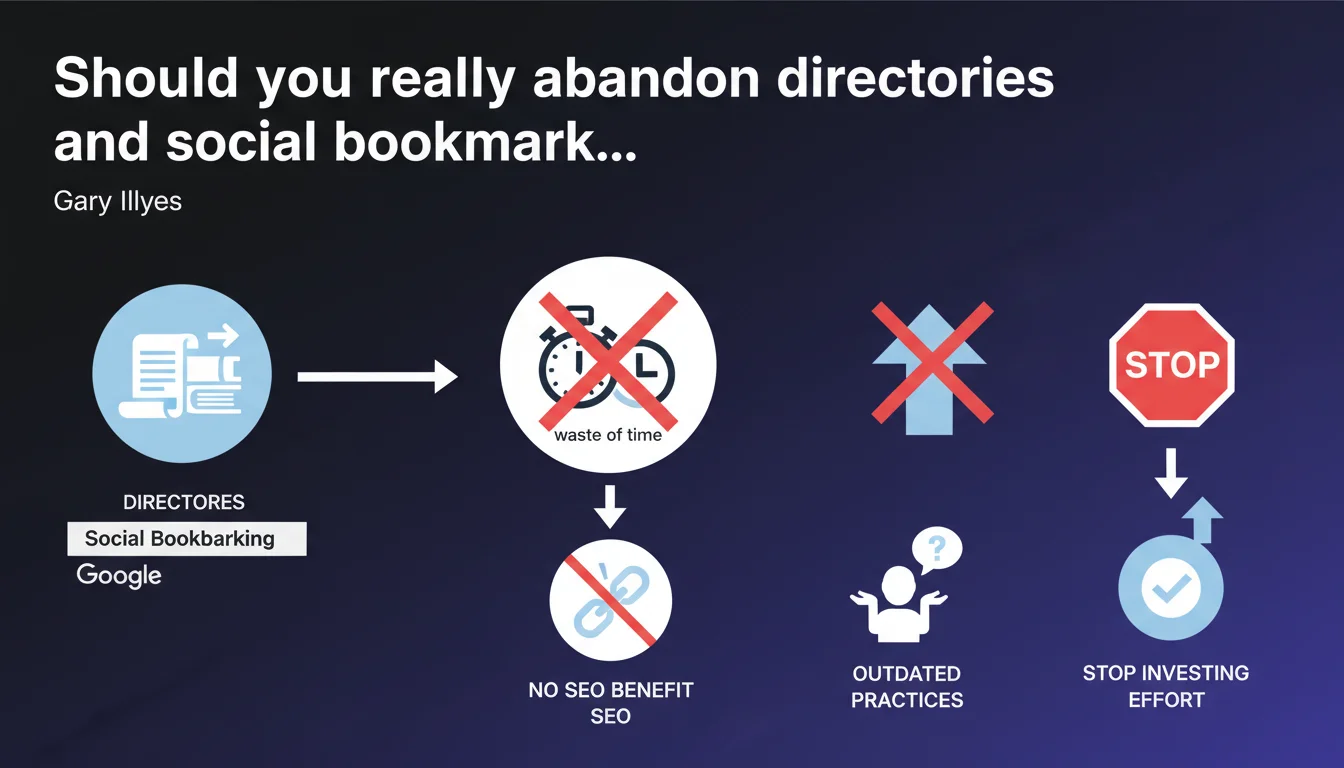
Google explicitly states that directory submissions and social bookmarking sites are a waste of time for SEO. These once-popular practices no longer deliver any measurable SEO value and should be removed from your link-building strategy.
What you need to understand
Why does Google so firmly condemn these practices?
Directories and bookmarking sites were long used as easy sources of backlinks. In the 2000s, these platforms allowed you to quickly build massive quantities of inbound links. The problem? This ease of access generated massive web pollution with low-quality links.
Google progressively refined its algorithms to detect and neutralize these artificial schemes. Today, the vast majority of these links are either completely ignored or flagged as potential spam. Investing time in these submissions is like building on sand.
What exactly does Google mean by "directories" and "social bookmarking"?
We're talking about generalist directories that list websites by category (like the old DMOZ), as well as bookmarking platforms such as Digg, StumbleUpon, or their current equivalents. These sites offer manual or automated submissions, often for a fee.
The distinction matters — Gary Illyes isn't targeting specialized professional directories in niche sectors, which may still have contextual relevance. But let's be honest: even these have largely lost their direct SEO impact.
Is this position really new?
Not at all. Google has been hammering home this message since at least 2012-2013, but old habits persist. Many SEOs continue these practices out of habit or ignorance, or because their clients demand it.
Illyes' statement simply clarifies unambiguously a position that the algorithm has held for years. The message: stop wasting your resources.
- Generalist directories and bookmarking sites deliver zero measurable SEO benefit
- Google has been detecting and neutralizing these link schemes for over a decade
- The ease of obtaining a link is inversely proportional to its value
- Resources invested in these submissions are better used elsewhere
- Some highly specialized niche directories may have indirect value (traffic, brand awareness) but not direct SEO impact
SEO Expert opinion
Is this statement consistent with real-world observations?
Absolutely. Testing we've conducted over many years shows that links from generalist directories have zero impact on rankings. Worse: in some cases, a backlink profile saturated with these sources can be a negative signal for Google.
The real debate centers on ultra-specialized niche directories. Could a healthcare website listed in a recognized professional directory in the health sector benefit from it? Perhaps, but it will never be a direct ranking factor — more of a marginal contextual trust signal.
Where's the line between a "useless" directory and a legitimate citation?
That's where things get murky. Google doesn't provide clear criteria to distinguish a spam directory from a citation in a legitimate professional repository. The empirical rule: if the site exists primarily to list other websites, it's a directory. If it's a value-added resource that occasionally includes references, that's different.
In practice? A Google Business Profile, a Yellow Pages listing, a mention on a recognized industry portal — these have value for local or sector visibility, but their direct SEO impact remains negligible. [To verify] the extent to which Google weights these sources differently based on their thematic authority.
Is social bookmarking really dead for SEO?
For direct ranking purposes, absolutely without question. Platforms like Reddit, Pinterest, or even LinkedIn use nofollow or UGC tags that don't pass PageRank. Their value lies elsewhere: traffic generation, content amplification, indirect social signals.
And that's where Google's position can cause confusion. These platforms can indirectly influence SEO through increased brand awareness, branded searches, and improved CTR in SERPs. But this isn't traditional link building — it's a second-order effect that Google doesn't count as such.
Practical impact and recommendations
What should you concretely do with existing directory submissions?
If you've heavily submitted your website to directories in the past, don't panic. Google simply ignores these links — they generally won't actively penalize you. The effort to disavow them usually isn't worth it.
However, stop immediately any new submissions to these platforms. Reallocate that time to strategies that actually work: expert content creation, digital PR, partnerships with authoritative sites in your sector.
How should you redirect your link-building strategy?
Focus on acquiring natural editorial links from relevant content. This means expert contributions, link-baiting through original resources (studies, tools, reference guides), or targeted digital PR campaigns.
The only submissions that remain relevant are those that deliver direct business value: Google Business Profile, listings on recognized sector comparison sites, selective professional directories. But never do it for the link — do it for visibility and qualified traffic.
How do you audit your current backlink profile?
Use Google Search Console and tools like Ahrefs or Majestic to identify the proportion of directory links in your profile. If it exceeds 20-30%, that's a red flag: your link-building strategy lacks qualitative diversity.
Prioritize acquiring links from natural editorial contexts: blog articles, resource pages, mentions in specialized press. The quality-to-quantity ratio should heavily favor quality.
- Stop immediately any new submissions to generalist directories and bookmarking sites
- Audit your backlink profile to identify the proportion of directory links
- Disavow these links only if they come from manifestly spammy sources
- Reallocate resources toward expert content strategies and digital PR
- Keep only inscriptions with direct business value (GMB, recognized comparators)
- Document your new backlink sources to measure their real impact
- Train your teams or clients on the evolution of modern link-building practices
❓ Frequently Asked Questions
Les annuaires locaux comme Pages Jaunes ont-ils encore une utilité ?
Dois-je désavouer tous mes liens d'annuaires existants ?
Partager du contenu sur Reddit ou LinkedIn a-t-il un impact SEO ?
Certains annuaires de niche très spécialisés peuvent-ils encore avoir de la valeur ?
Comment remplacer efficacement ces pratiques obsolètes ?
🎥 From the same video 14
Other SEO insights extracted from this same Google Search Central video · published on 04/05/2023
🎥 Watch the full video on YouTube →
💬 Comments (0)
Be the first to comment.