
Official statement
Other statements from this video 14 ▾
- □ Les liens sortants de sites pénalisés sont-ils vraiment ignorés par Google ?
- □ Faut-il abandonner définitivement les annuaires et le bookmarking social pour son SEO ?
- □ Google ignore-t-il vraiment les liens spam automatiquement ?
- □ Faut-il vraiment utiliser l'outil de désaveu de liens Google ou simplement les ignorer ?
- □ Le choix de votre CMS et du langage de programmation affecte-t-il vraiment votre SEO ?
- □ Les mots-clés dans les URL ont-ils vraiment un impact sur le référencement ?
- □ La profondeur de l'URL des images bloque-t-elle vraiment le crawl de Googlebot ?
- □ Les données Search Console reflètent-elles vraiment ce que voient vos utilisateurs ?
- □ Faut-il abandonner le dynamic rendering pour le SEO ?
- □ Faut-il vraiment optimiser les noms de fichiers images pour le SEO ?
- □ Googlebot rend-il vraiment TOUTES les pages crawlées avec succès ?
- □ Faut-il vraiment se préoccuper de la différence entre redirections 301 et 302 ?
- □ Le contenu boilerplate étendu pénalise-t-il vraiment votre référencement ?
- □ Un changement de domaine peut-il vraiment se faire sans perte de trafic SEO ?
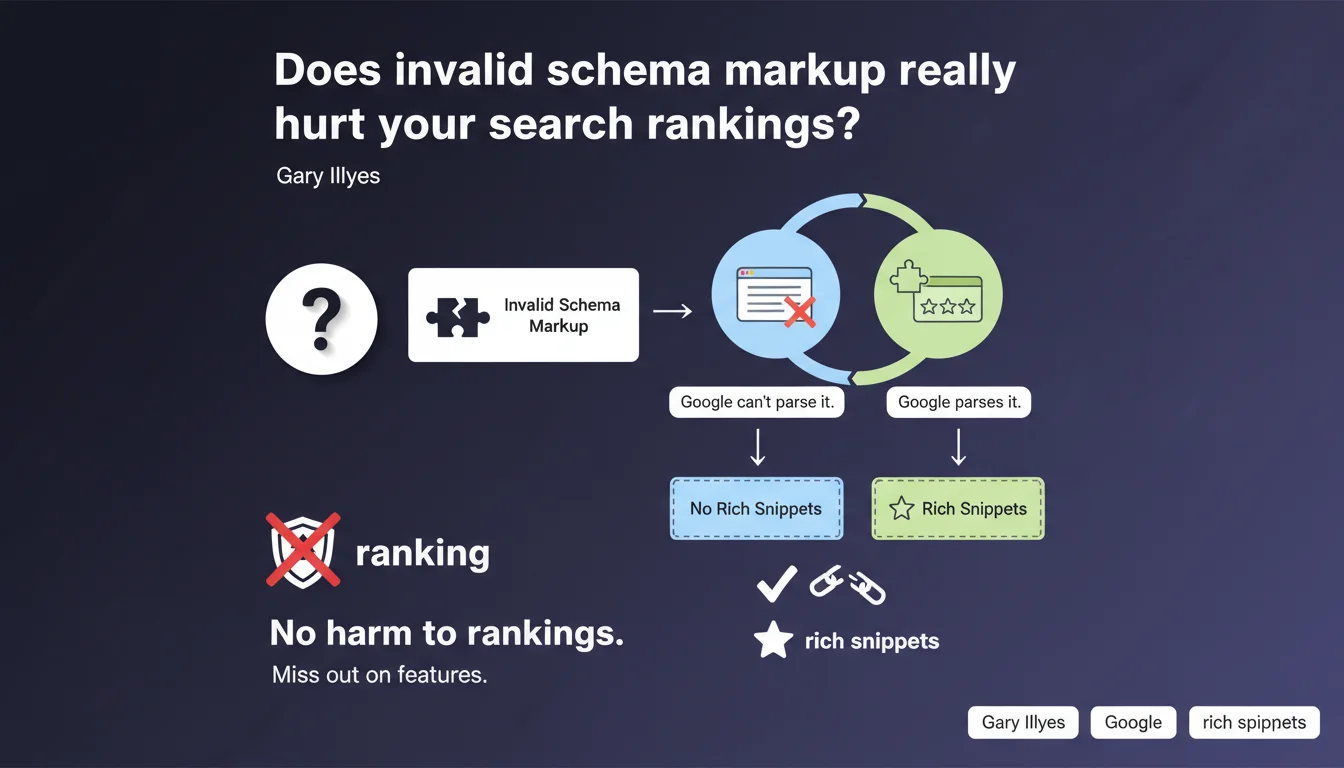
Google states that invalid schema markup doesn't penalize your site — it's simply ignored. You miss out on the opportunity to display rich snippets, but there's no negative impact on ranking. The real risk? Missing visibility levers without even knowing it.
What you need to understand
Gary Illyes puts an end to a persistent misconception: poorly implemented schema markup doesn't harm your rankings. Google simply can't parse it, so it ignores it.
What changes the game is that many SEOs hesitate to test advanced implementations for fear of creating penalizing errors. This statement removes that psychological barrier.
What exactly does Google do with invalid schema?
When markup contains syntax or structural errors, Google's robots attempt to parse it. If they fail, they simply abandon that portion of code.
No algorithmic penalty results from this situation. Your site continues to be crawled, indexed, and ranked normally. The only consequence: you don't benefit from the enriched search features that the schema could have triggered.
Why is this distinction between "invalid" and "harmful" so important?
The nuance is critical for prioritizing your technical projects. Broken schema isn't an urgent matter like a 500 error or massive duplicate content.
On the other hand, it's a missed opportunity. You're leaving zero-position snippets, product cards, or enriched FAQs to your competitors when your content could deserve them.
- Invalid schema triggers no algorithmic penalty
- Google simply ignores code it cannot parse
- You lose access to rich snippets and advanced SERP features
- The error doesn't affect crawling, indexation, or standard organic ranking
- Search Console reports these errors without impacting your overall SEO "health"
SEO Expert opinion
Is this statement consistent with real-world observations?
Yes, and it's even confirmed by years of testing. I've seen sites with completely broken schemas maintain their positions without notable variation. The only measurable impact: the absence of visual features in SERPs.
What's less clear — and what Gary doesn't specify — is the tolerance threshold. Completely invalid schema gets ignored, fine. But what about partially valid schema with missing or incorrectly typed properties? [To be verified] whether Google exploits the correct parts anyway or rejects the whole thing.
What nuances should be added to this statement?
Let's be honest: saying "it's not harmful" doesn't mean "it's not serious". Not having rich snippets in a sector where 70% of competitors have them is a direct CTR loss. So yes, technically no penalty. But economically? It's a real handicap.
Another point Gary sidesteps: structured data spam errors. If you intentionally implement misleading markup (fake reviews, false pricing), Google can intervene manually. That's no longer technical invalidity, it's manipulation — and that's sanctionable.
In what cases might this rule not fully apply?
There's a gray area with mandatory structured data for certain content types. For example, Google News or Google Shopping have strict requirements. A product without valid schema might never appear in these feeds, even if the site remains indexed normally.
And that's where it gets tricky. Technically, Google doesn't "penalize" the site. But if your business model relies on Google Shopping and your feed gets rejected due to invalid schemas, the impact is as severe as a standard penalty.
Practical impact and recommendations
What should you concretely do with this information?
First, audit your existing schemas via Search Console and Google's Rich Results Test. Identify errors, but don't treat them all with the same urgency.
Prioritize pages with high traffic potential where a rich snippet could make a difference. A mismarked flagship product page? Fix immediately. An old buried article? Secondary.
Which errors should you absolutely avoid?
Don't fall into the "all or nothing" trap. Some SEOs abandon schema markup entirely after spotting errors. That's exactly the opposite of what you should do.
Another common mistake: copying schemas found on forums without validation. Always use the official Schema.org validator and Google's version — they don't test the exact same things.
- Audit your schemas via Search Console ("Enhancements" section)
- Use Google's Rich Results Test to validate page by page
- Prioritize fixes on strategic pages (conversions, high traffic)
- Test implementations in staging before production deployment
- Document schema types used and their mapping to your templates
- Set up monitoring to detect regressions after CMS updates
- Don't overlook "secondary" schemas (Breadcrumb, Organization) that structure your entity
Invalid schema markup doesn't penalize, but it deprives you of essential visibility levers. The stakes aren't about avoiding a penalty, but about maximizing your presence in enriched SERPs.
Concretely? Audit, prioritize, fix. And most importantly, don't let the fear of errors prevent you from testing advanced implementations. This type of optimization requires pointed technical expertise and regular monitoring — if your internal resources are limited or you manage a complex product catalog, partnering with a specialized SEO agency can help you avoid missing critical opportunities while securing your implementations.
❓ Frequently Asked Questions
Un schema invalide peut-il empêcher l'indexation de ma page ?
La Search Console signale des erreurs de schema : dois-je les corriger en urgence ?
Vaut-il mieux ne pas avoir de schema du tout plutôt qu'un schema invalide ?
Google peut-il sanctionner un schema techniquement valide mais trompeur ?
Dois-je implémenter tous les types de schema possibles sur mes pages ?
🎥 From the same video 14
Other SEO insights extracted from this same Google Search Central video · published on 04/05/2023
🎥 Watch the full video on YouTube →
💬 Comments (0)
Be the first to comment.