
Official statement
Other statements from this video 14 ▾
- □ Les liens sortants de sites pénalisés sont-ils vraiment ignorés par Google ?
- □ Faut-il abandonner définitivement les annuaires et le bookmarking social pour son SEO ?
- □ Google ignore-t-il vraiment les liens spam automatiquement ?
- □ Faut-il vraiment utiliser l'outil de désaveu de liens Google ou simplement les ignorer ?
- □ Le choix de votre CMS et du langage de programmation affecte-t-il vraiment votre SEO ?
- □ La profondeur de l'URL des images bloque-t-elle vraiment le crawl de Googlebot ?
- □ Les données Search Console reflètent-elles vraiment ce que voient vos utilisateurs ?
- □ Faut-il abandonner le dynamic rendering pour le SEO ?
- □ Faut-il vraiment optimiser les noms de fichiers images pour le SEO ?
- □ Googlebot rend-il vraiment TOUTES les pages crawlées avec succès ?
- □ Le schema markup invalide pénalise-t-il vraiment votre référencement ?
- □ Faut-il vraiment se préoccuper de la différence entre redirections 301 et 302 ?
- □ Le contenu boilerplate étendu pénalise-t-il vraiment votre référencement ?
- □ Un changement de domaine peut-il vraiment se faire sans perte de trafic SEO ?
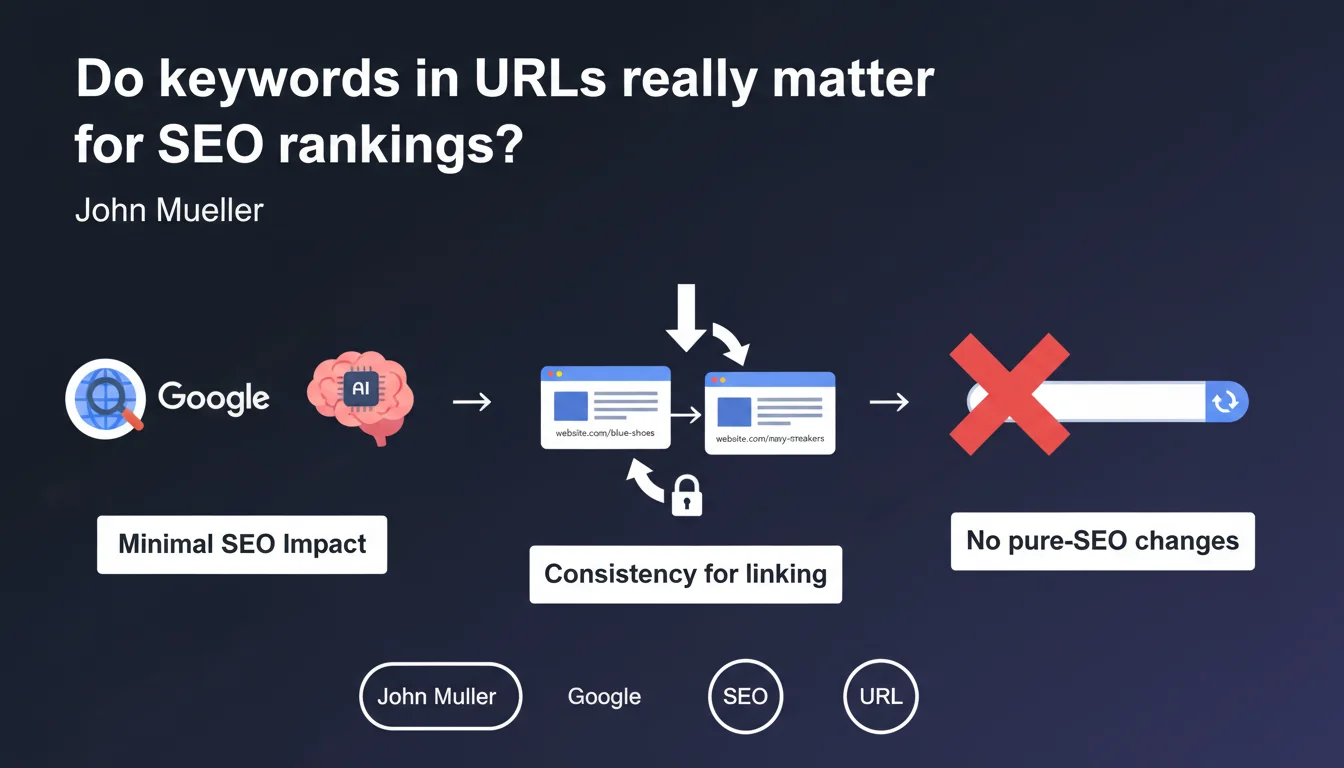
Keywords in URLs have minimal effect on rankings according to Google. The absolute priority is URL consistency to avoid duplication and unnecessary redirects. Modifying a site's URL structure solely to insert keywords provides almost no SEO benefit and often creates more problems than solutions.
What you need to understand
The question of optimized URLs is a recurring debate in the SEO community. For years, we've heard every possible opinion: some claim that keywords in the URL are a determining factor, while others consider them negligible.
This statement from John Mueller makes it clear: the impact is minimal. Not nonexistent, but so weak that it doesn't justify a complete architecture overhaul just for this criterion.
Why does Google downplay the importance of keywords in URLs?
The answer is simple: Google has evolved. Current algorithms analyze the complete semantic content of a page — title, H1, body text, named entities, context. The URL is just one signal among hundreds, and a relatively weak one at that.
Historically, words in the URL carried more weight. But faced with abuse (keyword stuffing in URLs), Google gradually reduced their influence.
What really matters to Google in a URL?
Consistency. That's the key word in this statement. A URL must be stable, logical, and not create confusion for the search engine.
If the same page is accessible through multiple different URLs, you fragment your SEO signals. Google must choose which canonical version to prioritize, and this hesitation dilutes your authority.
- Stability trumps optimization: a clear and permanent URL is better than a keyword-stuffed URL that changes
- Avoid duplication: variable parameters, inconsistent trailing slashes, mixed HTTP/HTTPS protocols create duplicate content
- Redirects have a cost: changing URLs generates redirect chains that slow crawling and dilute PageRank
- User experience matters: a readable and memorable URL facilitates sharing and builds trust
What is the true role of URLs in modern SEO?
The URL remains an element of identification and navigation. It appears in search results, can influence click-through rate if it's clear and reassuring, and helps users understand where they are in your site's architecture.
But as a direct ranking factor? Marginal. Google reads your content, not just the page address.
SEO Expert opinion
Is this statement consistent with real-world observations?
Yes and no. Comparative tests show that a page with /article-seo-google doesn't systematically rank better than a page with /article-12345 if the content and other signals are identical.
But — and this is where it gets tricky — readable URLs have a measurable indirect advantage. They generate more organic clicks (improved CTR), more natural inbound links (people copy-paste understandable URLs), and facilitate server log analysis.
So Google's "minimal" effect is technically accurate for raw rankings, but ignores the ecosystem around it. It's a reductive view.
When should you still optimize URLs?
If you're building a new site, clean and semantic URL architecture costs nothing and provides these indirect benefits. You might as well do it right from the start.
For an existing site with thousands of indexed pages? That's a different story. A poorly managed URL migration can destroy traffic for months. 301 redirects don't transmit 100% of SEO juice contrary to popular belief — [To verify] recent studies suggest transmission close to 100%, but Google remains vague on the details.
The real question: do your current URLs pose a concrete problem? Inaccessible pages, massive duplication, unreadable dynamic URLs with 15 parameters? There, yes, intervene. Otherwise, your time is better spent elsewhere.
What are the limitations of this statement?
Mueller doesn't specify what he means by "minimal impact." 1% of algorithm weight? 0.1%? This imprecision is typical of Google communications: it guides without truly enlightening.
Another blind spot: the impact on Featured Snippets and SERP display. A clean, short, and descriptive URL improves readability in search results, which influences user behavior even if it's not a "direct ranking factor."
Practical impact and recommendations
Should you overhaul an existing site's URL structure?
No, unless it's a critical situation. If your site is working, generating traffic, and URLs aren't causing major technical issues, leave them alone.
The risk of a URL migration far outweighs the hypothetical gain from better SEO through keywords. You'll waste time, create temporary 404 errors, dilute your backlinks during the transition.
Focus your efforts on content, links, speed, user experience. That's where the real ROI is.
How to structure URLs for a new project?
If you're starting from scratch, adopt a logical and permanent architecture. No need to cram 5 keywords, but prioritize clarity.
Effective example: /category/subcategory/page-title. Short, descriptive, hierarchical. Avoid dates in the URL (except for a news blog where freshness is crucial), obscure numeric identifiers, multiple parameters.
- Use hyphens to separate words, not underscores (Google treats them differently)
- Stick to lowercase to avoid case sensitivity issues (example.com/Page vs example.com/page)
- Limit depth: 3-4 levels maximum for most pages
- Remove unnecessary stop words (the, a, of, etc.) unless it's the exact keyword being searched
- Configure canonicals correctly to manage variants (www/non-www, trailing slashes)
- Implement 301 redirects properly if you need to migrate (single redirect, no chains)
- Block unnecessary parameters in Search Console to prevent indexing of duplicates
What mistakes must you absolutely avoid?
Don't create internal duplication. That's the cardinal sin according to Mueller. If /product and /product/ and /product?ref=123 point to the same content, that's a problem.
Also avoid unreadable dynamic URLs (ex: /page.php?id=4567&cat=12&sort=asc). They work technically, but they're hostile to users and complicate analysis.
In summary: for an existing site, only touch URLs if they cause real technical problems. For a new project, structure properly from the start without obsessing over the perfect keyword. And in all cases, ensure absolute consistency — one URL, one piece of content, full stop.
These technical optimizations may seem simple in theory, but their implementation requires deep expertise to avoid critical errors. If you're considering a redesign or migration, working with a specialized SEO agency can save you valuable time and secure the transition.
❓ Frequently Asked Questions
Les URL courtes sont-elles mieux classées que les URL longues ?
Dois-je inclure mon mot-clé principal dans chaque URL ?
Les accents et caractères spéciaux dans les URL posent-ils problème ?
Peut-on utiliser des URL avec des IDs numériques sans pénalité SEO ?
Combien de temps faut-il maintenir les redirections 301 après une migration ?
🎥 From the same video 14
Other SEO insights extracted from this same Google Search Central video · published on 04/05/2023
🎥 Watch the full video on YouTube →
💬 Comments (0)
Be the first to comment.