
Official statement
Other statements from this video 14 ▾
- □ Should you really abandon directories and social bookmarking for your SEO strategy once and for all?
- □ Does Google really ignore spam links automatically without any action needed?
- □ Should you really use Google's link disavow tool, or is it just wasting your time?
- □ Does your choice of CMS and programming language really impact your SEO?
- □ Do keywords in URLs really matter for SEO rankings?
- □ Does image URL depth really prevent Googlebot from crawling your images?
- □ Are your Search Console metrics really showing what's actually happening to your site in Google search results?
- □ Should you abandon dynamic rendering for SEO?
- □ Do you really need to optimize image file names for SEO?
- □ Does Google really render EVERY successfully crawled page with JavaScript?
- □ Does invalid schema markup really hurt your search rankings?
- □ Should you really worry about the difference between 301 and 302 redirects anymore?
- □ Does extended boilerplate content really hurt your SEO rankings?
- □ Can a domain migration really happen without losing your SEO rankings?
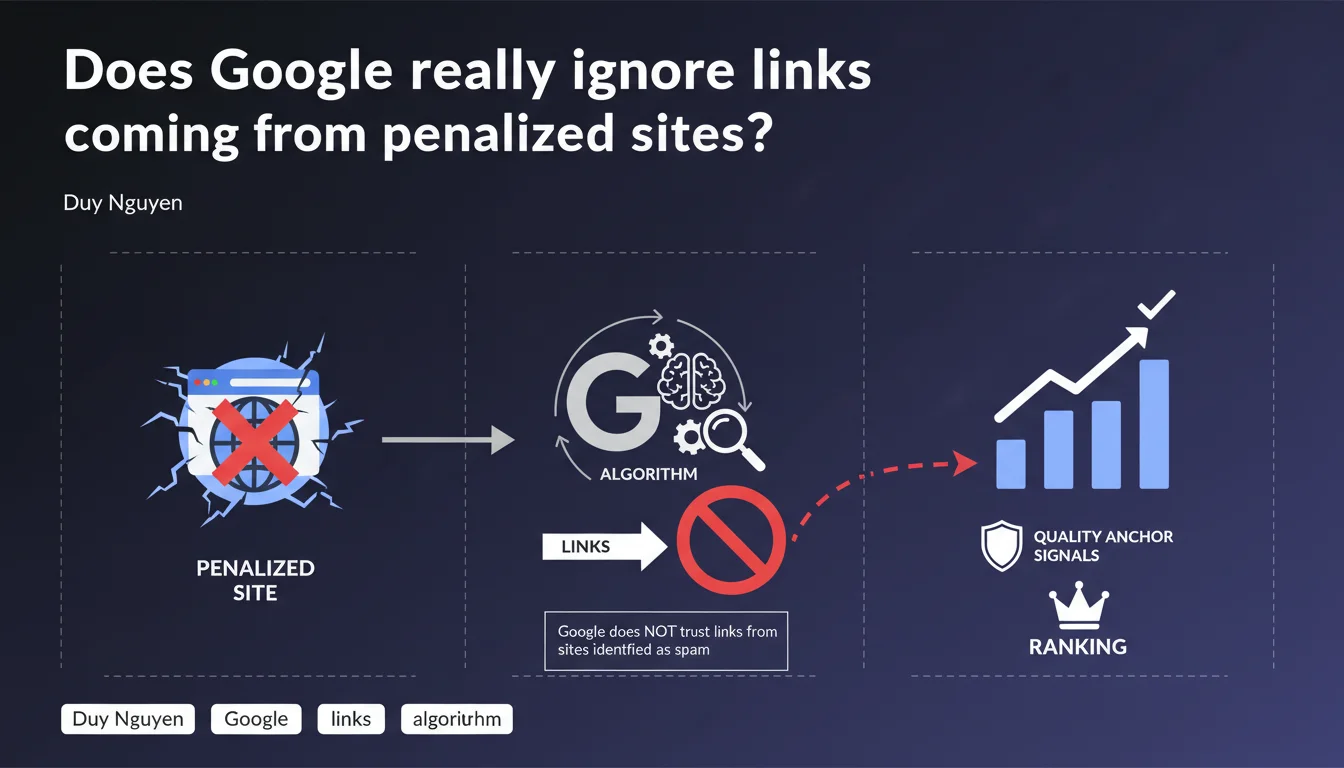
Google does not take into account links coming from sites identified as spam, whether through algorithms or manual actions. This position aims to preserve the quality of anchor signals used for ranking. Concretely, receiving a link from a penalized site brings no SEO value.
What you need to understand
Why does Google filter links from penalized sites?
The official statement by Duy Nguyen confirms that Google applies strict filtering on links from sites considered spam. The objective is clear: prevent the manipulation of anchor signals that directly influence ranking.
Google's algorithms — notably SpamBrain — automatically detect low-quality sites. Manual actions complement this work. In both cases, outbound links from these sites lose all transmission value.
What's the difference between algorithmic penalty and manual action?
An algorithmic penalty results from an automated process: the site is identified as spam without human intervention. A manual action, on the other hand, means that a member of Google's team examined the site and confirmed it violated the guidelines.
In both scenarios, the result is identical: outbound links no longer count. Google severs the transmission chain to protect the integrity of its link graph.
How does Google maintain the quality of anchor signals?
Anchor signals — link text, context, source authority — remain central elements of ranking. By neutralizing links from spam sites, Google prevents malicious actors from manipulating these signals.
It's a defense mechanism. Without this filtering, anyone could create link farms and artificially influence positioning.
- Links from penalized sites (manually or algorithmically) transmit no value
- Anchor signals remain an important ranking factor, but only if they come from reliable sources
- SpamBrain and manual actions work in parallel to identify and neutralize problematic sites
- This official position confirms that seeking links from low-quality sites is pointless
SEO Expert opinion
Is this statement consistent with field observations?
Yes, and it's even reassuring. For years, SEO practitioners have observed that links from visibly spammed sites have no positive impact — or may even be ignored. This statement officially confirms what was already a practical reality.
But let's be honest: Google says nothing about the exact threshold that triggers this removal. Can a site be partially penalized? Are some links filtered and others not? [To verify] — the statement remains vague on these operational details.
What nuances should we consider?
First point: this rule only applies to sites identified as spam. A low-quality site that hasn't yet been detected can technically transmit value. It's a question of timing and detection.
Second point — and this is where it gets tricky: Google doesn't specify whether a link from a penalized site can actively harm the target site. The wording talks about "not trusting," not "penalizing in return." Subtle nuance, but important.
Finally, this statement says nothing about redirects or well-built PBNs. A network of private sites that hasn't yet been detected escapes this filtering. It's a game of cat and mouse.
Should you systematically disavow links from penalized sites?
In theory, no. If Google already ignores these links, disavowing them becomes redundant. But in practice, no one knows for certain which sites are already filtered by Google.
My advice: focus on obvious toxic links — over-optimized anchors, clearly spammed sites, link farms. For the rest, disavowal remains a safety measure, but not an absolute priority.
Practical impact and recommendations
What should you do concretely to protect your link profile?
First step: regularly audit your backlink profile. Use tools like Ahrefs, Majestic or SEMrush to identify sites pointing to you. Spot suspect domains — low authority, unrelated thematic, over-optimized anchors.
Second step: check in Search Console if you've received manual actions. If so, address the problem at its source before requesting a reconsideration. Google won't lift the penalty as long as violations persist.
What mistakes should you absolutely avoid?
Don't seek to obtain links from low-quality directories, link farms or visibly spammed sites. Even if these links are ignored, they pollute your profile and can attract Google's attention.
Also avoid massive link exchanges with unrelated sites. Google detects these artificial schemes increasingly better, and it always ends up backfiring.
Finally, don't rely solely on disavowal. It's a last resort tool, not a miracle solution. Better to prevent than cure by building a natural link profile from the start.
How do you verify that your site itself isn't penalized?
Check the Manual Actions section in Search Console. If no notification appears, you don't have an active manual action. For algorithmic penalties, it's more complicated: monitor sudden drops in organic traffic after major updates.
Also use tools like SEMrush Sensor or Sistrix to cross-reference data. If your traffic drops while your competitors remain stable, there may be an underlying problem.
- Audit your backlink profile at least every quarter
- Monitor Search Console to detect manual actions
- Avoid low-quality directories and link farms
- Don't over-optimize your link anchors — vary them naturally
- Use the disavow file only for truly toxic cases
- If you notice a traffic drop post-update, analyze your site's quality signals
❓ Frequently Asked Questions
Un lien provenant d'un site pénalisé peut-il nuire à mon site ?
Comment savoir si un site qui me lie est pénalisé par Google ?
Le désaveu de liens reste-t-il utile si Google ignore déjà les liens toxiques ?
Un site peut-il être partiellement pénalisé, avec certains liens filtrés et d'autres pas ?
Si un PBN bien construit n'a pas encore été détecté, ses liens ont-ils encore de la valeur ?
🎥 From the same video 14
Other SEO insights extracted from this same Google Search Central video · published on 04/05/2023
🎥 Watch the full video on YouTube →
💬 Comments (0)
Be the first to comment.