
Official statement
Other statements from this video 14 ▾
- □ Les liens sortants de sites pénalisés sont-ils vraiment ignorés par Google ?
- □ Faut-il abandonner définitivement les annuaires et le bookmarking social pour son SEO ?
- □ Faut-il vraiment utiliser l'outil de désaveu de liens Google ou simplement les ignorer ?
- □ Le choix de votre CMS et du langage de programmation affecte-t-il vraiment votre SEO ?
- □ Les mots-clés dans les URL ont-ils vraiment un impact sur le référencement ?
- □ La profondeur de l'URL des images bloque-t-elle vraiment le crawl de Googlebot ?
- □ Les données Search Console reflètent-elles vraiment ce que voient vos utilisateurs ?
- □ Faut-il abandonner le dynamic rendering pour le SEO ?
- □ Faut-il vraiment optimiser les noms de fichiers images pour le SEO ?
- □ Googlebot rend-il vraiment TOUTES les pages crawlées avec succès ?
- □ Le schema markup invalide pénalise-t-il vraiment votre référencement ?
- □ Faut-il vraiment se préoccuper de la différence entre redirections 301 et 302 ?
- □ Le contenu boilerplate étendu pénalise-t-il vraiment votre référencement ?
- □ Un changement de domaine peut-il vraiment se faire sans perte de trafic SEO ?
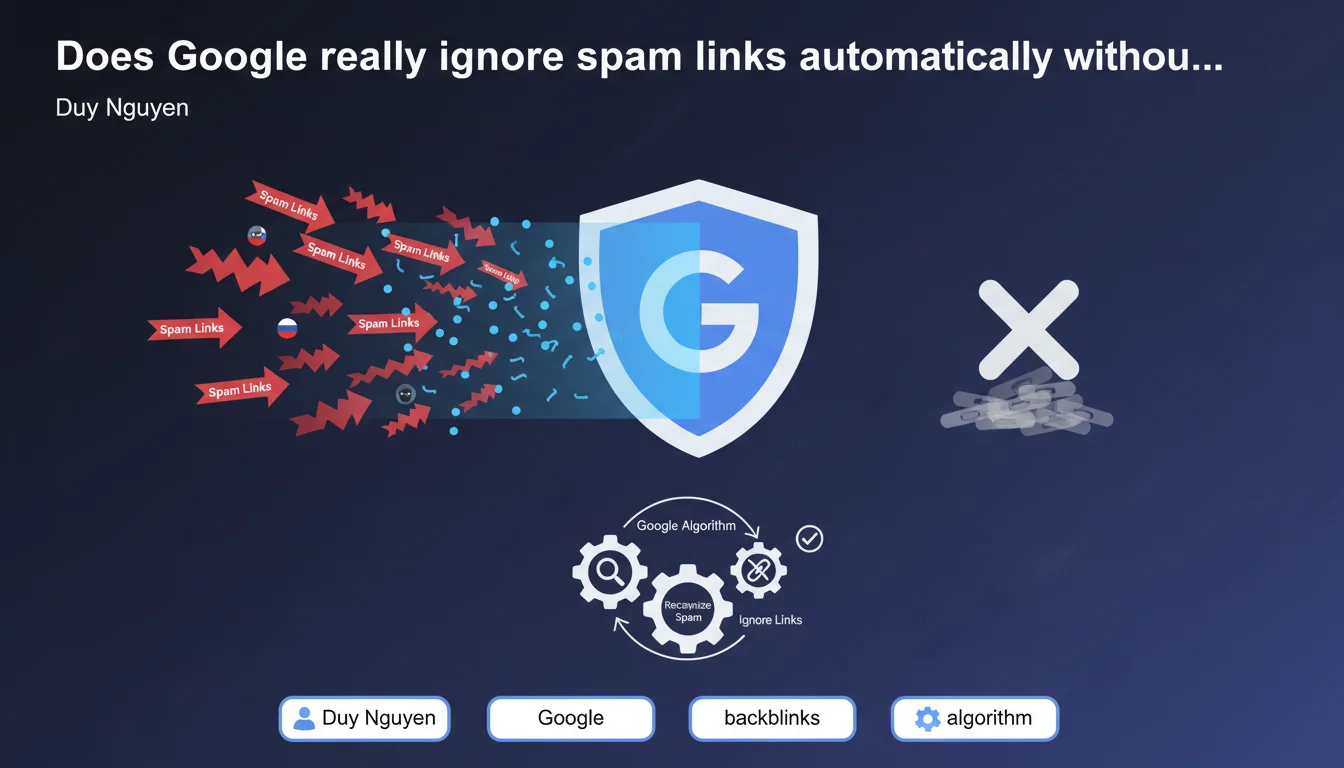
Google claims that its algorithms detect and automatically ignore spam links without requiring any manual intervention. There's no need to disavow suspicious Russian backlinks or low-quality links — the systems handle it themselves. A statement that invites us to reconsider our link profile cleanup practices.
What you need to understand
What exactly does Google say about handling spam links?
Duy Nguyen asserts that Google algorithms automatically ignore low-quality or spam links. This statement goes beyond Google's usual messaging: it's not just that Google *can* ignore them, but that it does so very effectively by default.
Concretely, this means that suspicious Russian backlinks, junky directories, link farms — everything that typically triggers our urge to disavow — would already be neutralized without any manual action on our part. Google thus establishes a clear framework: their systems manage the problem upstream.
Why does Google keep emphasizing this point so much?
This emphasis is not trivial. For years, the disavow tool has generated excessive anxiety among webmasters. Every site receives questionable links — it's mechanical. But fear of penalties drives massive disavowals, sometimes counterproductive.
Google is probably trying to reduce the noise: fewer unnecessary disavow requests, less technical support mobilized for nothing. And above all, clarification against certain agencies that sell "link profile cleanup" as a systematic service.
Which links does Google automatically consider as spam?
- PBN links (private blog networks) detected through pattern analysis
- Link farms and low-quality directories without editorial oversight
- Automated spam comments with optimized anchors
- Purchased links from known platforms or with detectable signatures
- Negative SEO attacks creating massive spikes of suspicious backlinks
SEO Expert opinion
Is this statement consistent with what we observe in the field?
Yes and no. In 80% of cases, Google effectively ignores toxic links with no visible impact. We observe this regularly: sites receiving hundreds of Russian or Chinese backlinks without any loss of rankings. The algorithms sort it out.
But — and this is where it gets tricky — there remain situations where disavowal produces measurable results. Sites recovering from manual penalties after thorough cleanup, or regaining traffic after disavowing massive purchased links. If Google really ignored *everything* automatically, these cases wouldn't exist.
In what cases does this rule not fully apply?
First, manual penalties escape this logic. If a manual action is issued for artificial links, disavowal remains mandatory for removal. Google admits this itself in its guidelines.
Second, certain sophisticated link patterns can temporarily slip under algorithmic radar. A well-built PBN with coherent themes and diversified link profiles will take longer to detect than an obvious trash directory. [To verify]: how far does the precision of this automatic detection really go? Google remains vague on the metrics.
Third, a problem of timing. The algorithm ignores spam links... but when exactly? If a site receives 5000 bad backlinks in 48 hours, how long before complete neutralization? This latency can create temporary fluctuations.
Should we remove the disavow tool from our SEO routine?
Let's be honest: no, not completely. But you must drastically reduce its usage. The systematic reflex of "I disavow everything with a toxic score" becomes counterproductive.
Keep disavowal for three specific cases: confirmed manual penalties, massive purchased link campaigns that you yourself orchestrated (and want to clean up), or documented negative SEO attacks with tangible proof. For everything else? Let the algorithms do the work.
Practical impact and recommendations
What should we concretely do with our existing link profiles?
Stop panicking over every Russian or Turkish backlink appearing in Search Console. If you have no manual penalty and your rankings are stable, don't touch anything. The time spent analyzing these links is better invested elsewhere.
Focus your link audits on identifying abnormal patterns: unexplained massive spikes, over-optimized anchors from the same network, links from hacked sites. These are warning signals, not a handful of isolated questionable links.
How do you distinguish between an ignored link and a penalizing link?
First rule: if Google actually penalized a link pattern, you would have a manual action in Search Console. No notification = no active penalty, even if Ahrefs displays red everywhere.
Second indicator: the effect of disavowal. If disavowing a group of links changes absolutely nothing in your rankings after 4-6 weeks, they were already being ignored. You wasted your time.
What mistakes should you avoid in backlink management?
- Never disavow links without thorough prior analysis — you risk removing neutral or positive links
- Don't blindly trust toxic scores from third-party tools — their algorithms aren't Google's
- Don't send disavow files containing entire domains without verifying each link individually
- Don't react hastily to an alleged negative SEO attack — wait to measure real impact on your rankings
- Don't neglect acquiring quality editorial links to naturally dilute bad signals
❓ Frequently Asked Questions
Dois-je continuer à utiliser l'outil de désaveu de Google ?
Les outils tiers comme Ahrefs ou Semrush sont-ils fiables pour détecter les liens toxiques ?
Combien de temps met Google à ignorer les liens spam après leur détection ?
Une attaque SEO négative peut-elle quand même nuire à mon site ?
Les liens de mauvaise qualité peuvent-ils transmettre du jus positif si Google ne les détecte pas ?
🎥 From the same video 14
Other SEO insights extracted from this same Google Search Central video · published on 04/05/2023
🎥 Watch the full video on YouTube →
💬 Comments (0)
Be the first to comment.