
Official statement
Other statements from this video 14 ▾
- □ Les liens sortants de sites pénalisés sont-ils vraiment ignorés par Google ?
- □ Faut-il abandonner définitivement les annuaires et le bookmarking social pour son SEO ?
- □ Google ignore-t-il vraiment les liens spam automatiquement ?
- □ Faut-il vraiment utiliser l'outil de désaveu de liens Google ou simplement les ignorer ?
- □ Le choix de votre CMS et du langage de programmation affecte-t-il vraiment votre SEO ?
- □ Les mots-clés dans les URL ont-ils vraiment un impact sur le référencement ?
- □ La profondeur de l'URL des images bloque-t-elle vraiment le crawl de Googlebot ?
- □ Les données Search Console reflètent-elles vraiment ce que voient vos utilisateurs ?
- □ Faut-il vraiment optimiser les noms de fichiers images pour le SEO ?
- □ Googlebot rend-il vraiment TOUTES les pages crawlées avec succès ?
- □ Le schema markup invalide pénalise-t-il vraiment votre référencement ?
- □ Faut-il vraiment se préoccuper de la différence entre redirections 301 et 302 ?
- □ Le contenu boilerplate étendu pénalise-t-il vraiment votre référencement ?
- □ Un changement de domaine peut-il vraiment se faire sans perte de trafic SEO ?
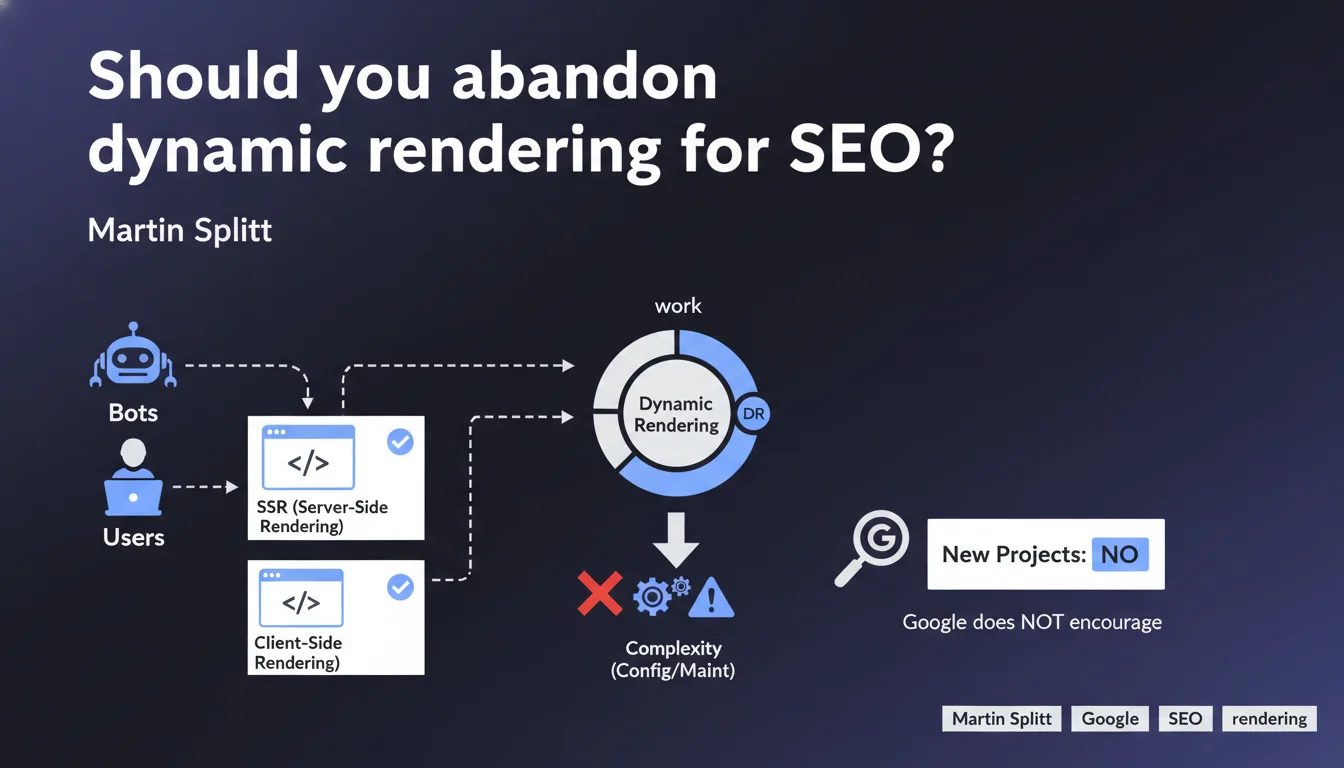
Google now discourages dynamic rendering (full HTML via SSR for bots, CSR for users) for new projects. The reason: increased configuration and maintenance complexity with no real indexing gains. Prioritize server-side rendering (SSR) or static generation (SSG) instead.
What you need to understand
What exactly is dynamic rendering?
The dynamic rendering technique involves serving two versions of the same page: fully pre-rendered HTML for crawlers (Googlebot, Bingbot), and client-side JavaScript (CSR) for human visitors. This approach was popularized as a temporary solution for heavy JavaScript sites (React, Vue, Angular) that struggled to be properly indexed.
Concretely, middleware detects the visitor's user-agent and routes the request to the correct rendering system. It works — but it doubles the infrastructure surface you need to manage.
Why is Google taking this position now?
Because alternatives have become mature and accessible. Next.js, Nuxt, SvelteKit, Astro — they all offer native SSR or SSG with hydration. The need to engineer a dual infrastructure has disappeared for most projects.
Google never liked dynamic rendering: it's cloaking legitimized by technical necessity. The less of it, the better for signal consistency.
Does dynamic rendering stop working?
No. If you're already using it, nothing forces you to rebuild everything tomorrow. Google says it works — but advises against starting there for a new project.
The nuance matters: this isn't a penalty, it's a strategic discouragement.
- Dynamic rendering remains technically valid in Google's eyes
- But it adds infrastructure complexity: two rendering pipelines to maintain, synchronize, and debug
- Google now prefers SSR/SSG: a single HTML version, identical for bots and humans
- Modern frameworks make these approaches accessible without complete overhaul
- For legacy sites using dynamic rendering: no urgency to migrate, but plan for gradual evolution
SEO Expert opinion
Is this statement consistent with what we observe in the field?
Absolutely. Clients maintaining dynamic rendering experience it as a permanent technical burden. Two caching systems, two deployment pipelines, bugs that only appear for Googlebot, detection delays that lengthen. Meanwhile, sites using SSR or SSG with partial hydration (islands architecture, for example) index faster with less friction. The original promise of dynamic rendering — "keep our JS stack intact" — no longer holds up against the maturity of hybrid frameworks.
Are there cases where dynamic rendering remains justified?
Yes, but they're becoming rarer. If you manage a massive legacy site in pure client-side React with no resources for an SSR refactor, dynamic rendering remains an acceptable crutch. But it's a stopgap, not a strategy.
Another edge case: highly personalized applications where server-side rendering becomes a performance nightmare. But even there, edge computing and streaming SSR are changing the game. [To verify]: Google has never provided clear metrics on dynamic rendering's impact on ranking — only on indexability.
What's the real reason behind this message?
Google wants to simplify its crawl. Fewer edge cases, less user-agent detection, fewer differences between what the bot sees and what the user sees. It's also about Core Web Vitals consistency: if the bot sees ultra-fast static HTML and the user sees slow CSR, signals diverge.
And let's be honest — they never truly liked blessing cloaking, even technical cloaking.
Practical impact and recommendations
What should you do if you're currently using dynamic rendering?
Don't panic. Google says it works — so no urgency to break everything. But ask yourself: is this complexity still worth it? If you're refactoring your front end in the next 12-18 months, now's the time to integrate native SSR/SSG.
In the meantime, closely monitor rendering gaps between bot and user. Google Search Console can alert you to divergent content.
Which alternative should you prioritize for a new project?
SSR with partial hydration has become the standard. Next.js (React), Nuxt (Vue), SvelteKit — they all offer server-side rendering out-of-the-box with excellent DX. For content-heavy sites, static generation (SSG) with incremental rebuilds is even more performant.
If you need heavy interactivity, opt for an islands architecture (Astro, Qwik): static HTML serves as the base, JS only activates where needed.
How do you verify your implementation is correct?
- Test your pages with Google Search Console's URL inspection tool — compare the rendering with what your users see
- Audit Core Web Vitals from both bot and user perspective — significant gaps signal a problem
- If you maintain dynamic rendering, precisely document the list of user-agents treated differently
- Implement automated tests to detect rendering divergences between bot and user versions
- For any new project: prioritize SSR, SSG, or hybrid architecture — never dynamic rendering
- Plan a progressive migration if you're in legacy mode: start with critical sections (categories, product pages)
❓ Frequently Asked Questions
Le dynamic rendering est-il considéré comme du cloaking par Google ?
Dois-je migrer mon site en dynamic rendering immédiatement vers du SSR ?
Quels frameworks permettent du SSR simple pour remplacer le dynamic rendering ?
Le SSG est-il préférable au SSR pour le SEO ?
Comment tester si mon dynamic rendering pose problème ?
🎥 From the same video 14
Other SEO insights extracted from this same Google Search Central video · published on 04/05/2023
🎥 Watch the full video on YouTube →
💬 Comments (0)
Be the first to comment.