
Official statement
Other statements from this video 14 ▾
- □ Les liens sortants de sites pénalisés sont-ils vraiment ignorés par Google ?
- □ Faut-il abandonner définitivement les annuaires et le bookmarking social pour son SEO ?
- □ Google ignore-t-il vraiment les liens spam automatiquement ?
- □ Faut-il vraiment utiliser l'outil de désaveu de liens Google ou simplement les ignorer ?
- □ Le choix de votre CMS et du langage de programmation affecte-t-il vraiment votre SEO ?
- □ Les mots-clés dans les URL ont-ils vraiment un impact sur le référencement ?
- □ La profondeur de l'URL des images bloque-t-elle vraiment le crawl de Googlebot ?
- □ Faut-il abandonner le dynamic rendering pour le SEO ?
- □ Faut-il vraiment optimiser les noms de fichiers images pour le SEO ?
- □ Googlebot rend-il vraiment TOUTES les pages crawlées avec succès ?
- □ Le schema markup invalide pénalise-t-il vraiment votre référencement ?
- □ Faut-il vraiment se préoccuper de la différence entre redirections 301 et 302 ?
- □ Le contenu boilerplate étendu pénalise-t-il vraiment votre référencement ?
- □ Un changement de domaine peut-il vraiment se faire sans perte de trafic SEO ?
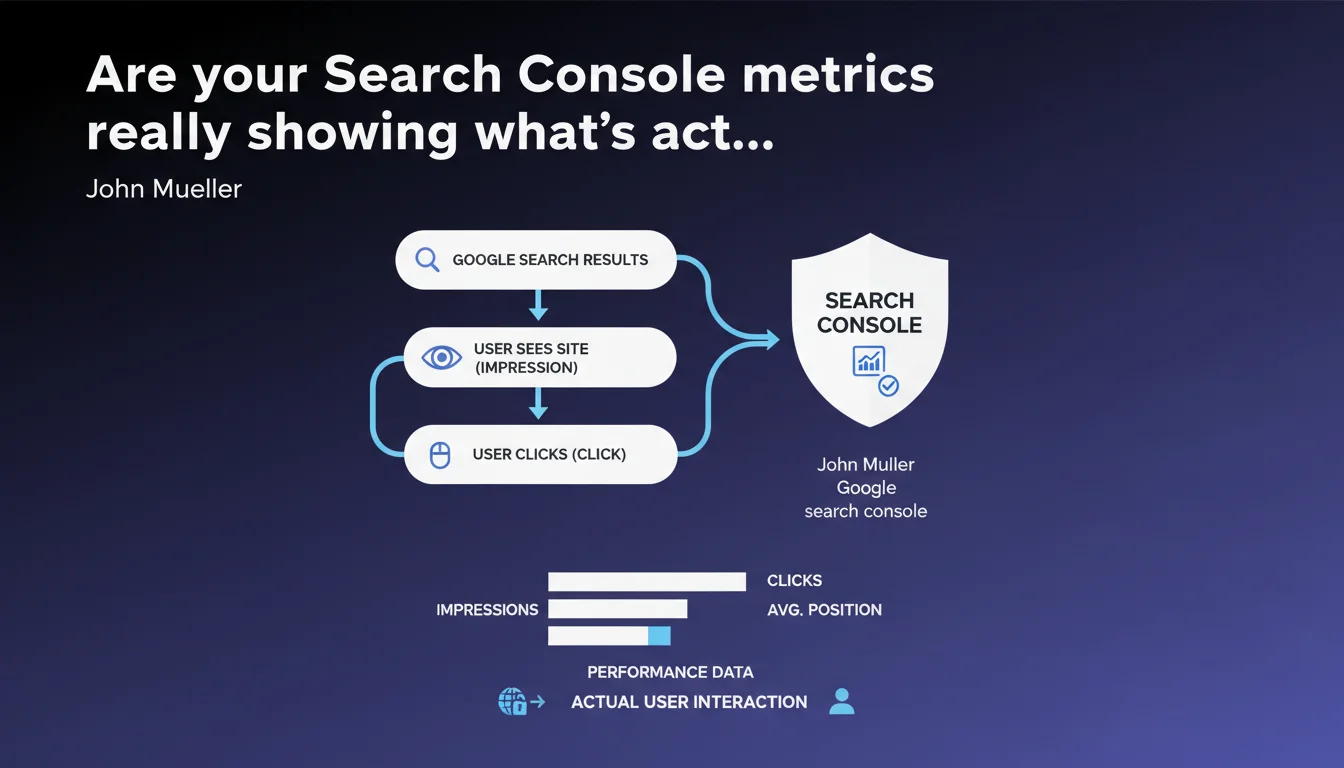
Google confirms that performance data in Search Console is not an estimate or theoretical projection. It corresponds exactly to the queries for which your site was displayed in search results to real users. This distinction has direct implications for how you interpret your traffic and ranking data.
What you need to understand
What's the real difference between actual data and theoretical data?
When Mueller talks about actual versus theoretical data, he's drawing a fundamental distinction. The data in Search Console corresponds to impressions that were actually delivered to users — not what your site "could" get or "should" get according to some predictive model.
In concrete terms: if you see 1,000 impressions for a specific query, that means your URL appeared 1,000 times in actual SERPs in front of real users who performed that search. No extrapolation, no adjusted sampling — just raw counting.
Why does this level of precision from Google matter so much?
Some SEOs still assume that Search Console applies multiplier coefficients or statistical models to "estimate" your true volume. This statement settles that question once and for all: there is no interpretation layer between the event (appearing in results) and the recorded data.
This changes how you should interpret fluctuations. A drop in impressions doesn't mean Google "thinks" you deserve less visibility — it means that fewer users actually performed those searches, or your site wasn't triggered for those queries.
What are the limitations of this data despite its "real" nature?
Real doesn't mean complete. Search Console still applies a privacy threshold: queries with extremely low volume can be filtered to protect user anonymity. You don't see 100% of your actual impressions.
Plus, "real" doesn't mean "instant." Data can have a processing delay of 24 to 48 hours or longer for certain metrics. And it only covers Google searches — obviously excluding Bing, DuckDuckGo, or any other search engine.
- Impressions correspond to actual displays in front of real users
- No extrapolation or statistical modeling is applied to raw data
- A privacy threshold filters out extremely low-volume queries
- Data excludes other search engines and may have processing delays
- A drop in impressions reflects real changes in how often your pages are triggered, not algorithmic "punishment"
SEO Expert opinion
Is this claim consistent with what we observe in the real world?
Yes, and it's actually reassuring. For years, SEOs who compare server logs against Search Console data have observed close alignment — provided they apply the right filters (Google bots only, indexable pages, etc.). If Google applied theoretical coefficients, these correlations would be far more erratic.
But let's be honest: this "reality" doesn't solve all the mysteries. We regularly observe significant gaps between GSC impressions and search volumes shown in Google Ads Keyword Planner for the same queries. [To verify]: Google has never publicly explained this divergence in a satisfactory way.
What nuances should we add to this statement?
Mueller says "real data," but he doesn't say "complete data." Temporal granularity is limited: you can't get precise hourly data, which complicates analysis of traffic spikes or time-sensitive A/B tests. Data is also aggregated at the Search Console property level — not segmented by language, region, or device as granularly as we'd like.
And that's where it gets tricky: "real" doesn't mean "actionable without reprocessing." To get insights you can act on, you need to cross-reference Search Console with Google Analytics 4, your server logs, your CRM data — and interpret the gaps rather than taking them at face value.
In what situations could this claim be misleading?
A typical scenario: you launch a content campaign targeting long-tail queries. You see zero impressions in Search Console. Quick conclusion: "Google isn't indexing me." But in reality, nobody searched for these ultra-specific keywords during that period — so no display, so no data.
Another trap: confusing "real data" with "representative data." If your site primarily targets a B2B audience using corporate VPNs, some searches might be geo-located differently than you expect, skewing your regional performance analysis.
Practical impact and recommendations
How do you leverage this "real" data to optimize your strategy?
First step: stop looking elsewhere for "theoretical" search volumes to validate your rankings. If Search Console shows you 50 impressions on a query that Keyword Planner estimates at 500 searches/month, that means your page only triggers on 10% of actual occurrences. The question becomes: why?
Dig into geographic distribution, devices, and query variations. Often, you'll discover that Google prefers to trigger your page on variants you didn't anticipate — and ignores the ones you thought you owned.
What mistakes should you avoid when interpreting this data?
Classic error: comparing Search Console impressions week-to-week without accounting for actual seasonal fluctuations. If your impressions drop 20% in August, it's not necessarily a penalty — it might just be that your target audience is on vacation and not searching.
Another trap: relying only on impressions to measure visibility. A page can get 10,000 impressions at position 50 — technically "displayed," but never actually seen by a human. Always cross-reference impressions with average position. Below position 10, an impression is worthless.
What concrete systems should you put in place to benefit from this reality?
Set up regular monitoring of emerging queries — those generating fewer than 10 impressions but appearing for the first time. This is the earliest signal that Google is testing your relevance on new topics.
Configure alerts for sudden impression drops (−30% over a 7-day rolling window). Since the data is real, a drop signals either a technical issue (partial deindexation, robots.txt blocking) or an algorithmic shift that's excluding you from certain queries.
- Export Search Console data weekly via API to bypass the 1,000-row interface limit
- Build a dashboard cross-referencing GSC impressions, server logs, and GA4 traffic to spot inconsistencies
- Segment your queries by intent (informational, transactional, navigational) to measure real coverage by type
- Identify queries with high impression volume but CTR under 2% — prioritize title and meta description optimization
- Monitor queries generating impressions with zero clicks (CTR = 0%): often Google displays your page but users click on featured snippets or direct answers instead
❓ Frequently Asked Questions
Les données Search Console incluent-elles les recherches effectuées sur Google Images ou Google News ?
Pourquoi certaines requêtes affichent-elles des impressions dans Search Console alors qu'elles n'apparaissent pas dans mes logs serveur ?
Les données Search Console sont-elles affectées par les variations de personnalisation des résultats de recherche ?
Search Console comptabilise-t-il une impression même si l'utilisateur ne fait pas défiler jusqu'à ma position ?
Peut-on faire confiance aux données Search Console pour mesurer l'impact d'une mise à jour algorithmique ?
🎥 From the same video 14
Other SEO insights extracted from this same Google Search Central video · published on 04/05/2023
🎥 Watch the full video on YouTube →
💬 Comments (0)
Be the first to comment.