
Official statement
Other statements from this video 14 ▾
- □ Les liens sortants de sites pénalisés sont-ils vraiment ignorés par Google ?
- □ Faut-il abandonner définitivement les annuaires et le bookmarking social pour son SEO ?
- □ Google ignore-t-il vraiment les liens spam automatiquement ?
- □ Faut-il vraiment utiliser l'outil de désaveu de liens Google ou simplement les ignorer ?
- □ Le choix de votre CMS et du langage de programmation affecte-t-il vraiment votre SEO ?
- □ Les mots-clés dans les URL ont-ils vraiment un impact sur le référencement ?
- □ La profondeur de l'URL des images bloque-t-elle vraiment le crawl de Googlebot ?
- □ Les données Search Console reflètent-elles vraiment ce que voient vos utilisateurs ?
- □ Faut-il abandonner le dynamic rendering pour le SEO ?
- □ Faut-il vraiment optimiser les noms de fichiers images pour le SEO ?
- □ Googlebot rend-il vraiment TOUTES les pages crawlées avec succès ?
- □ Le schema markup invalide pénalise-t-il vraiment votre référencement ?
- □ Faut-il vraiment se préoccuper de la différence entre redirections 301 et 302 ?
- □ Un changement de domaine peut-il vraiment se faire sans perte de trafic SEO ?
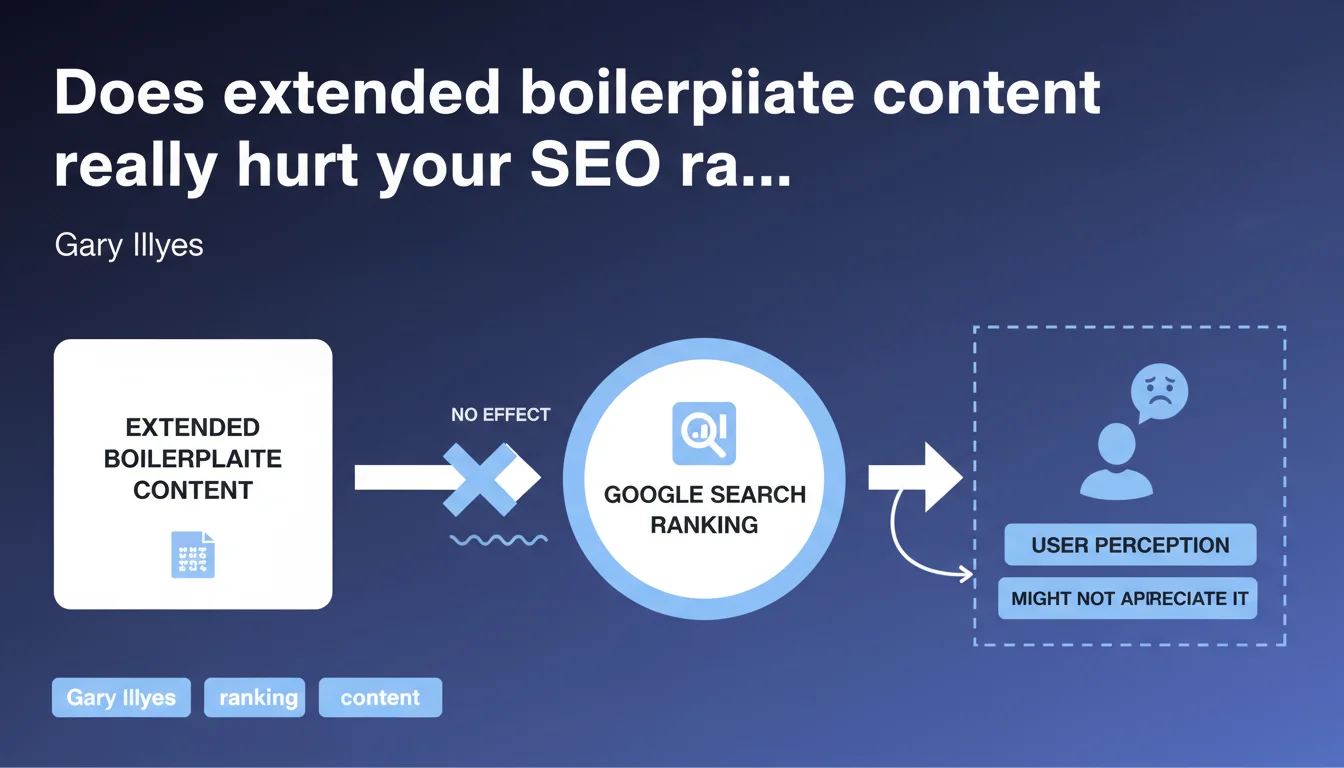
Google states that extended boilerplate content (legal notices, disclaimers, footers) generally does not impact SEO performance. The real issue lies on the user experience side, which can be degraded by an excess of repetitive content. This statement invites you to reconsider your content hierarchy rather than worry about an algorithmic penalty.
What you need to understand
What exactly does Google mean by "extended boilerplate content"?
The term boilerplate refers to any repetitive content appearing on multiple pages of a site: detailed legal notices, extensive legal disclaimers, generic company descriptions replicated identically, privacy policies, bloated footers. In short, anything that isn't specific to the main topic of the page.
The word "extended" changes everything — we're not talking about a simple 3-line footer here, but substantial blocks, sometimes several hundred words repeated page after page. This type of content is particularly common on e-commerce sites with product disclaimers or news sites with lengthy legal warnings.
Why this clarification from Google now?
This statement likely addresses a recurring concern among SEO professionals: will Google treat my pages as duplicate content if they all contain the same 500-word footer block? Will my unique content to repeated content ratio penalize me?
Gary Illyes cuts through the noise: no, there's no negative impact on your search presence. Google knows how to differentiate between main content and repetitive secondary content. The algorithms are mature enough to identify what constitutes the core of a page.
What does "generally" mean in this statement?
The word "generally" deserves close attention — it's rarely innocent in Google communications. It leaves the door open for edge cases where boilerplate could become problematic.
In practice? If your unique content is 50 words and your boilerplate is 800 words, one might legitimately wonder whether Google will consider your page valuable enough. The "generally" qualifier likely signals that an extreme imbalance could still work against you.
- Repetitive boilerplate is not treated as penalizing duplicate content
- Google distinguishes between main content and repetitive secondary content
- The probable exception: an unbalanced ratio where boilerplate overshadows unique content
- The real impact occurs at the user experience level, not at the algorithmic level
SEO Expert opinion
Does this statement match what we observe in the field?
Yes, generally speaking. Sites with bulky footers or extended disclaimers aren't systematically penalized. E-commerce platforms with identical reassurance blocks across thousands of product pages continue to rank well if quality unique content is present.
However — and this is where it gets tricky — this statement says nothing about indirect impacts. Excessively prominent boilerplate can dilute the semantic density of your pages, slow down load times if poorly implemented, and most importantly, frustrate users who have to scroll through 3 screens before finding the information they're looking for. And Google picks up on that through behavioral signals.
What gray areas does Google leave unaddressed?
First gray area: boilerplate placement. Does placing 500 words of disclaimers at the top of a product page have the same effect as placing them in the footer? Google doesn't specify, but my experience suggests it doesn't. Repetitive content that precedes the main content can complicate crawlers' ability to identify the page's subject.
Second unclear point: the tolerance threshold. At what ratio of unique content to boilerplate do you step outside of "generally"? 50/50? 30/70? Impossible to say with certainty. [To verify] on your own sites through A/B testing on similar page groups.
Is the user experience angle Google's indirect way of saying something else?
When Google says "think about how users perceive it", it's rarely just friendly advice. It's an indirect indicator: if users don't appreciate it, behavioral metrics will reflect that (bounce rate, time on page, clicks to other results).
And Google uses these signals. So yes, boilerplate might not directly affect the algorithm, but it can harm your SEO indirectly if UX degrades. This is an important technical distinction but doesn't change the bottom line.
Practical impact and recommendations
What should you do concretely with your current boilerplate content?
First step: audit the ratio on your main page types. Take 10 representative pages and measure unique content words versus boilerplate. If boilerplate exceeds 40% of total content, you're in a caution zone.
Second action: reposition boilerplate. Detailed legal notices, lengthy disclaimers — all of that can move to the bottom of the page, or even be externalized in accordion menus closed by default or links to dedicated pages. The goal is to ensure that main content is immediately visible and identifiable.
What mistakes should you absolutely avoid?
Don't confuse boilerplate with useful reassurance content. A "Free Shipping" or "Secure Payment" block of 2-3 lines is not problematic boilerplate — it's information that reassures and converts. The problem is a 15-line block of general terms repeated word-for-word across 10,000 pages.
Another pitfall: hiding boilerplate with CSS to "trick" Google. Bad idea. If the content is in the HTML, it's crawled. If you really want to reduce it, delete it or externalize it, don't hide it.
How do you verify that your structure is optimal?
Use the URL inspection tool in Search Console and see how Google renders your page. Is the main content clearly identified? Also test with semantic analysis tools to see if your main topic stands out despite the boilerplate.
Monitor your behavioral metrics: if time on page drops or bounce rate spikes after adding substantial boilerplate, that's a signal. UX degrades SEO indirectly but very really.
- Calculate the unique content to boilerplate ratio on your main templates
- Reposition extended boilerplate at the end of the page or in collapsible sections
- Externalize detailed legal notices to dedicated pages with discrete links
- Avoid hiding boilerplate content with CSS — reduce it at the source instead
- Test the impact on UX metrics after any structural modifications
- Regularly check your rendering in Search Console
❓ Frequently Asked Questions
Un footer de 200 mots identique sur toutes les pages peut-il me pénaliser ?
Dois-je supprimer mes disclaimers juridiques pour améliorer mon SEO ?
Quel ratio contenu unique/boilerplate est acceptable ?
Le boilerplate compte-t-il dans le calcul de la longueur de contenu d'une page ?
Faut-il utiliser des balises spécifiques pour signaler le boilerplate à Google ?
🎥 From the same video 14
Other SEO insights extracted from this same Google Search Central video · published on 04/05/2023
🎥 Watch the full video on YouTube →
💬 Comments (0)
Be the first to comment.