
Official statement
Other statements from this video 14 ▾
- □ Les liens sortants de sites pénalisés sont-ils vraiment ignorés par Google ?
- □ Faut-il abandonner définitivement les annuaires et le bookmarking social pour son SEO ?
- □ Google ignore-t-il vraiment les liens spam automatiquement ?
- □ Faut-il vraiment utiliser l'outil de désaveu de liens Google ou simplement les ignorer ?
- □ Le choix de votre CMS et du langage de programmation affecte-t-il vraiment votre SEO ?
- □ Les mots-clés dans les URL ont-ils vraiment un impact sur le référencement ?
- □ La profondeur de l'URL des images bloque-t-elle vraiment le crawl de Googlebot ?
- □ Les données Search Console reflètent-elles vraiment ce que voient vos utilisateurs ?
- □ Faut-il abandonner le dynamic rendering pour le SEO ?
- □ Faut-il vraiment optimiser les noms de fichiers images pour le SEO ?
- □ Googlebot rend-il vraiment TOUTES les pages crawlées avec succès ?
- □ Le schema markup invalide pénalise-t-il vraiment votre référencement ?
- □ Le contenu boilerplate étendu pénalise-t-il vraiment votre référencement ?
- □ Un changement de domaine peut-il vraiment se faire sans perte de trafic SEO ?
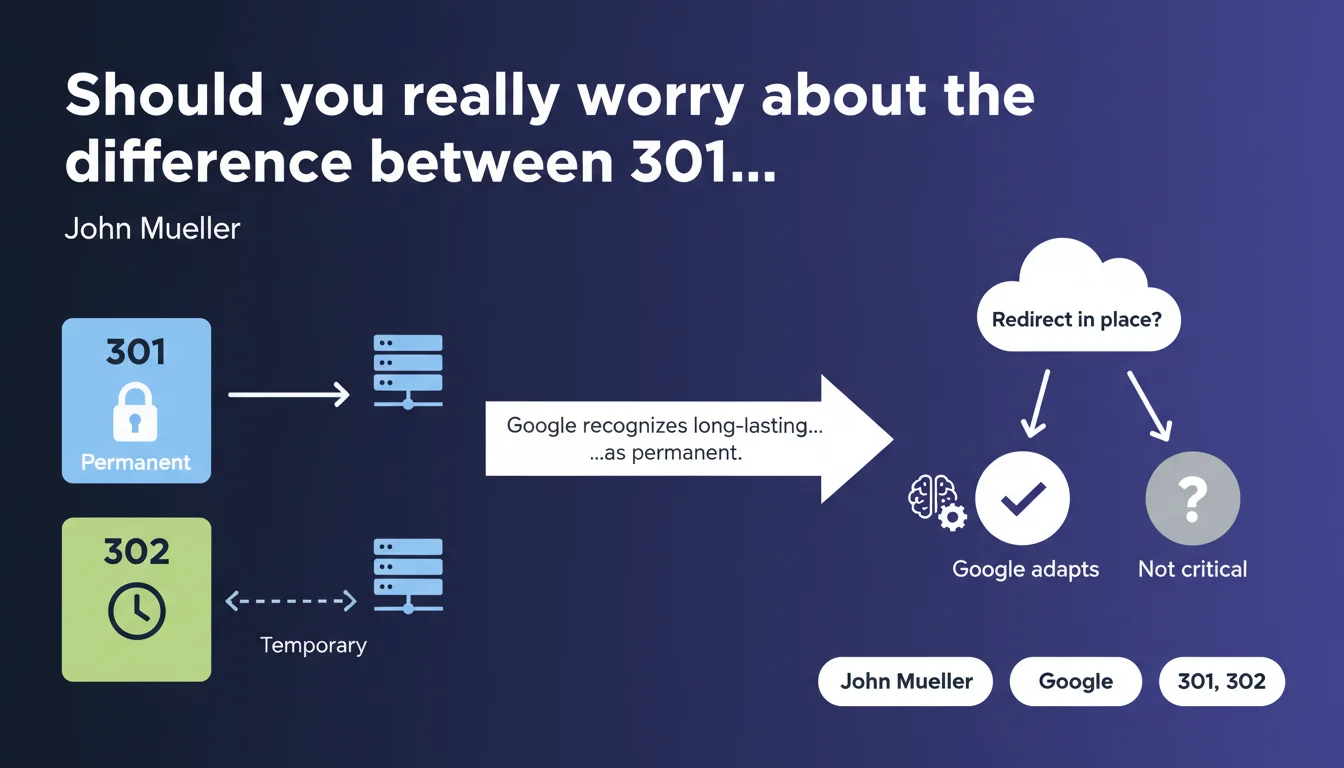
Google automatically converts 302 redirects that remain in place for a long time into permanent 301 redirects. In practice, using a 302 instead of a 301 isn't critical if the redirect stays active, because the algorithm adapts. Technical purism gives way to pragmatism.
What you need to understand
This statement from John Mueller puts into perspective a distinction that has long obsessed SEOs: the difference between temporary (302) and permanent (301) redirects. For years, the consensus was clear: a 301 transfers PageRank, a 302 does not.
But technical reality has evolved. Google observes signals over time, and if a 302 redirect remains active for months or even years, it is treated as permanent in terms of indexation and signal transmission.
Why did Google adopt this pragmatic approach?
Because in real life, many sites use 302 redirects by default without any real intention of temporality. CMSs, e-commerce platforms, or domain management tools sometimes generate 302s where a 301 would be more appropriate.
Rather than penalizing these sites for a minor technical error, Google chose to interpret the intention based on observed behavior. If the redirect persists, it's probably permanent — regardless of the declared HTTP code.
- A 302 redirect active for several months will be treated as a 301 by Google
- PageRank transfer works in both cases if the redirect is stable
- The theoretical difference between 301 and 302 fades in practice for long-duration redirects
- Google prioritizes observation of actual behavior over strict compliance with HTTP codes
What triggers this automatic conversion?
Google doesn't give a precise timeframe. We generally talk about weeks to months of observation. The engine analyzes the stability of the redirect: is it still active? Does it point to the same target URL?
If yes, the signal is clear: this redirect is permanent, regardless of the HTTP code returned. The algorithm adjusts its processing accordingly.
Does this mean we can ignore the 301/302 distinction?
Not exactly. Mueller clarifies that it is theoretically correct to use 301s for permanent redirects. It's the best practice, the one that avoids any ambiguity.
But if you have a 302 in place and it's doing the job, don't panic. Google will eventually understand the intention. It's simply not a critical emergency that justifies an immediate technical overhaul.
SEO Expert opinion
Is this statement consistent with real-world observations?
Yes, absolutely. For several years now, we've observed that sites with massive 302 redirects don't systematically lose visibility. PageRank circulates, rankings hold steady.
Where it sometimes gets stuck is on fresh migrations. A 302 can slow down signal consolidation during the first few weeks, creating a period of instability in the SERPs. But over the long term, the gap narrows.
What nuances should be added to Google's position?
Let's be honest: saying "it's not critical" doesn't mean "it's optimal". If you're launching a domain migration tomorrow, using 302s instead of 301s is still a technical error.
The problem is the interpretation delay. Google has to observe, analyze, decide. Meanwhile, you might be losing rankings. A 301 sends an immediate and unambiguous signal: "this page has moved permanently".
[To verify] Mueller doesn't specify how long this automatic conversion takes. Field feedback varies: some see the effect within weeks, others wait several months. This uncertainty is a risk in itself.
In what cases does this rule not apply?
If you're genuinely using a temporary redirect — for example for an A/B test, scheduled maintenance, or a seasonal campaign — then the 302 remains relevant. And in that case, remove it after use.
The problem arises when a "temporary" 302 becomes permanent through neglect. That's where Google steps in with its automatic interpretation. But it's better not to rely on this crutch.
Practical impact and recommendations
What should you actually do if you have old 302 redirects?
Start with an audit of active redirects on your site. Identify all 302s in place for more than 3 months. Ask yourself: is this redirect really temporary?
If the answer is no, convert it to a 301. It's a simple modification on the server side (.htaccess, nginx.conf, or through your CMS). Immediate benefit: you send a clear signal to Google without waiting for it to guess your intention.
- Crawl your site with Screaming Frog or Botify to list all redirects
- Filter 302 codes and check when they were set up
- Identify which ones are permanent and convert them to 301
- Test the new redirects to avoid chains or loops
- Monitor indexation and rankings post-modification
What mistakes must you absolutely avoid?
Don't create redirect chains when fixing your 302s. If page A redirects to B with a 302, then B redirects to C with a 301, you're wasting crawl budget and diluting signals. Redirect A directly to C.
Also avoid changing all your redirects at once if your site is massive. A sudden change can disrupt indexation. Proceed in waves, starting with strategic pages (high traffic, strong backlinks).
How do you verify that your redirects are correctly interpreted by Google?
Use the URL Inspection tool in Search Console. Submit the old URL (the one that redirects) and check if Google considers it as permanently redirected. Also look at the indexed canonical URL: if it's the redirect target, that's a good sign.
Also monitor your backlinks via Ahrefs or Majestic. If you've migrated important pages, verify that PageRank is passing through well to the new URLs. A localized drop in visibility could indicate a redirect problem.
In summary: Google adapts to old 302 redirects, but this doesn't exempt you from using the correct HTTP codes. A 301 remains the best practice for any permanent redirect. Auditing and fixing your redirects isn't technically complex, but requires rigor and methodology.
If your redirect architecture is complex — particularly after multiple migrations or successive redesigns — calling in a specialized SEO agency can save you valuable time and prevent costly visibility errors.
❓ Frequently Asked Questions
Une redirection 302 transmet-elle réellement le PageRank ?
Combien de temps faut-il pour que Google convertisse une 302 en 301 ?
Dois-je corriger toutes mes redirections 302 existantes ?
Peut-on utiliser des 302 pendant une migration de domaine ?
Comment vérifier si mes redirections 302 sont bien traitées comme des 301 par Google ?
🎥 From the same video 14
Other SEO insights extracted from this same Google Search Central video · published on 04/05/2023
🎥 Watch the full video on YouTube →
💬 Comments (0)
Be the first to comment.