
Official statement
Other statements from this video 13 ▾
- □ Are stock images really hurting your search rankings?
- □ Should you really prioritize strategy over technical implementation when optimizing images?
- □ Does adding context to alt attributes really boost your image SEO rankings?
- □ Should you really stop writing 'image of' in alt attributes?
- □ Should you really write complete sentences in alt attributes?
- □ Should you really choose between accessibility and SEO in your alt tags?
- □ Should you really fill the alt attribute for every single image on your site?
- □ Do you really need to rename all your image files for SEO?
- □ Why does Google crawl your images far less often than your HTML pages?
- □ Is it really worth risking a major image URL overhaul if Google will penalize you with months of reduced visibility?
- □ Do you really need rel="canonical" for multiple image versions?
- □ Should you optimize ALL your images or just the ones on high-traffic pages?
- □ Are your logos and clickable buttons sabotaging your accessibility and SEO performance?
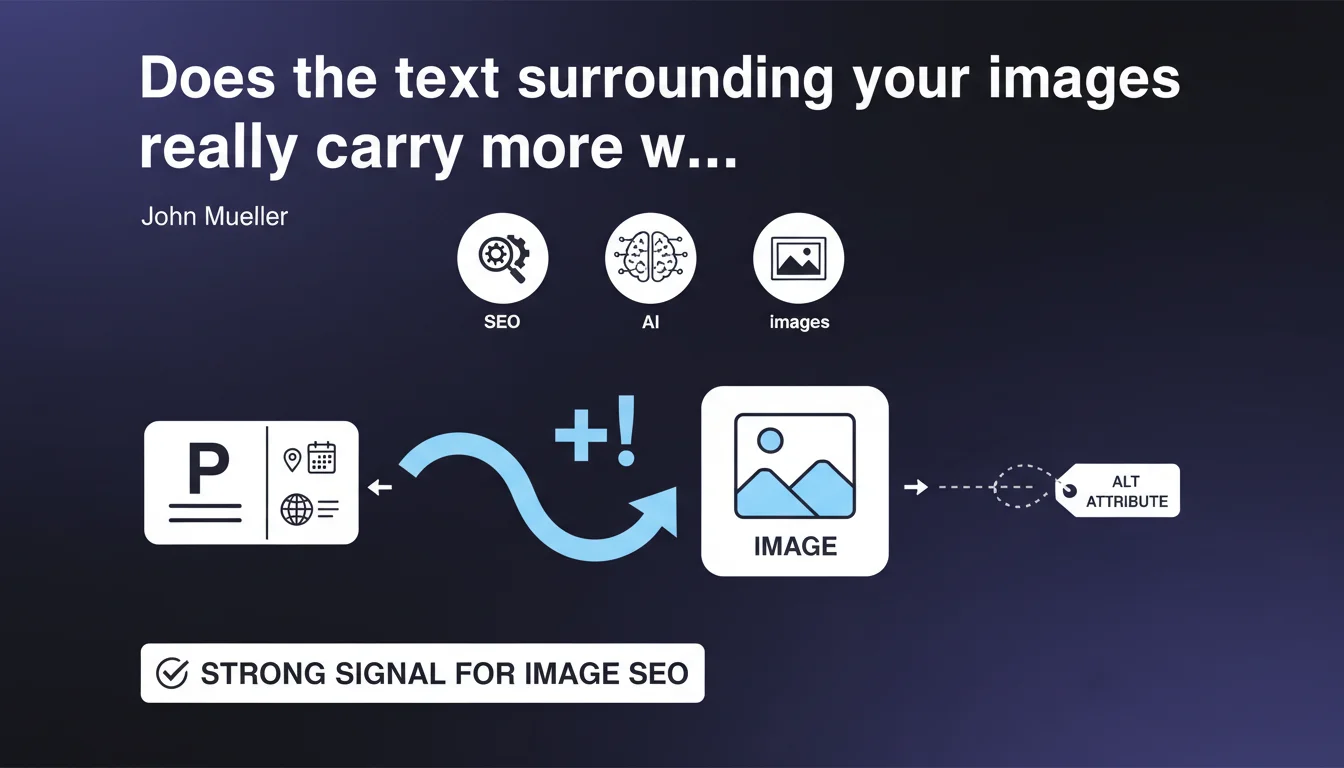
The text surrounding an image constitutes a stronger SEO signal than the alt attribute alone. Google prioritizes editorial context (introductory paragraphs, captions) to understand an image's subject. The alt attribute remains essential for accessibility, but it should no longer bear the entire semantic load.
What you need to understand
Why does Google value textual context more than the alt attribute?
Google now analyzes images within their overall editorial environment, not solely through technical metadata. The engine seeks to understand the author's intent and the image's relevance within the narrative flow.
A paragraph located before or after an image offers semantic richness that a 125-character alt cannot match: shooting date, precise location, historical context, identified individuals. This information structures algorithmic understanding.
Does the alt attribute become useless then?
No. The alt retains two critical functions: WCAG accessibility (screen readers) and fallback if the image fails to load. It is a legal requirement in many countries, regardless of SEO.
On the image ranking side, however, it is no longer necessary to stuff the alt with keywords or insert large amounts of contextual information. This practice was counterproductive for UX and is now minimally relevant algorithmically.
Specifically, what types of text around the image does Google analyze?
The engine scans <figcaption> tags, paragraphs immediately adjacent (before/after), and potentially section headings <h2> or <h3> that structure visual content.
Proximity matters: text located 3 paragraphs away will carry less weight than a caption directly linked. Semantic HTML structure (figure, figcaption) facilitates this association.
- Contextual text (paragraphs, captions) takes priority over the alt attribute for image ranking
- The alt remains mandatory for accessibility and technical fallback
- Detailed information (location, date, author) should live in editorial content, not in metadata
- Semantic HTML structure (figure/figcaption) reinforces text-image association
- Google prioritizes analyzing texts immediately adjacent to the image
SEO Expert opinion
Is this approach consistent with Google Images' evolution?
Absolutely. Since 2018, Google Images has integrated SERP features that display text excerpts from the source page — not just the alt. Visual fact checks, context badges, rich snippets: everything relies on editorial content analysis.
This evolution also aligns with computer vision models (Google Lens, multimodal MUM). The engine now crosses visual recognition with textual understanding to score an image. An isolated alt is no longer sufficient to create this semantic coherence.
In what cases does this recommendation not fully apply?
On poorly structured e-commerce sites, the alt sometimes remains the only available descriptive text if product sheets are thin on content. In this specific case, the alt retains disproportionate weight — but that's a symptom of weak content, not a viable strategy.
Purely decorative images (icons, visual separators) should have an empty alt (alt="") to avoid polluting accessibility. There, textual context is obviously null, but these images aren't supposed to rank.
What data is missing to fully validate this directive?
[To verify] Mueller does not quantify relative weight: does contextual text account for 60% vs 40% for the alt? 80/20? Impossible to say. A/B tests on this point yield variable results across verticals (news, e-commerce, blogs).
[To verify] The maximum distance between text and image for Google to link them remains unclear. Does a <figcaption> carry the same weight as a paragraph located 200px higher on responsive? Field observations show variations, but no official threshold exists.
Practical impact and recommendations
What should you concretely do on your existing content?
Audit your image-rich pages (blog articles, guides, portfolios) to identify those where the alt alone bears the descriptive load. Write introductory paragraphs that contextualize the image: where, when, why it illustrates the point.
Systematically integrate <figure> and <figcaption> tags to structure visuals and captions. This is clean semantic HTML, good for accessibility AND for facilitating Google's algorithmic analysis.
What mistakes should you absolutely avoid?
Don't empty your existing alts. The goal is not to transfer keywords from the alt to the text, but to create complementarity. The alt describes the image itself ("organic traffic growth chart 2019-2023"), context explains its role in the argument.
Avoid generic captions ("Photo 1", "Illustration"). A weak <figcaption> adds nothing. It should clarify a factual element (date, location, source) or interpretive one ("this curve shows the impact of March's Core Update").
How can you verify your strategy is working?
Use Google Search Console > Performance > "Images" tab to track impressions and clicks evolution. Cross-reference with your server logs to see if Googlebot Images visits your pages more frequently after contextual optimization.
Test your pages in Google Lens or via the Vision AI API to verify that visual recognition + textual context results in coherent interpretation. If Google Lens misidentifies your image despite good context, the visual itself is problematic (quality, sharpness, composition).
- Write rich introductory paragraphs around each key image
- Use <figure> and <figcaption> to structure visuals and captions
- Maintain precise, descriptive alts (accessibility + fallback)
- Add dates, locations, sources to contextual text, not the alt
- Audit Google Search Console > Performance > Images to measure impact
- Test via Google Lens for coherence between visual recognition and context
- Never leave images without alt, even with good textual context
❓ Frequently Asked Questions
Dois-je supprimer mes attributs alt si j'ajoute du texte contextuel autour des images ?
Quelle longueur minimale doit faire le texte autour d'une image pour que Google en tienne compte ?
Les légendes en figcaption ont-elles plus de poids que les paragraphes normaux ?
Cette recommandation s'applique-t-elle aussi aux images de produits e-commerce ?
Faut-il répéter les mots-clés de l'alt dans le texte contextuel ?
🎥 From the same video 13
Other SEO insights extracted from this same Google Search Central video · published on 06/10/2022
🎥 Watch the full video on YouTube →
💬 Comments (0)
Be the first to comment.