
Official statement
Other statements from this video 15 ▾
- □ Why does Google cap sitemaps at 50,000 URLs, and how does it impact large websites?
- □ Do ARIA attributes really improve your website's SEO?
- □ Do you really need to redirect canonicalized URLs to improve your search rankings?
- □ Does Google really ignore URL fragments (#) for SEO purposes?
- □ Is your website hit by a manual penalty? Here's exactly how to check in Search Console
- □ Why is Product markup completely useless for real estate listings?
- □ Can you really use hreflang for non-translated content targeting different regions?
- □ Does color contrast really impact your SEO rankings?
- □ Does the HTML <article> tag really boost your SEO rankings?
- □ Do Relative and Absolute Links Really Make a Difference for SEO?
- □ Does Google really require English day names in structured data for non-English websites?
- □ How can you verify that a crawler is really Googlebot and block fake ones without hurting your SEO?
- □ Should you really use prefetch and prerender to boost your SEO rankings?
- □ Should you really stop relying on Google cache to diagnose indexation issues?
- □ Is Google really indexing content that doesn't exist on your site?
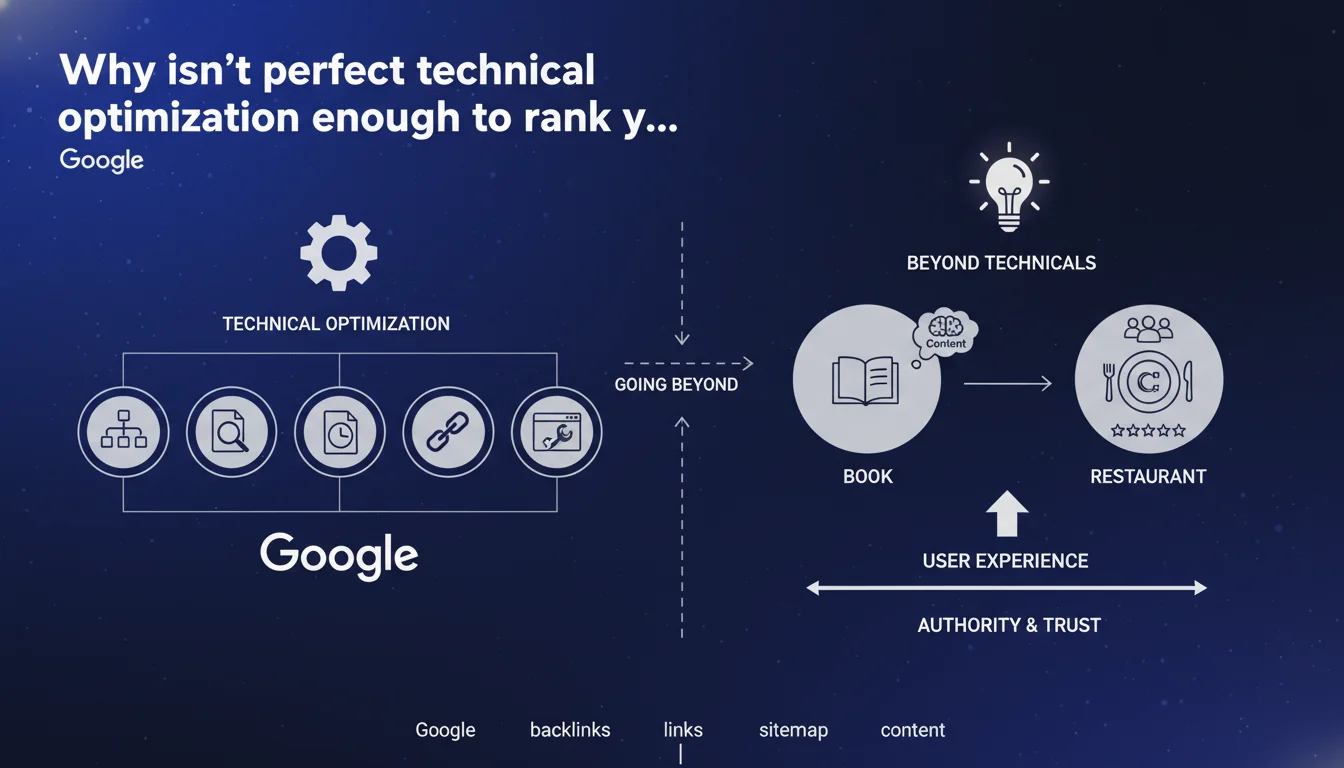
Google confirms that sitemaps, indexation, backlinks, and on-page optimization are no longer sufficient to achieve good rankings. Technical aspects remain essential, but the search engine now expects much more: content quality, user experience, real authority. Perfect technicality has become a prerequisite, not a competitive advantage.
What you need to understand
Is Google questioning the importance of technical SEO?
No, and that's precisely where this statement can be misinterpreted. Google is not saying that technical SEO is useless — it's saying it's no longer differentiating. A site without a properly configured sitemap, without indexable pages, or with catastrophic structure won't rank, period.
The nuance? Technical foundations have become the baseline. Everyone understood that you needed an XML sitemap, coherent heading tags, backlinks. What separated good sites from bad ones 10 years ago is now a minimum standard.
What makes the difference today?
Google uses a telling metaphor: a technically well-printed book or a restaurant with clean cutlery doesn't guarantee success. The content needs to be remarkable, the experience needs to be memorable, the authority needs to be legitimate.
Concretely, this means Google now evaluates much more subjective signals — and therefore harder to optimize: deep semantic relevance, user behavior, real satisfaction, E-E-A-T signals, editorial consistency over time.
Does this position reflect a recent algorithm change?
Not really. This statement mainly formalizes an already observable reality from several years ago. Successive Core Updates have gradually reduced the impact of isolated technical optimizations in favor of qualitative signals.
What's changing is that Google is saying it openly. Gone are the days when a well-executed technical audit could boost a site 20 positions. Today, it mainly prevents it from falling — and that's already a lot.
- Technical SEO remains mandatory, but is no longer sufficient to rank
- Technical aspects have become a prerequisite, not a differentiation lever
- Google now evaluates qualitative signals hard to simulate: user satisfaction, real authority, deep relevance
- This statement formalizes a trend already observable through several Core Updates
SEO Expert opinion
Is this statement consistent with field observations?
Absolutely. On competitive queries, we regularly observe technically less optimized sites outperforming perfectly optimized ones. A standard WordPress blog with average structure but recognized expert content can crush an ultra-fast Next.js site packed with generic pages.
The problem? This reality creates an uncomfortable gray zone for SEO practitioners. How do you quantify "editorial excellence" or "perceived authority" in a dashboard? How do you sell a qualitative audit to a client used to Screaming Frog reports?
What nuances should be brought to Google's position?
First nuance: competitive context changes everything. On a super-niche query with little competition, a technically solid site can still dominate without exceptional content. On "car insurance," good luck.
Second nuance: certain technical aspects remain differentiating in specific contexts. An e-commerce site with 500k products that perfectly manages crawl budget and facets will have a real advantage. A media outlet that finely optimizes its InternalRank through link structure can gain positions.
[To verify]: Google remains very vague about what it means by "going beyond." No precise metrics, no thresholds. This statement stays in the characteristic vagueness of official communications — useful in principle, frustrating in practice.
In what cases doesn't this rule apply completely?
On very specific site typologies where volume takes precedence over editorial finesse. A well-structured local directory, a price comparison site with functional content, a news site playing the freshness angle — here, technical excellence can still do 70% of the job.
Another case: sites in non-competitive languages/markets. In certain geographic or linguistic niches, the average level remains low. A technically solid site with decent content can dominate there without editorial genius.
Practical impact and recommendations
What should you do concretely if your strategy was very technical?
First reflex: audit the perceived quality of your content with fresh eyes. Ask yourself if your pages provide real added value or if they recycle what's already out there. Have someone outside your industry read your texts — if they're bored, Google is too.
Second axis: invest in real authority. This means digital PR, natural citations, recognized expert contributions, creative linkbaiting. Forget mass link buying — Google looks for legitimate authority signals, not inflated metrics.
Third lever: optimize user engagement. Reading time, adjusted bounce rate, interactions, social shares — all these signals matter. Content that nobody reads entirely sends a clear message to Google.
What mistakes should you avoid after this statement?
Classic mistake: abandoning technical SEO under the pretense that it "isn't enough anymore." It's like saying you can open a restaurant without a functional kitchen because "atmosphere is what matters." Technical remains the foundation.
Another trap: believing that "good content" compensates for everything. A brilliant article buried in a slow site, poorly structured, with indexation errors will never perform. Synergy between technical and qualitative is essential.
Finally, don't fall into the "we'll do like the big media outlets" syndrome. They have newsrooms of 50 people and domain authority built over 20 years. You need to find your differentiating angle, not copy them.
How do you verify your site is going in the right direction?
Install fine-grained behavioral tracking: Clarity, Hotjar, or equivalent. Watch if users actually read your content, where they drop off, what they ignore. Heatmaps don't lie.
Analyze competitor SERPs on your target queries. Who ranks? Why? Factually compare editorial depth, freshness, author credibility. If you're objectively worse, Google sees it too.
Measure your authority signals: natural mentions without links, citations in forums/Reddit, reprints by other sites. If nobody talks about you spontaneously, you're probably still in the "technically correct, not memorable" zone.
- Audit the real added value of each strategic page — be honest
- Invest in real authority: digital PR, recognized experts, creative linkbaiting
- Optimize engagement: behavioral tracking, continuous improvement of editorial UX
- Never neglect technical — it remains mandatory even if no longer differentiating
- Analyze competitor SERPs to identify qualitative gaps
- Measure spontaneous authority signals: mentions, citations, reprints
❓ Frequently Asked Questions
Le SEO technique est-il devenu inutile selon Google ?
Quels aspects sont désormais plus importants que le technique ?
Un site techniquement imparfait peut-il quand même bien ranker ?
Faut-il arrêter les audits techniques SEO ?
Comment mesurer si mon contenu est 'suffisamment bon' pour Google ?
🎥 From the same video 15
Other SEO insights extracted from this same Google Search Central video · published on 09/08/2023
🎥 Watch the full video on YouTube →
💬 Comments (0)
Be the first to comment.