
Official statement
Other statements from this video 15 ▾
- □ Pourquoi Google limite-t-il les sitemaps à 50 000 URLs, index compris ?
- □ Faut-il vraiment rediriger les URL canonicalisées pour améliorer son référencement ?
- □ Google ignore-t-il vraiment les fragments d'URL (#) pour le référencement ?
- □ Pourquoi l'optimisation technique seule ne fait-elle plus ranker un site ?
- □ Comment vérifier si votre site est sous pénalité manuelle dans Search Console ?
- □ Pourquoi le balisage Product ne sert à rien pour l'immobilier ?
- □ Hreflang fonctionne-t-il vraiment pour du contenu non traduit mais ciblant des pays différents ?
- □ Le contraste des couleurs impacte-t-il vraiment le référencement naturel ?
- □ La balise HTML <article> améliore-t-elle vraiment le référencement ?
- □ Liens relatifs vs absolus : y a-t-il vraiment un impact SEO ?
- □ Faut-il vraiment imposer l'anglais dans les données structurées pour les jours de la semaine ?
- □ Comment vérifier qu'un crawler est réellement Googlebot et bloquer les imposteurs ?
- □ Faut-il vraiment utiliser prefetch et prerender pour améliorer son SEO ?
- □ Faut-il vraiment oublier le cache Google pour diagnostiquer l'indexation ?
- □ Pourquoi Google indexe-t-il du contenu qui n'existe pas sur votre site ?
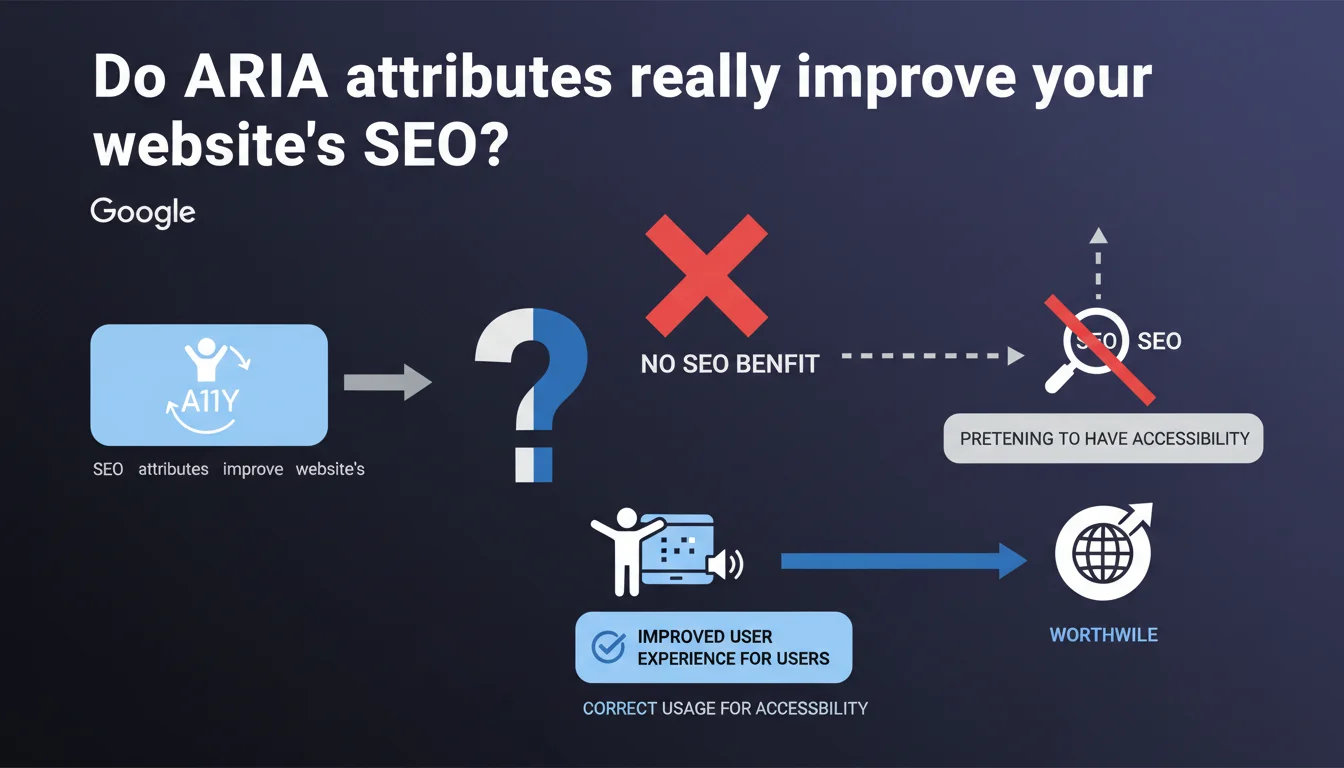
Google states that ARIA attributes offer no direct SEO advantage. Their use is exclusively for accessibility, not for search engine optimization. Pretending to have accessibility features serves absolutely nothing for your rankings.
What you need to understand
Why does Google insist on clarifying that ARIA attributes have no SEO impact?
Confusion has persisted for years in the SEO community. Some practitioners still believe that stuffing a website with ARIA attributes — aria-label, aria-describedby, role — improves rankings because it "enriches the content" or "helps robots understand better".
Google puts an end to it. ARIA attributes serve exclusively assistive technologies like screen readers. Googlebot completely ignores them in its ranking process.
What does it concretely mean to "pretend to have accessibility features"?
It means adding ARIA attributes without actually implementing accessibility. For example: slapping an aria-label="main menu" on a clickable div that is neither a button nor a link — just to "optimize".
Or using role="navigation" everywhere hoping Google will better understand the structure. It doesn't work. Worse, it creates false accessibility that fools audit tools without helping real users.
Does accessibility really have no connection to SEO at all?
Important clarification. Google says that ARIA attributes themselves have no direct SEO advantage. That doesn't mean overall accessibility is useless for search rankings.
A well-structured website using semantic HTML — <nav>, <main>, <header> tags, logical heading hierarchy — helps both accessibility AND SEO. ARIA attributes come as a complement when HTML alone isn't enough, but they never replace a solid semantic foundation.
- ARIA attributes are not indexed by Google as a ranking factor
- Their use should only address actual accessibility needs
- Semantic HTML remains the common foundation for both SEO and accessibility
- Millions of users depend on these attributes — reason enough to implement them correctly
SEO Expert opinion
Is this statement consistent with real-world observations?
Completely. No serious empirical test has ever shown that adding ARIA attributes — on their own, without improving the underlying HTML — impacts rankings. Cases where gains are observed after "accessibility optimization" actually stem from a complete overhaul of global semantic markup.
The myth persists because accessibility and SEO share common goals: structural clarity, logical hierarchy, understandable navigation. But correlating the two doesn't mean direct causality.
Why does Google emphasize that "it's worthwhile even without SEO benefit"?
Because too many decision-makers still justify accessibility budgets with vague SEO promises. Google wants to break this narrative. Accessibility is an ethical and legal imperative — not a positioning lever.
Let's be honest: many sites only invest in accessibility if they see an SEO ROI. This statement makes it crystal clear that this isn't the right motivation — and you should do it anyway.
What are the exceptions or edge cases to watch out for?
There are situations where ARIA indirectly impacts SEO. If a site misuses ARIA attributes and creates a disastrous user experience for assistive technologies, it can affect behavioral signals — bounce rate, time on site.
Similarly, a JavaScript-heavy site that requires ARIA to be navigable could see its SEO suffer not because of ARIA, but because Googlebot struggles with JavaScript rendering. The problem isn't ARIA, but the overall technical architecture. [To verify]: no public data quantifies this impact in isolation.
Practical impact and recommendations
What should you concretely do after this statement?
Stop adding ARIA attributes "for SEO". If you've already stuffed your code with unnecessary aria-label or redundant role attributes, it probably doesn't hurt — but it doesn't help either.
Focus on pure semantic HTML. Use the right tags — <button> for buttons, <a> for links, <h1> through <h6> in logical order. ARIA only comes into play if HTML cannot convey the necessary information.
What mistakes should you absolutely avoid?
Never justify an accessibility budget with hypothetical SEO gains. It's dishonest and discredits both disciplines. Accessibility has its own reasons to exist — legal, ethical, commercial.
Don't mix everything together. An accessible site is not automatically well-ranked. A well-ranked site isn't necessarily accessible. The two share fundamentals (clear structure, logical navigation) but don't overlap.
How do you verify that your approach is correct?
Audit your HTML with W3C validation tools. If your semantics are clean, you've done the essentials for SEO. Next, test accessibility with a screen reader — NVDA on Windows, VoiceOver on Mac — and see if navigation is smooth.
If you need to add ARIA, document why. "To improve search rankings" is not a valid justification. "Because this custom JavaScript component has no native HTML equivalent" is.
- Prioritize native semantic HTML before any ARIA attribute
- Only add ARIA if HTML alone is insufficient to make content accessible
- Test with real users or screen readers, not just automated tools
- Never sell accessibility as an "SEO hack"
- Train your teams: accessibility AND SEO share foundations, but have distinct objectives
❓ Frequently Asked Questions
Les attributs ARIA peuvent-ils nuire au SEO s'ils sont mal utilisés ?
Faut-il supprimer les attributs ARIA existants pour améliorer le SEO ?
Un site accessible se positionne-t-il mieux dans Google ?
Google pénalise-t-il les sites non accessibles ?
Dois-je quand même implémenter ARIA si ça n'aide pas le SEO ?
🎥 From the same video 15
Other SEO insights extracted from this same Google Search Central video · published on 09/08/2023
🎥 Watch the full video on YouTube →
💬 Comments (0)
Be the first to comment.