
Official statement
Other statements from this video 15 ▾
- □ Pourquoi Google limite-t-il les sitemaps à 50 000 URLs, index compris ?
- □ Les attributs ARIA améliorent-ils vraiment le SEO de votre site ?
- □ Faut-il vraiment rediriger les URL canonicalisées pour améliorer son référencement ?
- □ Google ignore-t-il vraiment les fragments d'URL (#) pour le référencement ?
- □ Pourquoi l'optimisation technique seule ne fait-elle plus ranker un site ?
- □ Comment vérifier si votre site est sous pénalité manuelle dans Search Console ?
- □ Hreflang fonctionne-t-il vraiment pour du contenu non traduit mais ciblant des pays différents ?
- □ Le contraste des couleurs impacte-t-il vraiment le référencement naturel ?
- □ La balise HTML <article> améliore-t-elle vraiment le référencement ?
- □ Liens relatifs vs absolus : y a-t-il vraiment un impact SEO ?
- □ Faut-il vraiment imposer l'anglais dans les données structurées pour les jours de la semaine ?
- □ Comment vérifier qu'un crawler est réellement Googlebot et bloquer les imposteurs ?
- □ Faut-il vraiment utiliser prefetch et prerender pour améliorer son SEO ?
- □ Faut-il vraiment oublier le cache Google pour diagnostiquer l'indexation ?
- □ Pourquoi Google indexe-t-il du contenu qui n'existe pas sur votre site ?
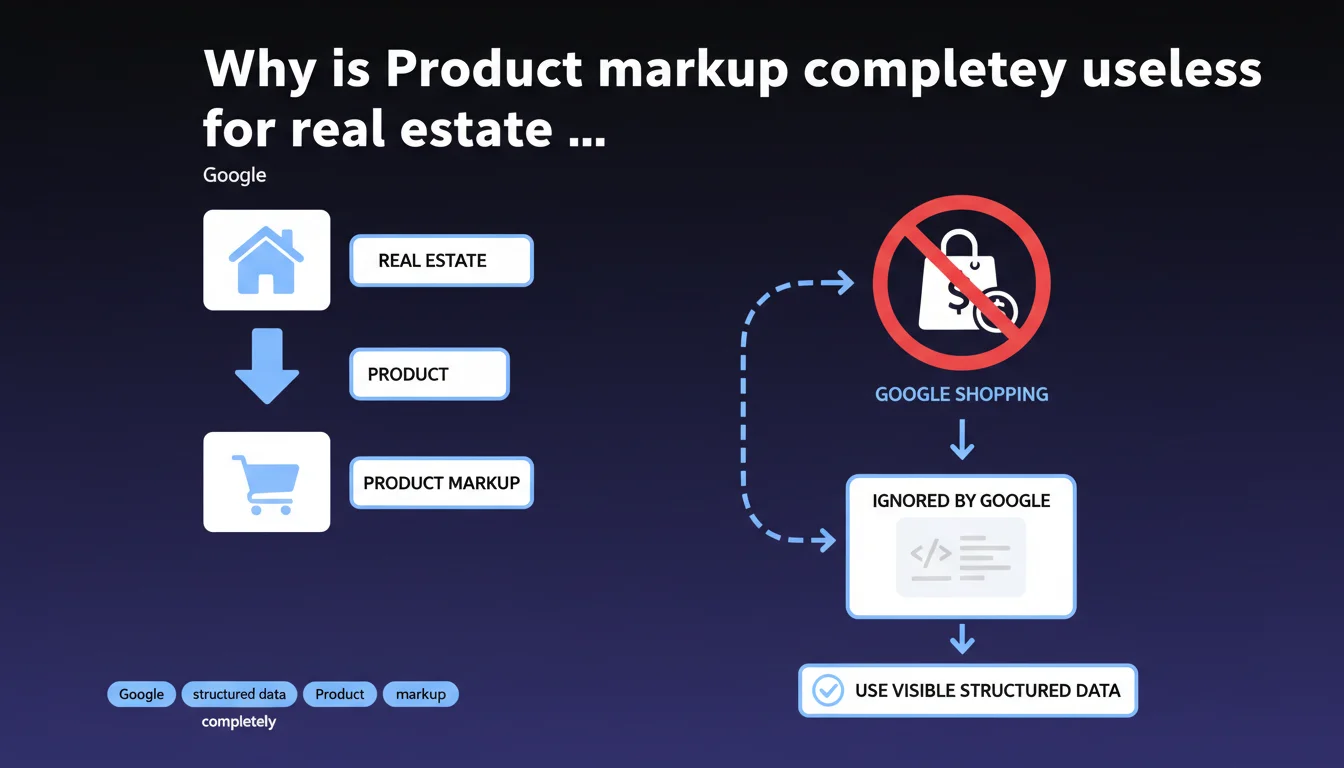
Google confirms that Product structured data applied to real estate is simply ignored by its systems. Shopping does not support real estate properties, and the markup will have no visible effect — neither positive nor negative. You're better off using schemas that actually produce results.
What you need to understand
Why does Google reject Product for real estate?
The answer is simple: Google Shopping only handles movable products, not fixed real estate properties. An apartment, a house, or a piece of land cannot be shipped in a package, and the very logic of Shopping — price comparison, market availability, add to cart — simply does not apply.
Product markup was designed for items that circulate physically or digitally. Applying this schema to a real estate property is like forcing an inappropriate taxonomy into a context where it has no practical value.
Is it considered spam or abuse?
No. Google explicitly states: it is not an abuse, just a functional incompatibility. You will not be penalized for using Product on a real estate listing. The markup will simply be ignored, with no negative consequences for your rankings.
That said, why waste time implementing a schema that serves absolutely no purpose? You might as well invest that development budget elsewhere.
What schemas should you use for real estate then?
Google does not specify this in this statement — and that's where the problem lies. The valid alternatives for real estate remain unclear. One could consider RealEstateListing, but its actual support by Google remains unconfirmed in the field.
There are also local schemas like Place or LocalBusiness to provide geographic context to a property, but again, there is no guarantee of enriched display in the SERPs.
- Product markup is ignored for real estate, with no penalty
- Google Shopping only handles movable commercial products
- Alternatives (RealEstateListing, Place) lack official confirmation of their effectiveness
- Prioritize schemas with a documented visible effect
SEO Expert opinion
Is this statement consistent with field observations?
Absolutely. For years, we have observed that Product triggers no rich snippets for real estate. No star ratings, no prices displayed in the SERPs, no "in stock" badges. Real estate sites that attempted this have hit the same wall: radio silence on the enriched display side.
What Google confirms here is a reality we have already observed empirically. But it remains frustrating: where are the clear guidelines on which schemas to use instead?
Why doesn't Google propose a documented alternative solution?
Good question. Google says "use structured data that has a visible effect," but gives no concrete examples for real estate. This is typical of their approach: point out the problem without providing the operational solution.
[To verify] The RealEstateListing schema exists in Schema.org, but its support by Google remains officially undocumented. We are in a gray area where you need to test in production to know if it produces a result.
Should you immediately remove Product from existing real estate sites?
Technically, it is not urgent since Google ignores the markup without penalty. But from a technical ROI perspective, yes, it makes sense to clean it up. Why clutter your code and your Search Console reports with a useless schema?
Instead redirect your development resources toward schemas that have a real chance of improving your SERP performance — or toward other optimizations with measurable impact.
Practical impact and recommendations
What should you do concretely on an existing real estate site?
First step: audit your current markup. If you have deployed Product on your real estate listings, document it but do not panic — you are not being penalized.
Next, prioritize removing or migrating to a more suitable schema. RealEstateListing seems like the logical candidate, even if its Google support remains to be validated by your own testing.
What mistakes should you avoid during migration?
Do not replace Product with just any other schema just to "have something." Inappropriate or poorly implemented markup can generate errors in Search Console and pollute your reports.
Also avoid overloading your pages with multiple redundant schemas "just in case." Google favors clarity: one well-implemented main schema is better than three approximate schemas stacked together.
- Identify all pages currently using Product markup for real estate
- Test RealEstateListing on a sample of pages and monitor SERP results
- Verify that mandatory properties (price, address, area) are properly filled in
- Clean up unnecessary schemas to reduce code clutter and Search Console reports
- Document tests and results to adjust your strategy based on observations
How do you measure the impact of a schema change?
Track your click-through rates in Search Console on the affected pages before and after migration. Enriched display should theoretically improve CTR — but only if Google actually displays something.
Also monitor the "Enhancements" reports in Search Console to detect any validation errors. A technically valid schema that is not supported will trigger no visible improvement, and that's where you will know if you are on the right track or not.
❓ Frequently Asked Questions
Est-ce que j'ai un risque de pénalité si j'ai déjà Product sur mes fiches immo ?
Quel schema utiliser à la place de Product pour l'immobilier ?
Les validateurs de balisage peuvent-ils confirmer qu'un schema fonctionne vraiment ?
Google Shopping peut-il un jour supporter l'immobilier ?
Faut-il retirer Product immédiatement ou puis-je attendre ?
🎥 From the same video 15
Other SEO insights extracted from this same Google Search Central video · published on 09/08/2023
🎥 Watch the full video on YouTube →
💬 Comments (0)
Be the first to comment.