
Official statement
Other statements from this video 15 ▾
- □ Pourquoi Google limite-t-il les sitemaps à 50 000 URLs, index compris ?
- □ Les attributs ARIA améliorent-ils vraiment le SEO de votre site ?
- □ Faut-il vraiment rediriger les URL canonicalisées pour améliorer son référencement ?
- □ Google ignore-t-il vraiment les fragments d'URL (#) pour le référencement ?
- □ Pourquoi l'optimisation technique seule ne fait-elle plus ranker un site ?
- □ Comment vérifier si votre site est sous pénalité manuelle dans Search Console ?
- □ Pourquoi le balisage Product ne sert à rien pour l'immobilier ?
- □ Hreflang fonctionne-t-il vraiment pour du contenu non traduit mais ciblant des pays différents ?
- □ Le contraste des couleurs impacte-t-il vraiment le référencement naturel ?
- □ La balise HTML <article> améliore-t-elle vraiment le référencement ?
- □ Liens relatifs vs absolus : y a-t-il vraiment un impact SEO ?
- □ Comment vérifier qu'un crawler est réellement Googlebot et bloquer les imposteurs ?
- □ Faut-il vraiment utiliser prefetch et prerender pour améliorer son SEO ?
- □ Faut-il vraiment oublier le cache Google pour diagnostiquer l'indexation ?
- □ Pourquoi Google indexe-t-il du contenu qui n'existe pas sur votre site ?
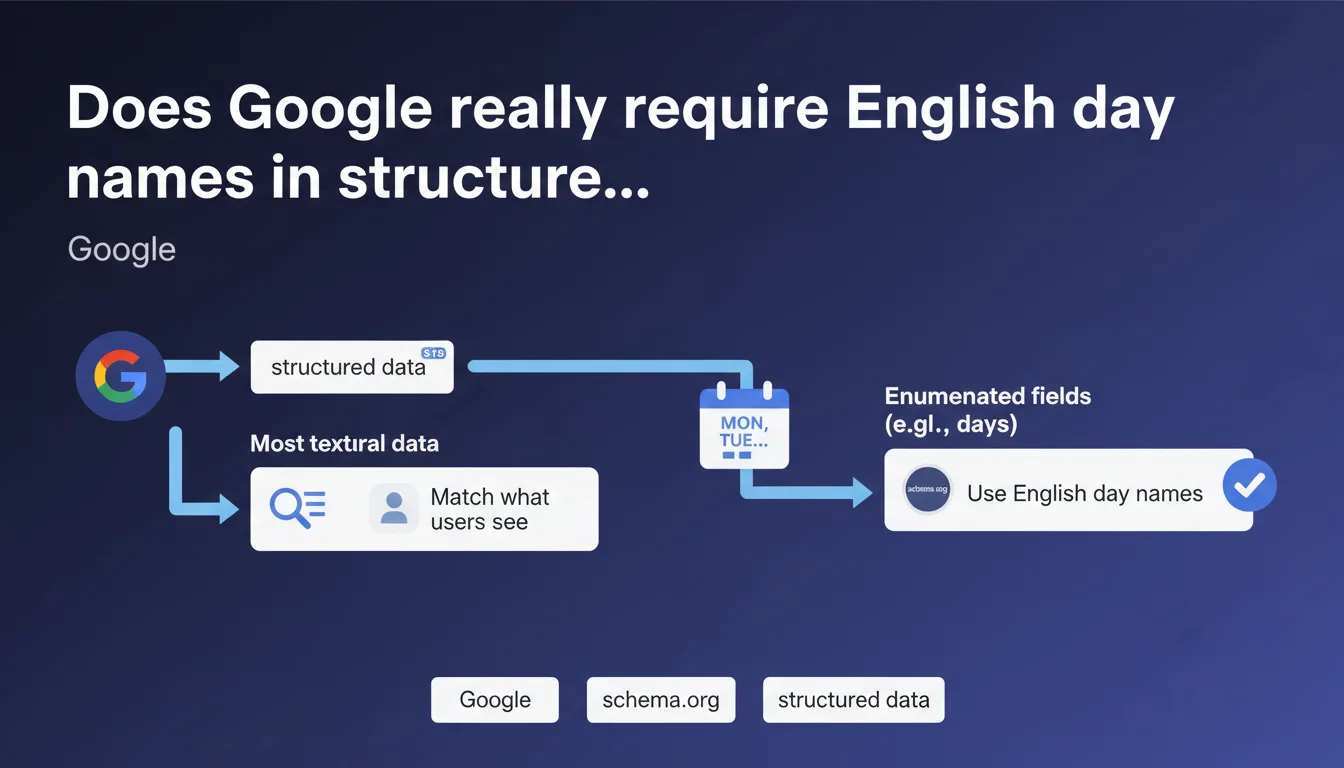
Google requires the use of English day names (Monday, Tuesday, etc.) in the day-of-week fields of structured data, even for non-English websites. This rule follows the schema.org specification and applies independently of the language displayed to users, unlike the general principle of content-markup consistency.
What you need to understand
Why is this an exception to the text-markup consistency principle?
Google enforces a fundamental rule: your structured data must reflect what the user sees. If your page displays "15 rue de la Paix", your LocalBusiness markup must contain exactly that address, not a translation or variant.
But day names are an exception. The day-of-week field requires English values according to schema.org — even if your French site displays "Open Monday to Friday".
Which fields are affected by this rule?
Concretely, this constraint affects the OpeningHoursSpecification properties used in LocalBusiness, Organization, or Place. The dayOfWeek field expects standardized values: Monday, Tuesday, Wednesday, etc.
A Japanese e-commerce site displaying 月曜日 (Monday in Japanese) must still encode "Monday" in its markup. This standardization allows Google to process schedules uniformly regardless of the site's language.
Does schema.org really impose English everywhere?
No, and that's where it gets interesting. Schema.org uses strict enumerations for certain fields — days of the week, but also payment methods (PaymentMethod), currencies, country codes.
For these enumerated values, schema.org imposes standardized identifiers in English. For everything else (names, descriptions, addresses), you use your natural language.
- General principle: structured data reflects content visible to the user
- Exception: day-of-week fields must use English names (Monday, Tuesday, etc.)
- Reason: schema.org defines these values as a standardized enumeration
- Impact: no penalty if you display "Monday" to users but encode "Monday" in the markup
- Similar fields: PaymentMethod, Currency, Country follow the same normalization logic
SEO Expert opinion
Is Google really enforcing this requirement?
Yes, and it's verifiable in Search Console. Validation errors are flagged explicitly when you use translated day names in dayOfWeek. Google rejects "lundi" or "Montag" — it expects strictly English values.
However — and this is where it gets tricky — there's no clear communication indicating whether this impacts your eligibility for rich schedule snippets. [To verify] on a significant sample of misconfigured multilingual sites: do they really lose their enriched display?
Does the consistency principle still apply elsewhere?
Absolutely. This exception should not overshadow the golden rule: for 99% of your structured properties, what you mark up must match what you show.
A French LocalBusiness displaying "Boulangerie Dupont" should not encode "Dupont Bakery" under the pretext of targeting an English-speaking audience. Google detects these inconsistencies and may ignore your markup or even apply a manual action for structured data spam.
What about languages using non-Latin alphabets?
Same situation. A Russian, Chinese, or Arabic site must encode "Monday" in dayOfWeek, even if the interface displays понедельник, 星期一, or الاثنين.
It's counter-intuitive for developers localizing their applications, but schema.org functions as a machine communication protocol, not a user interface. English serves as a lingua franca for search engines.
Practical impact and recommendations
How should you properly encode opening hours?
Use the OpeningHoursSpecification structure with dayOfWeek in English, even if your visible content is translated. Example for a French site:
Your page displays: "Open Monday to Friday, 9am-6pm"
Your markup encodes: "dayOfWeek": ["Monday", "Tuesday", "Wednesday", "Thursday", "Friday"]
- Verify in the source code that dayOfWeek contains Monday, Tuesday, etc. (never lundi, Montag, lunedì)
- Test your markup with Google's structured data validation tool
- Check Search Console (Enhancements > Local Businesses) for validation errors
- Audit plugins and CMS: some automatically translate these values (common mistake)
- Apply the same logic to PaymentMethod ("CreditCard" not "Credit card") and Currency ("EUR" not "€")
- Document this exception for your dev and translation teams — it's counter-intuitive
Which tools can detect these errors?
Google's schema validator (Rich Results Test) explicitly flags non-conforming values. Search Console also surfaces these errors in the dedicated local business section.
For a comprehensive audit, tools like Schema Markup Validator or Screaming Frog allow you to scan all your pages and identify inconsistencies across languages. Prioritize manual verification of your key templates before deployment.
Should you urgently correct translated day names?
It depends on your reliance on schedule rich snippets. If you're a local business counting on enriched display in the SERPs, fix it quickly. Losing these snippets directly impacts your CTR.
For a B2B e-commerce site where schedules are secondary, the priority is lower — but plan the correction anyway. Google could tighten its stance at any time.
❓ Frequently Asked Questions
Puis-je utiliser les jours en français si mon site est uniquement francophone ?
Cette règle s'applique-t-elle aussi aux champs opens et closes ?
Que se passe-t-il si j'utilise des jours traduits dans mes données structurées ?
Les codes ISO (Mo, Tu, We) sont-ils acceptés comme alternative ?
Cette exception concerne-t-elle d'autres champs que les jours de la semaine ?
🎥 From the same video 15
Other SEO insights extracted from this same Google Search Central video · published on 09/08/2023
🎥 Watch the full video on YouTube →
💬 Comments (0)
Be the first to comment.