
Official statement
Other statements from this video 15 ▾
- □ Pourquoi Google limite-t-il les sitemaps à 50 000 URLs, index compris ?
- □ Les attributs ARIA améliorent-ils vraiment le SEO de votre site ?
- □ Google ignore-t-il vraiment les fragments d'URL (#) pour le référencement ?
- □ Pourquoi l'optimisation technique seule ne fait-elle plus ranker un site ?
- □ Comment vérifier si votre site est sous pénalité manuelle dans Search Console ?
- □ Pourquoi le balisage Product ne sert à rien pour l'immobilier ?
- □ Hreflang fonctionne-t-il vraiment pour du contenu non traduit mais ciblant des pays différents ?
- □ Le contraste des couleurs impacte-t-il vraiment le référencement naturel ?
- □ La balise HTML <article> améliore-t-elle vraiment le référencement ?
- □ Liens relatifs vs absolus : y a-t-il vraiment un impact SEO ?
- □ Faut-il vraiment imposer l'anglais dans les données structurées pour les jours de la semaine ?
- □ Comment vérifier qu'un crawler est réellement Googlebot et bloquer les imposteurs ?
- □ Faut-il vraiment utiliser prefetch et prerender pour améliorer son SEO ?
- □ Faut-il vraiment oublier le cache Google pour diagnostiquer l'indexation ?
- □ Pourquoi Google indexe-t-il du contenu qui n'existe pas sur votre site ?
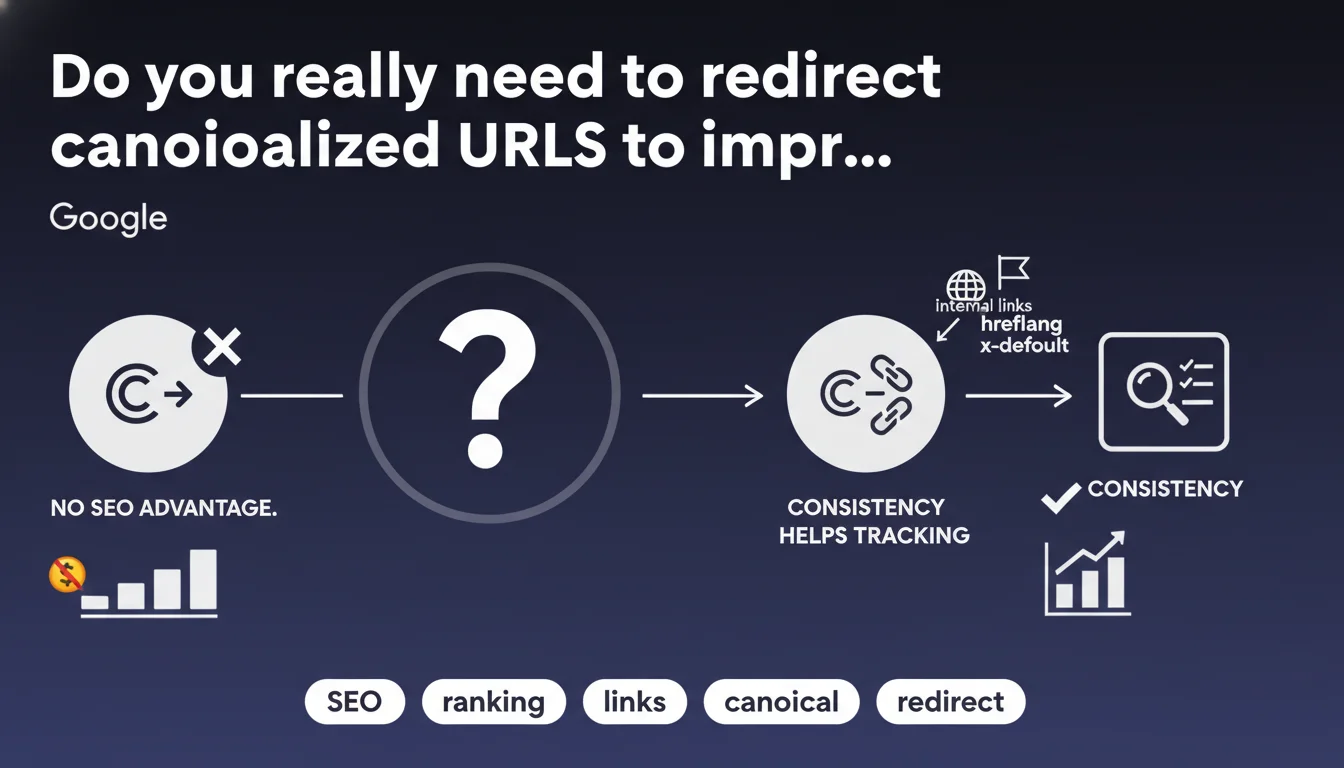
Redirecting an already canonicalized URL changes strictly nothing for SEO. Google recommends being consistent with canonicals and x-default to facilitate technical tracking, but claims this consistency doesn't directly influence ranking. The real question: does this supposed neutrality hold up in real-world testing?
What you need to understand
What does "canonicalization without impact" really mean?
Google states clearly that adding a 301 redirect to a URL already designated as canonical via the rel="canonical" tag provides no SEO benefit. In other words: if page-B already points to page-A as the canonical version, redirecting page-B to page-A via HTTP changes nothing in terms of ranking.
This statement sets a clear framework — at least on the surface. Google separates technical consistency (useful for your internal tracking, your logs, your audits) from algorithmic impact (nil according to them). Canonicalization via tag would be sufficient to transfer all signals; the HTTP redirect would add nothing.
Why does Google insist on consistency then?
Because maintaining uniform logic between canonical, hreflang x-default and internal links simplifies crawling and avoids ambiguities. If you declare page-A as canonical but your internal links point to page-B, Google must make a decision — and you lose clarity.
The underlying message: be predictable. Make the bot's job easier, even if it doesn't directly boost your rankings. This is a maintenance argument, not a performance one.
- Redirecting a canonicalized URL: no direct SEO gain according to Google
- Consistency between canonical and hreflang x-default: useful for technical tracking, not for ranking
- Aligned internal links: reduce conflicting signals and improve crawlability
- Algorithmic impact: Google claims it is zero — to be validated in the field
SEO Expert opinion
Does this statement hold up against real-world testing?
Let's be honest: claiming that an HTTP redirect adds no signal compared to a declarative canonical ignores the fact that Google itself treats these two mechanisms as canonicalization hints, not absolute directives. And not all hints carry the same weight.
In practice, we regularly observe that sites that have cleaned up their redirects after canonicalization see improvements in crawl budget and indexation stabilization. [To be verified]: is this improvement correlated with ranking or does it remain purely technical? Google provides no metric to settle this.
What nuances should be added to this rule?
The statement relies on an assumption: that your canonical is properly recognized. However, Google sometimes chooses to ignore your canonical tag if it judges another URL to be more relevant (different content, contradictory hreflang, massive backlinks to the secondary URL).
If your canonical is contested by other signals, adding an HTTP redirect can strengthen the decision in your favor — because a 301 is a stronger signal than an HTML tag. Saying it has "no impact" is therefore misleading: it depends on your canonicalization context.
In what cases does this rule not apply?
When you have external backlinks pointing to the secondary URL. Google consolidates PageRank via canonical, certainly, but the HTTP redirect ensures that the user (and the bot) land on the right version. This affects user experience and consistency of engagement metrics.
Another case: multilingual or multiregional sites with hreflang. If your x-default points to a non-redirected but canonicalized URL elsewhere, you create a disconnect between language signal and content signal. This complicates algorithmic processing, even if Google claims it's neutral.
Practical impact and recommendations
What should you do concretely on your sites?
First rule: audit your canonicals. Use Screaming Frog or your logs to identify canonicalized URLs that still generate recurring crawl. If they receive regular hits without reason (no backlinks, no user traffic), consider redirecting to clean up your crawl budget.
Second rule: align hreflang x-default and canonical. If your default page for international visitors is page-A, it must be both your x-default AND your canonical. Otherwise, you're sending contradictory signals.
What mistakes should you absolutely avoid?
Never redirect a canonicalized URL if it still receives significant direct traffic (campaigns, social shares, emails). The redirect will break shared URLs and you'll lose traffic — even if SEO theoretically remains neutral.
Also avoid canonicalizing and then redirecting in a chain (page-C > page-B > page-A). Google follows up to 5 hops, but each step dilutes signals and lengthens processing time. Consolidate directly.
How can you verify that your configuration is optimal?
Run your strategic URLs through Google Search Console's URL inspection tool. Compare the requested URL, the declared canonical URL, and the canonical URL selected by Google. If they differ, dig deeper: backlinks, hreflang, redirect chains.
Monitor your coverage reports to detect URLs "Excluded by canonical tag". If their number explodes for no reason, it might be a sign of conflict between canonical and other signals.
- Audit canonicalized URLs generating unnecessary crawl
- Align hreflang x-default and canonical on the same reference URL
- Avoid redirect chains after canonicalization
- Verify in Search Console that Google respects your declared canonicals
- Don't redirect if the canonicalized URL receives significant direct traffic
- Monitor crawl budget evolution after modifications
❓ Frequently Asked Questions
Si je redirige une URL déjà canonicalisée, est-ce que je perds du PageRank ?
Faut-il systématiquement rediriger toutes les URLs canonicalisées ?
Quelle est la différence entre canonical et x-default en hreflang ?
Google respecte-t-il toujours la balise canonical que je déclare ?
Comment savoir si mes canonicals sont bien pris en compte ?
🎥 From the same video 15
Other SEO insights extracted from this same Google Search Central video · published on 09/08/2023
🎥 Watch the full video on YouTube →
💬 Comments (0)
Be the first to comment.