
Official statement
Other statements from this video 15 ▾
- □ Why does Google cap sitemaps at 50,000 URLs, and how does it impact large websites?
- □ Do ARIA attributes really improve your website's SEO?
- □ Do you really need to redirect canonicalized URLs to improve your search rankings?
- □ Does Google really ignore URL fragments (#) for SEO purposes?
- □ Why isn't perfect technical optimization enough to rank your site anymore?
- □ Is your website hit by a manual penalty? Here's exactly how to check in Search Console
- □ Why is Product markup completely useless for real estate listings?
- □ Can you really use hreflang for non-translated content targeting different regions?
- □ Does color contrast really impact your SEO rankings?
- □ Do Relative and Absolute Links Really Make a Difference for SEO?
- □ Does Google really require English day names in structured data for non-English websites?
- □ How can you verify that a crawler is really Googlebot and block fake ones without hurting your SEO?
- □ Should you really use prefetch and prerender to boost your SEO rankings?
- □ Should you really stop relying on Google cache to diagnose indexation issues?
- □ Is Google really indexing content that doesn't exist on your site?
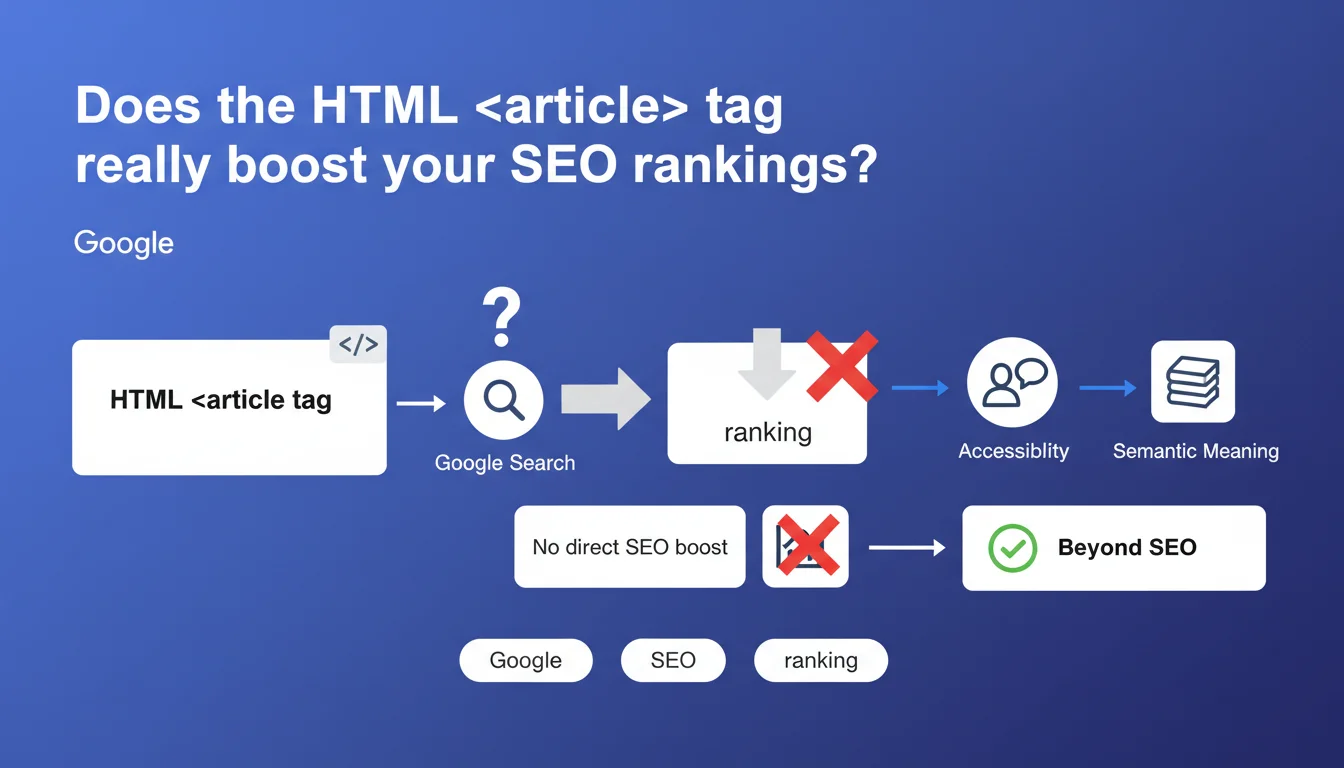
Google states that the <article> tag has no impact on ranking in its search results. It joins a long list of semantic HTML elements that do not directly influence SEO, even though their use remains relevant for accessibility and code structuring.
What you need to understand
Why is Google making this clarification?
Google's statement comes at a time when many SEO practitioners over-invest in HTML5 semantic markup, believing it directly influences rankings. The <article> tag, introduced with HTML5, was theoretically supposed to help search engines identify self-contained and reusable content.
Except Google cuts to the chase: this tag has no particular effect in its search engine. It doesn't enhance crawling, doesn't boost indexation, doesn't modify ranking. Period.
What does this mean for using semantic tags?
Google clarifies that HTML serves far more than just SEO. Tags like <article>, <section>, or <aside> have semantic and accessibility value — they help screen readers, structure the DOM for developers, and facilitate code maintenance.
But from a strictly SEO perspective, their presence or absence changes nothing about ranking. Google relies on other signals: text content, links, technical performance, JSON-LD structured data.
Which HTML tags really matter for Google?
If <article> does nothing for rankings, what actually counts? Heading tags (h1, h2, h3…), image alt attributes, internal and external links, meta tags (title, description). And of course, everything related to performance (lazy loading, defer, preload) and structured data (JSON-LD).
- The
<article>tag does not influence Google rankings - It retains utility for accessibility and code structuring
- Google prioritizes other HTML elements to understand and rank pages
- HTML5 semantic markup does not replace traditional SEO signals
SEO Expert opinion
Does this statement match real-world observations?
Yes, completely. No serious SEO test has ever demonstrated that adding or removing <article> changes rankings. Audits recommending wrapping every blog post in an <article> to "boost SEO" are selling snake oil.
What works is clean HTML structure (coherent heading hierarchy), well-written content, relevant internal links, and properly implemented JSON-LD structured data. Not a container tag that provides no exploitable information to Googlebot.
Should semantic HTML be abandoned entirely?
No. Google explicitly states there's "much more to using HTML than just Google Search." It's a healthy reminder: SEO isn't the only criterion for quality web design.
Semantic markup facilitates maintenance, improves accessibility (WCAG, RGAA), helps developers understand code, and can serve in other contexts (RSS feeds, APIs, syndication). If your dev team uses it correctly, keep it. But don't expect SEO miracles.
What are the limits of this statement?
Google remains vague about what actually matters in HTML. We know heading tags structure content, but how much weight do they carry against Core Web Vitals or backlinks? [Needs verification]
Likewise, Google doesn't detail whether certain tag combinations (for example <article> + Article structured data) could have an indirect effect on SERP display (featured snippets, rich results). That remains unclear.
Practical impact and recommendations
What should you concretely change on your site?
If you already use <article>, don't rush to remove everything. It won't harm, and it can serve other purposes (accessibility, CSS, scripts). However, if your dev team spends hours perfecting every HTML5 semantic tag hoping to climb the SERPs, redirect those efforts.
Focus on what truly moves the needle: optimizing title and meta description tags, coherent heading structure, strategic internal linking, improving Core Web Vitals, and properly configured JSON-LD structured data.
What mistakes should you avoid with semantic HTML?
Don't sacrifice performance or code maintainability in the name of semantic HTML. A fast, well-structured site with regular <div> tags will always beat a slow site packed with cutting-edge HTML5 semantic tags.
Also avoid neglecting real SEO leverage: quality content, user experience, domain authority, and link building. Semantic HTML will never compensate for weak content or slow pages.
How do you verify your site is relying on the right HTML elements?
- Audit the heading hierarchy (unique h1, logical h2-h3) using tools like Screaming Frog or Oncrawl
- Verify all images have descriptive and relevant alt attributes
- Check meta tags (title, description): unique, optimized, without duplication
- Implement JSON-LD structured data (Article, Breadcrumb, FAQ, etc.) and test with Google's Rich Results Test
- Measure Core Web Vitals (LCP, FID, CLS) and fix blocking issues
- Analyze internal linking to efficiently distribute PageRank
<article> tag won't improve your SEO — focus on headings, links, performance, and structured data instead. If your team lacks resources or expertise to properly prioritize these technical optimizations, support from a specialized SEO agency can help you identify high-impact levers and implement a coherent strategy without scattering your efforts.❓ Frequently Asked Questions
Est-ce que la balise <article> peut nuire au référencement si elle est mal utilisée ?
Faut-il supprimer toutes les balises <article> de mon site ?
Les autres balises HTML5 sémantiques (<section>, <aside>, <nav>) ont-elles un impact SEO ?
Les données structurées JSON-LD sont-elles plus efficaces que le balisage HTML sémantique ?
Pourquoi Google insiste-t-il sur l'accessibilité et la sémantique si cela n'impacte pas le SEO ?
🎥 From the same video 15
Other SEO insights extracted from this same Google Search Central video · published on 09/08/2023
🎥 Watch the full video on YouTube →
💬 Comments (0)
Be the first to comment.