
Official statement
Other statements from this video 15 ▾
- □ Pourquoi Google limite-t-il les sitemaps à 50 000 URLs, index compris ?
- □ Les attributs ARIA améliorent-ils vraiment le SEO de votre site ?
- □ Faut-il vraiment rediriger les URL canonicalisées pour améliorer son référencement ?
- □ Google ignore-t-il vraiment les fragments d'URL (#) pour le référencement ?
- □ Pourquoi l'optimisation technique seule ne fait-elle plus ranker un site ?
- □ Comment vérifier si votre site est sous pénalité manuelle dans Search Console ?
- □ Pourquoi le balisage Product ne sert à rien pour l'immobilier ?
- □ Le contraste des couleurs impacte-t-il vraiment le référencement naturel ?
- □ La balise HTML <article> améliore-t-elle vraiment le référencement ?
- □ Liens relatifs vs absolus : y a-t-il vraiment un impact SEO ?
- □ Faut-il vraiment imposer l'anglais dans les données structurées pour les jours de la semaine ?
- □ Comment vérifier qu'un crawler est réellement Googlebot et bloquer les imposteurs ?
- □ Faut-il vraiment utiliser prefetch et prerender pour améliorer son SEO ?
- □ Faut-il vraiment oublier le cache Google pour diagnostiquer l'indexation ?
- □ Pourquoi Google indexe-t-il du contenu qui n'existe pas sur votre site ?
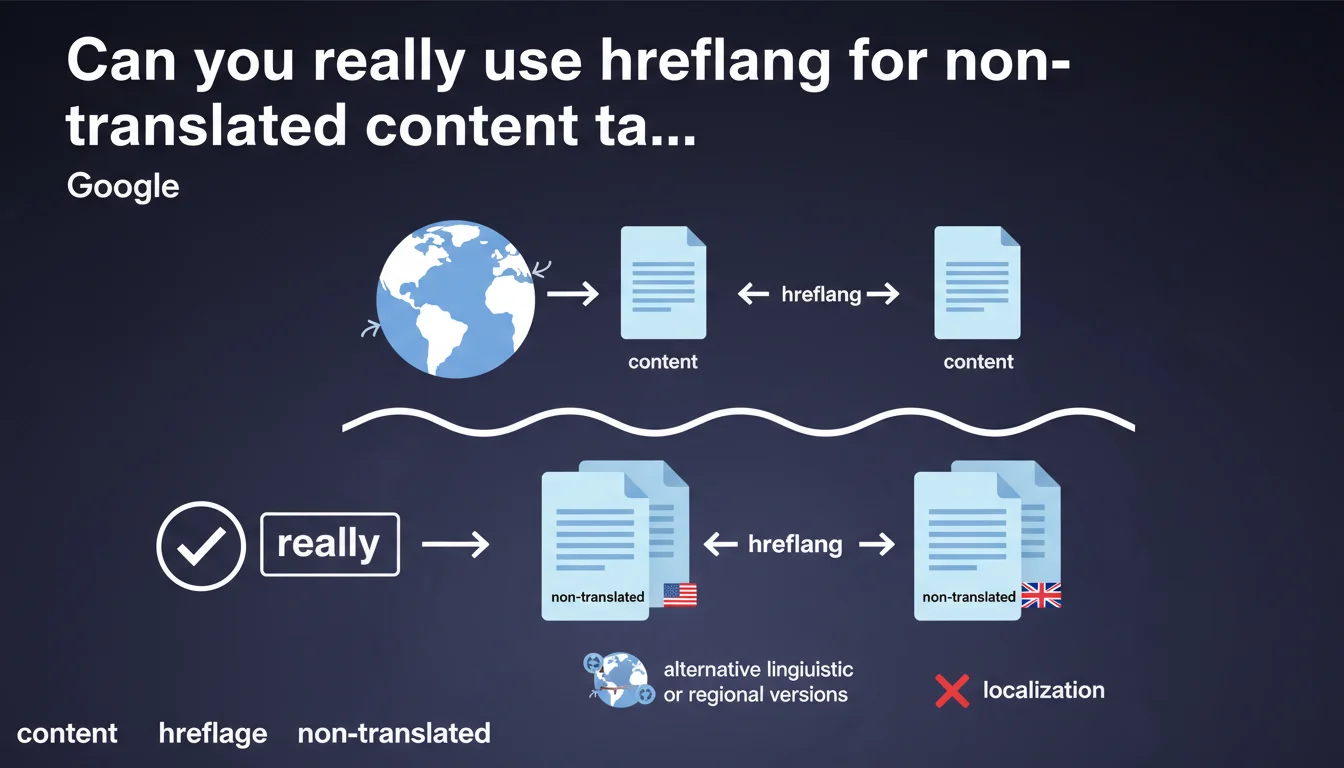
Google confirms that hreflang isn't limited to strict translations. You can use it to signal very similar content targeting different countries, even if it's not a word-for-word translation. The nuance: these are linguistic or regional versions, not simple marketing localization.
What you need to understand
Is hreflang only for exact translations?
No, and that's where many SEOs get it wrong. Google clarifies that hreflang can link very similar content targeting different countries, even without a direct translation. Concretely? A page in English for the UK and another in English for the US can be linked by hreflang.
The trap is confusing "similar" with "almost identical". If your pages differ only by a few words or a currency, you're using it correctly. If the content is radically different, hreflang serves no purpose.
What's the difference between linguistic/regional versions and localization?
Google contrasts alternative versions and pure localization. An alternative version addresses the same user need in another language or region. Marketing localization — adapting tone, visuals, offers — doesn't systematically justify an hreflang tag.
Concrete example: a UK English product page with prices in pounds and a US version with prices in dollars = regional versions. A promotional campaign specific to the French market with no equivalent elsewhere = not an alternative version, so hreflang is inappropriate.
Why does Google insist on "very similar"?
Because hreflang tells Google that pages are interchangeable for different audiences. If the content diverges too much, you send a contradictory signal: either these pages are alternatives, or they target different intentions.
Google wants to prevent you from using hreflang as a crutch to manage duplicate content or competing pages. The algorithm needs to understand that these URLs address the same need, just for a different geolocation audience.
- Hreflang works for similar content, not only for perfect translations
- Use it for linguistic or regional versions, not for simple marketing variants
- Content must be very similar: same user intent, same structure, minor regional adaptations
- Don't confuse localization (deep cultural adaptation) with alternative versions (same content, different language/region)
SEO Expert opinion
Is this statement consistent with real-world observations?
Yes and no. On paper, Google is right: hreflang handles multi-region similar content well. In practice, the boundary between "similar" and "too different" remains fuzzy. I've seen sites with nearly identical UK/US English pages (only currency changes) where hreflang worked perfectly. And others where 30% content differences caused indexing inconsistencies.
The problem is that Google doesn't define "very similar". 80% common content? 90%? [To verify] — no official data on this. Result: we're flying blind, and some sites end up with cannibalized or poorly geographically targeted pages.
What nuances should be added to this claim?
Let's be honest: hreflang is a signal, not a command. Google can ignore your tags if it detects inconsistencies — content too different, contradictory geographic signals (hosting, backlinks, local mentions), or implementation errors.
Another rarely mentioned point: hreflang doesn't fix duplicate content issues. If your UK/US pages are 95% identical, you first have a duplication problem to solve. Hreflang simply tells Google which version to show to which user — it doesn't magically whitewash duplicate content.
In what cases does this rule not apply?
If your pages target different search intentions, forget hreflang. Typical example: a "car insurance France" page with French regulations versus "car insurance USA" with American laws. Same topic, but user needs too distinct to be considered alternative versions.
Same if your content changes radically by region — local case studies, different teams, region-specific offers. In that case, you have distinct pages that should rank independently, not alternative versions to link with hreflang.
Practical impact and recommendations
What should you concretely do to use hreflang correctly?
First, audit your multi-region pages to verify they address the same user need. If you're unsure, compare structure: same H1/H2? Same sections? Only local references change? Then hreflang is relevant.
Next, implement it correctly. It might seem obvious, but 90% of hreflang errors come from sloppy syntax — poorly formatted language codes, non-reciprocal tags, URLs in HTTP while the site is HTTPS. Use an hreflang validator before deploying.
What errors must you avoid?
Never link pages with radically different content through hreflang. Google will detect the inconsistency and either ignore your tags or penalize your geographic targeting. Your similarity rate should exceed 70% minimum — below that, you're taking a risk.
Another classic pitfall: forgetting the x-default tag. It tells Google which version to show to users outside specified languages/regions. Without it, you let Google decide — and it doesn't always choose the right page.
- Verify that your multi-region pages have similar structure and intent (not just the same topic)
- Implement hreflang in HTML tags, HTTP headers, or sitemap — choose one method and stick with it
- Ensure reciprocity: if FR page points to EN page, EN page must point back to FR page
- Use correct ISO codes: en-GB, en-US, fr-FR (language-COUNTRY), no invented codes
- Always include an x-default tag for users outside your targets
- Test with Search Console: "International targeting" section to catch errors
- If your pages differ too much, consider separate pages without hreflang rather than forcing the link
❓ Frequently Asked Questions
Peut-on utiliser hreflang pour relier une page en anglais US et une autre en anglais UK ?
Quelle différence de contenu est acceptable entre deux pages reliées par hreflang ?
Hreflang résout-il un problème de duplicate content entre pages multi-régions ?
Faut-il utiliser hreflang pour des pages localisées avec ton et visuels adaptés ?
La balise x-default est-elle obligatoire dans une implémentation hreflang ?
🎥 From the same video 15
Other SEO insights extracted from this same Google Search Central video · published on 09/08/2023
🎥 Watch the full video on YouTube →
💬 Comments (0)
Be the first to comment.