
Official statement
Other statements from this video 15 ▾
- □ Pourquoi Google limite-t-il les sitemaps à 50 000 URLs, index compris ?
- □ Les attributs ARIA améliorent-ils vraiment le SEO de votre site ?
- □ Faut-il vraiment rediriger les URL canonicalisées pour améliorer son référencement ?
- □ Google ignore-t-il vraiment les fragments d'URL (#) pour le référencement ?
- □ Pourquoi l'optimisation technique seule ne fait-elle plus ranker un site ?
- □ Pourquoi le balisage Product ne sert à rien pour l'immobilier ?
- □ Hreflang fonctionne-t-il vraiment pour du contenu non traduit mais ciblant des pays différents ?
- □ Le contraste des couleurs impacte-t-il vraiment le référencement naturel ?
- □ La balise HTML <article> améliore-t-elle vraiment le référencement ?
- □ Liens relatifs vs absolus : y a-t-il vraiment un impact SEO ?
- □ Faut-il vraiment imposer l'anglais dans les données structurées pour les jours de la semaine ?
- □ Comment vérifier qu'un crawler est réellement Googlebot et bloquer les imposteurs ?
- □ Faut-il vraiment utiliser prefetch et prerender pour améliorer son SEO ?
- □ Faut-il vraiment oublier le cache Google pour diagnostiquer l'indexation ?
- □ Pourquoi Google indexe-t-il du contenu qui n'existe pas sur votre site ?
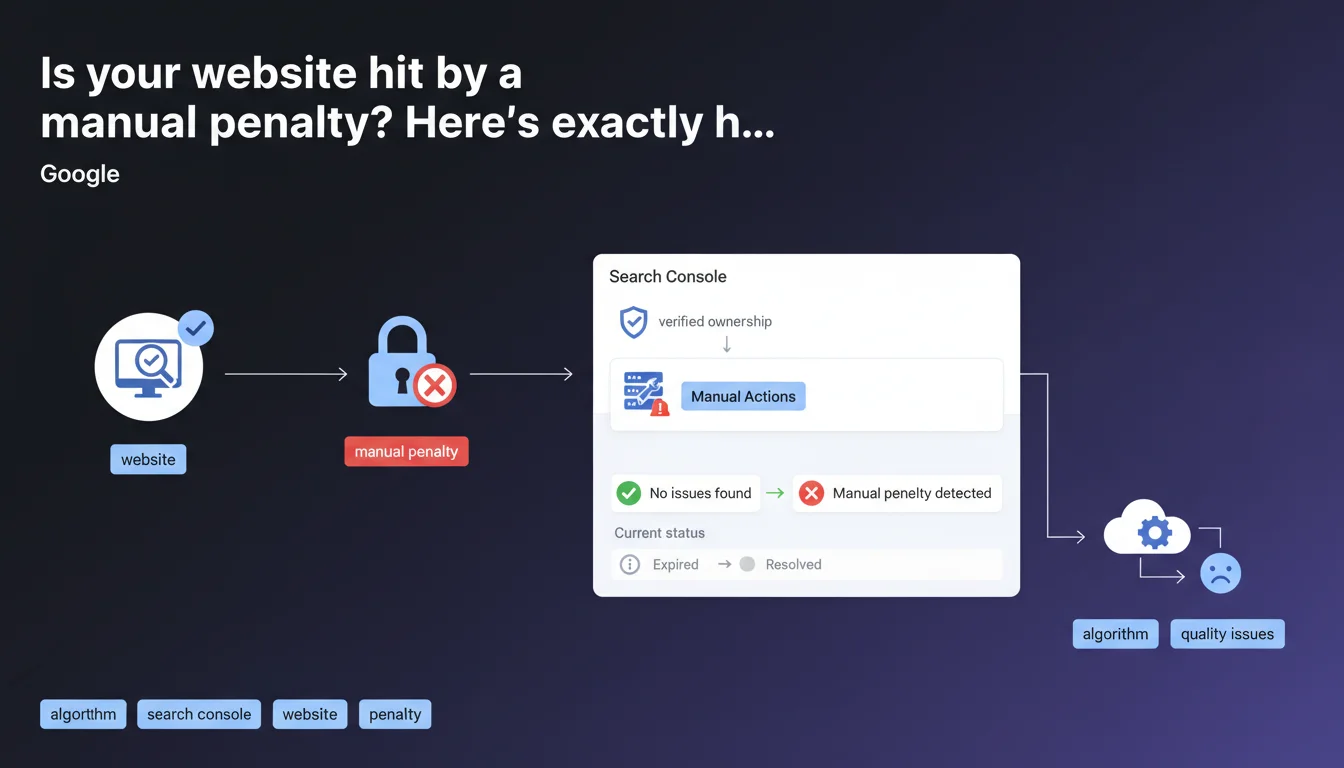
Google confirms that manual penalties are visible in Search Console for all verified owners, but expired or resolved actions disappear from history. More importantly: algorithms can penalize your site without any manual action appearing in the interface.
What you need to understand
Where exactly can you see manual actions in Search Console?
Google centralizes all active manual penalties in a dedicated Search Console section, accessible once you've verified your site ownership. This information is shared among all verified owners — there are no access restrictions.
Here's what matters: only ongoing actions display. Once a penalty is lifted or expires naturally, it vanishes from the interface. Google doesn't maintain a searchable history of past sanctions.
What's the difference between a manual action and an algorithmic penalty?
A manual action results from human intervention at Google — a reviewer has identified a flagrant guideline violation and applies an explicit sanction. You receive a notification in Search Console detailing the issue.
Algorithmic penalties, on the other hand, are silent. No alerts, no messages — just sometimes a sudden traffic drop. The algorithm detects insufficient quality signals and adjusts your rankings accordingly, without human involvement.
Why doesn't Google keep a record of old penalties?
This erasure policy raises questions. In practice, it prevents a new team member or external provider from diagnosing a site's complete history. If a penalty was lifted three months before you arrived, you'll never know about it through Search Console.
Google justifies this approach by citing privacy and the desire not to stigmatize sites that have corrected their mistakes. Yet for a thorough audit, this opacity makes it harder to identify patterns of past sanctions.
- Active manual penalties are visible to all verified owners in Search Console
- Resolved or expired actions completely disappear from the interface — no accessible history
- Algorithmic filters generate no notification and can impact your rankings with no visible trace
- A site can lose traffic due to quality issues without any manual action appearing
- Multiple owners can simultaneously check the status of manual actions on the same site
SEO Expert opinion
Does this statement truly reflect what's happening in the real world?
Yes, but it hides the essential part. In fifteen years of practice, I've seen far more sites impacted by algorithmic adjustments than by manual penalties. Google emphasizes the transparency of manual actions but downplays the complexity of automatic filters affecting the majority of sites.
The real problem? A client whose traffic collapses checks Search Console, sees no manual action, and concludes Google isn't responsible. [To verify] — because often, it's a quality filter that struck, without any notification sent. Google's statement is factually accurate, but it creates a false sense of security.
Why is the lack of history problematic for professionals?
Because understanding a site's past is crucial to anticipating its future. When I take over a site that suffered a Penguin or Panda penalty two years ago, the absence of records in Search Console forces me to reconstruct history using third-party tools, backlink analysis, and traffic fluctuations.
Let's be honest: Google could easily maintain this history while making it accessible only to verified owners. The choice to completely erase it seems more driven by a desire to limit traceability of the Webspam team's decisions than by technical considerations.
Are algorithms really distinct from manual actions?
In theory, yes. In practice, the boundary blurs. Some algorithmic filters function like automated penalties — think of sites hit by the Helpful Content Update that lose 70% of their traffic overnight.
And that's where it gets sticky: these algorithmic adjustments can be just as devastating as a manual action, but they generate no notification, no explanation, no recourse. You're left completely in the dark, trying to guess which quality signal triggered the sanction.
Practical impact and recommendations
What should you actually do to monitor manual penalties?
First obvious step: verify your site ownership in Google Search Console if you haven't already. Without this verification, you have no access to any information about current manual actions.
Then set up email alerts in Search Console to be notified immediately if a new manual action appears. Don't rely on manual weekly checks — you risk losing weeks before discovering a penalty.
Beyond Search Console, implement organic traffic monitoring with automatic alerts on sudden drops (>15% over 7 days). Algorithmic penalties won't send you any email — only analyzing traffic curves will alert you.
How do you tell the difference between a manual penalty and an algorithmic adjustment?
If Search Console shows a manual action, diagnosis is straightforward. But if you see traffic decline without notification, you're entering complex territory.
Cross-reference multiple indicators: the suddenness of the drop (algorithmic) versus gradual erosion (competition), correlation with documented Core Updates dates, analysis of losing pages (entire site or specific topics only).
- Check the Manual Actions section in Search Console daily
- Enable email alerts for any new manual actions detected
- Set up automated organic traffic monitoring with alert thresholds
- Document any manual action received in an external file (date, reason, resolution) — Google doesn't keep records
- Analyze backlinks regularly to detect toxic patterns before a filter strikes
- Correlate traffic drops with Core Update dates and known algorithms
- Audit content quality according to E-E-A-T criteria even without visible penalties
Should you worry if no manual action appears?
No, but don't fall asleep either. The absence of a manual action doesn't mean Google validates your site quality — it simply means no human reviewer deemed intervention necessary.
Algorithmic filters do most of the cleanup work. They're more discreet, more frequent, and often harder to resolve than a clear manual penalty with an explicit reason.
❓ Frequently Asked Questions
Combien de temps une action manuelle reste-t-elle visible dans Search Console ?
Peut-on récupérer l'historique des anciennes pénalités manuelles d'un site ?
Si mon trafic chute sans action manuelle visible, est-ce forcément un problème algorithmique ?
Tous les propriétaires vérifiés voient-ils les mêmes actions manuelles ?
Les pénalités algorithmiques peuvent-elles être plus graves que les actions manuelles ?
🎥 From the same video 15
Other SEO insights extracted from this same Google Search Central video · published on 09/08/2023
🎥 Watch the full video on YouTube →
💬 Comments (0)
Be the first to comment.