
Official statement
Other statements from this video 15 ▾
- □ Why does Google cap sitemaps at 50,000 URLs, and how does it impact large websites?
- □ Do ARIA attributes really improve your website's SEO?
- □ Do you really need to redirect canonicalized URLs to improve your search rankings?
- □ Does Google really ignore URL fragments (#) for SEO purposes?
- □ Why isn't perfect technical optimization enough to rank your site anymore?
- □ Is your website hit by a manual penalty? Here's exactly how to check in Search Console
- □ Why is Product markup completely useless for real estate listings?
- □ Can you really use hreflang for non-translated content targeting different regions?
- □ Does color contrast really impact your SEO rankings?
- □ Does the HTML <article> tag really boost your SEO rankings?
- □ Do Relative and Absolute Links Really Make a Difference for SEO?
- □ Does Google really require English day names in structured data for non-English websites?
- □ How can you verify that a crawler is really Googlebot and block fake ones without hurting your SEO?
- □ Should you really stop relying on Google cache to diagnose indexation issues?
- □ Is Google really indexing content that doesn't exist on your site?
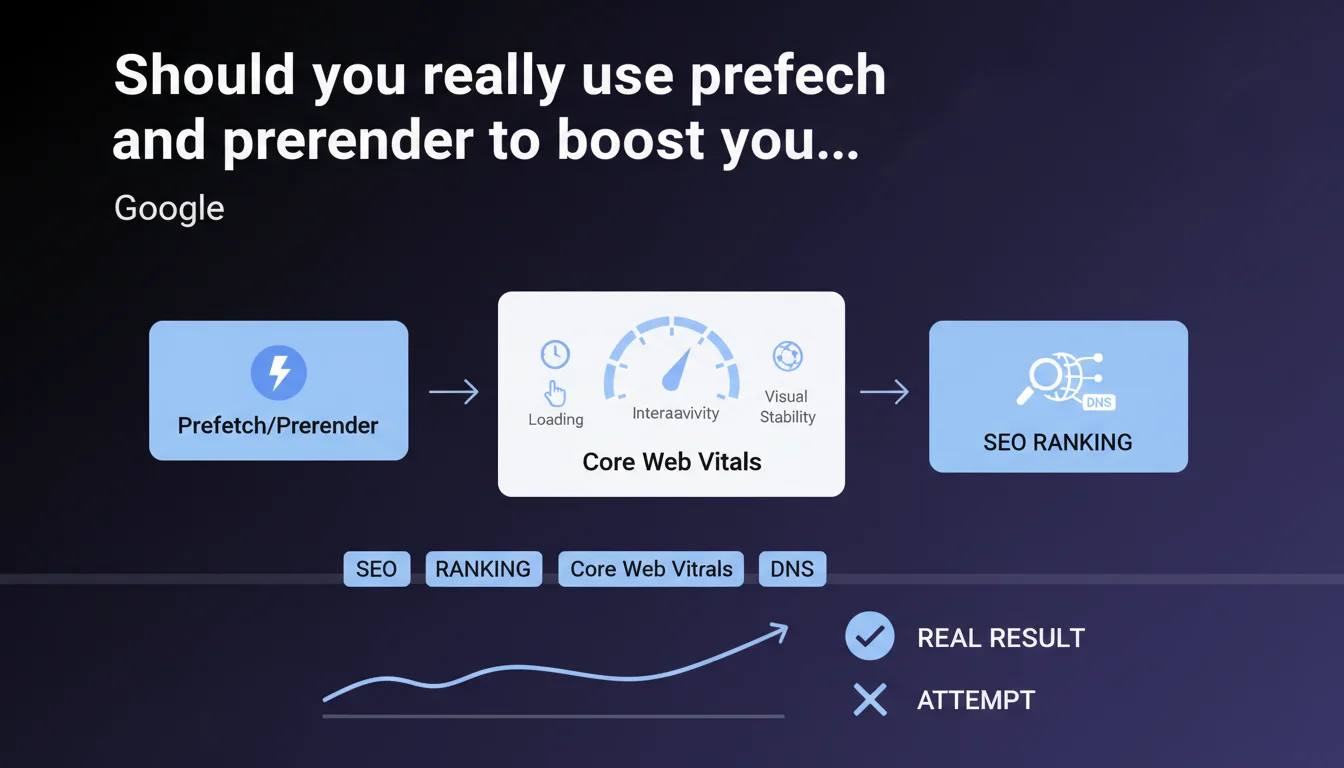
Prefetch, prerender, and DNS-prefetch tags are not direct ranking signals. If they genuinely improve user experience, this will be reflected in measured Core Web Vitals, which are a ranking factor. Google only values observable results, not technical intent.
What you need to understand
Are resource hints a ranking factor?
No, not directly. Google doesn't check whether you've added a prefetch or prerender tag in your code. These directives don't work like meta robots tags or structured markup: their presence doesn't improve your rankings by itself.
What matters is the measurable impact on Core Web Vitals. If your real users load pages faster, if LCP decreases, if INP improves, then these gains will be captured in field data (CrUX). And this data does influence rankings.
Why this distinction between attempt and result?
Because these techniques can be poorly implemented or pointless in certain contexts. Preloading a resource that will never be used wastes bandwidth. Prerendering a page that only 5% of visitors access can degrade overall performance.
Google doesn't want to reward blind technical checklists. It values what concretely improves experience. If your Core Web Vitals don't budge, then your prefetch efforts don't count — even if the code is technically perfect.
What's the key takeaway from this logic?
- Resource hints (prefetch, prerender, dns-prefetch, preconnect) are not standalone ranking signals
- Their SEO value passes exclusively through improvements in actual Core Web Vitals (CrUX data)
- Correct technical implementation without measurable user impact = zero SEO benefit
- Google explicitly distinguishes intent (adding the tag) from result (improving metrics)
SEO Expert opinion
Is this position consistent with what we observe in the field?
Yes, completely. Since Core Web Vitals became a ranking factor, Google keeps repeating that only real user metrics matter. Not Lighthouse lab scores, not theoretical optimizations — only what visitors actually experience.
What's interesting is that this statement definitively rules out the idea of a "technical bonus" for sites that check all the boxes. If prefetch were a signal, we'd have seen correlation studies prove it. We haven't.
Where does this rule become fuzzy?
In measuring causality. How can you tell if a Core Web Vitals improvement comes from prefetch, a more performant CDN, CSS critical path refactoring, or a change in user behavior? [To verify]: Google provides no metric to isolate the impact of a specific resource hint.
Another tricky point: CrUX data aggregates 28 days of real navigation. A poorly calibrated prefetch can degrade performance for a user segment (mobile 3G for example) without you detecting it immediately. The feedback loop is slow and imprecise.
In what cases do these techniques remain relevant?
When you have predictable user journeys and identified bottlenecks. For example: preloading the cart page from a product sheet if 60% of visitors add the item. Or dns-prefetch to a critical third-party domain (analytics, fonts) that blocks rendering.
But don't preload everything "just in case". That's the best way to saturate bandwidth and slow initial load — the exact opposite of the desired effect. If your Core Web Vitals don't improve after implementation, remove these hints.
Practical impact and recommendations
What should you do concretely?
Start by identifying which resources really impact your Core Web Vitals. Analyze PageSpeed Insights, WebPageTest, Chrome DevTools — not to follow generic recommendations, but to understand where real bottlenecks are.
Then test resource hints on a sample of pages. Measure the before/after impact on CrUX data or via RUM if you have it. If nothing moves after 4 weeks, abandon it: you're optimizing a non-issue.
What mistakes should you absolutely avoid?
- Preloading resources used by less than 30% of visitors
- Prerendering heavy or dynamic pages (API connections, personalization)
- Multiplying dns-prefetch to infrequently used domains
- Implementing these tags without measurement tools (RUM, CrUX API) to validate the effect
- Forgetting that lab gains (Lighthouse) guarantee nothing on field data
How do you verify the optimization is working?
Use the CrUX API or Search Console (Web Vitals report) to track your real metrics over time. Compare the period before and after implementation. If LCP, FID, or CLS don't improve significantly, it means the resource hint isn't solving the real bottleneck.
You can also segment data by device type and connection. A prefetch may help desktop but penalize 3G mobile. Be careful not to degrade one segment to improve another.
❓ Frequently Asked Questions
Le prefetch améliore-t-il directement mon classement Google ?
Comment savoir si mon prefetch fonctionne vraiment ?
Puis-je utiliser prerender sur toutes mes pages ?
Les données Lighthouse suffisent-elles pour valider l'optimisation ?
Le dns-prefetch est-il utile sur tous les domaines tiers ?
🎥 From the same video 15
Other SEO insights extracted from this same Google Search Central video · published on 09/08/2023
🎥 Watch the full video on YouTube →
💬 Comments (0)
Be the first to comment.