
Official statement
Other statements from this video 17 ▾
- 1:24 Pourquoi Google republie-t-il des guides sur robots.txt et meta robots maintenant ?
- 7:02 GoogleBot crawle-t-il des URLs que votre site n'a jamais générées ?
- 7:27 Pourquoi Search Console et Google Analytics affichent-ils des chiffres différents ?
- 7:27 GoogleBot crawle-t-il vraiment des URLs que votre site n'a jamais générées ?
- 8:07 Pourquoi Search Console et Google Analytics affichent-ils des données différentes ?
- 8:51 Combien de temps Google met-il vraiment à reconnaître une correction de balise noindex ?
- 9:49 Pourquoi Google met-il autant de temps à reconnaître la suppression d'une balise noindex ?
- 11:11 L'encodage des caractères spéciaux dans le code source nuit-il vraiment au référencement ?
- 11:11 L'encodage des caractères spéciaux dans le code source pose-t-il un problème pour le SEO ?
- 11:47 Comment bloquer efficacement les PDF du crawl Google sans risquer l'indexation ?
- 11:51 Faut-il vraiment bloquer les PDF avec robots.txt ou utiliser noindex ?
- 14:14 Combien de temps Google met-il vraiment à afficher votre nouveau nom de site ?
- 14:14 Comment forcer Google à afficher le bon nom de votre site dans les SERP ?
- 14:59 Pourquoi Google pénalise-t-il les noms de marque trop similaires dans les SERP ?
- 19:01 Pourquoi Google refuse-t-il de détailler ses critères de classification adulte ?
- 20:13 Un site 100% HTTPS sans version HTTP est-il pénalisé par Google ?
- 20:30 Un site HTTPS-only pose-t-il un problème SEO ?
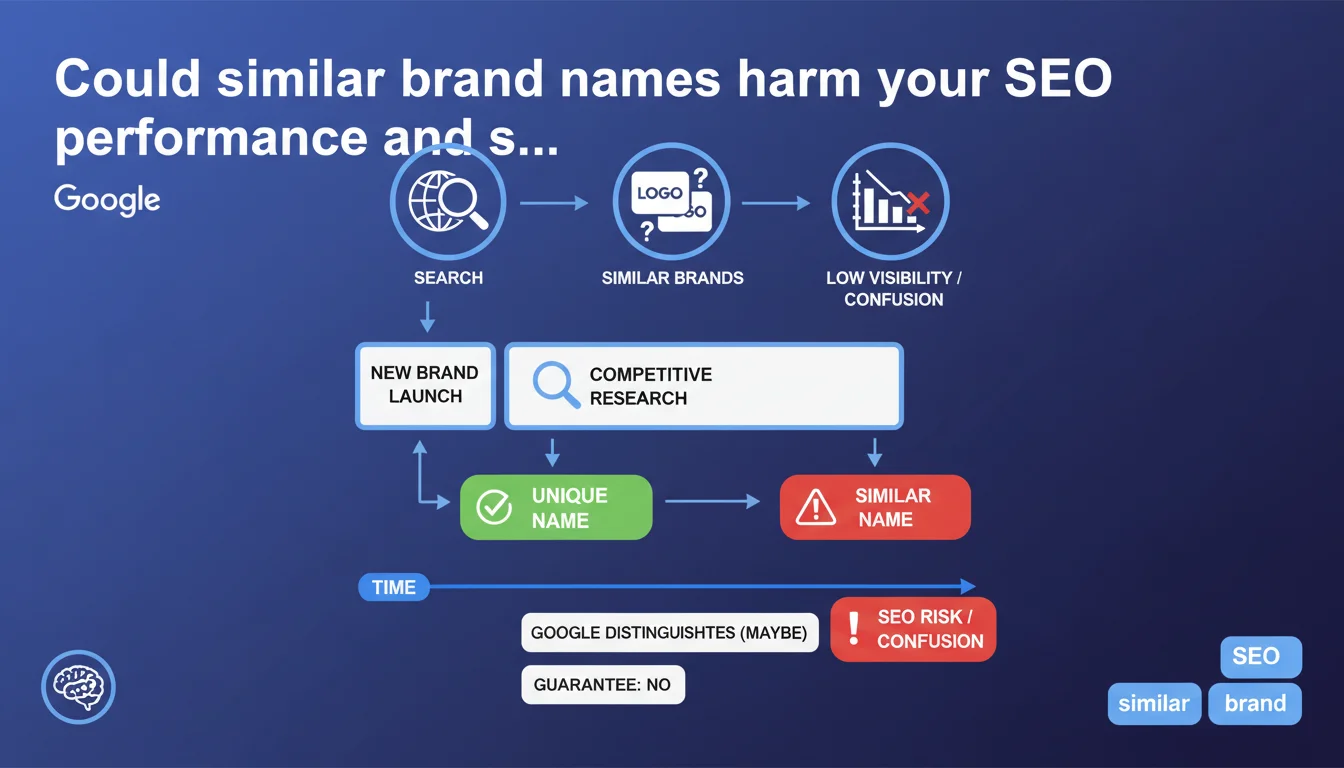
Google recommends avoiding brand names too similar to existing companies to prevent confusion in search results. The search engine might eventually learn to distinguish between the two entities over time, but there's no guarantee — making it a risky gamble. Conducting thorough competitive research before launch becomes a critical SEO step, not just a legal formality.
What you need to understand
Why does Google warn against similar brand names?
Search engines rely on semantic understanding algorithms that attempt to match queries with relevant entities. When two brands have nearly identical names, these systems struggle to determine which company actually corresponds to the user's intent.
The concrete result? Your content can be buried among your competitor's results, even if you've done solid optimization work. Google then distributes visibility between the two entities unpredictably — and often to the disadvantage of the newcomer.
Will Google eventually understand the difference over time?
Google mentions the possibility of gradual learning, but remains deliberately vague. Translation: no time guarantee, no commitment to effectiveness. This could take months, years — or may never truly stabilize.
The Knowledge Graph, brand signals (citations, mentions, contextual backlinks), and user behavior all play a role. But if your competitor already dominates these signals, you start at a structural disadvantage.
What are the concrete risks for your visibility?
The consequences go beyond simple dilution of organic results. Your Google Business Profile listing can be confused with a homonym's, your featured snippets attributed to the other entity, your rich results misassociated.
On the SERP, you risk losing qualified traffic that clicks on your competitor's results thinking they're accessing your site. And frustrated users generate pogo-sticking, a negative signal for Google.
- Confusion in organic results and risk of uncontrolled cannibalization
- Entity attribution problems in the Knowledge Graph and Google Business Profile
- Loss of qualified traffic redirected to a homonym competitor
- Negative behavioral signals (pogo-sticking, high bounce rate)
- Unpredictable learning delay for Google to correctly distinguish between the two brands
SEO Expert opinion
Is this Google recommendation really new?
Not really. SEO practitioners have known for years that brand signals carry significant weight in rankings. What's changing is that Google now states this explicitly — and with a caution that says a lot.
The fact they specify "it's not guaranteed" reveals the limits of their own algorithms. Google implicitly admits it doesn't always master disambiguation of homonym entities. [To verify]: no public data documents the success rate of this "distinction over time" or average observed timeframes.
In which cases can this rule be circumvented?
If you operate in an ultra-specific niche or on a distinct geographic territory, confusion can remain limited. A "Smith Plumbing" in New York won't necessarily collide with a "Smith Plumbing" in Los Angeles — especially if queries include geolocators.
But beware: the moment you target a national or international audience, the problem becomes critical. And if your homonym is already an established brand with authority, you're at a disadvantage — regardless of your SEO budget.
What field observations contradict or nuance this statement?
We regularly observe cases where two similar brands coexist without major SERP problems — often because their semantic universes diverge enough. If your content, backlinks, and lexical fields are sufficiently differentiated, Google can learn faster.
Conversely, when two companies battle over the same commercial keywords with similar names, it's chaos. A/B tests of rebranding show that changing names can multiply organic visibility by 2 to 3 times in these borderline cases — but it's a heavy and risky operation.
Practical impact and recommendations
What should you verify before choosing a brand name?
SEO competitive research becomes as important as trademark searches. Type your intended name into Google and analyze the first 3 pages of results — not just the first line.
Also verify existing entities in the Knowledge Graph, similar Google Business profiles, and domains already positioned on your target keywords. If a homonym competitor already dominates these positions, reconsider your choice.
What mistakes should you avoid if you're already in a confusion situation?
Don't just wait for "Google to learn over time." Actively strengthen your entity signals: consistent NAP citations, brand mentions on authority sites, properly implemented Organization and LocalBusiness structured data.
Also avoid creating overly generic content that could be attributed to your competitor. Differentiate yourself through specific editorial angles, a distinctive lexical field, and unique brand markers (slogan, recurring visual elements, tone of voice).
How do you measure the impact of this confusion on your SEO?
Monitor your impressions and CTR in Search Console on brand queries. If CTR is abnormally low despite good rankings, users are probably clicking on your competitor by mistake.
Also track unlinked brand mentions using monitoring tools. If your brand is frequently cited but backlinks go to your homonym, you have an entity attribution problem.
- Conduct exhaustive Google search on your intended brand name (minimum 3 pages of results)
- Check existing entities in the Knowledge Graph and Google Business Profile
- Analyze competitor domains ranked on your target keywords with similar names
- Implement Organization/LocalBusiness structured data from launch
- Build differentiating brand signals (NAP citations, mentions, contextual backlinks)
- Create a distinctive semantic universe (lexical field, editorial angles, tone of voice)
- Monitor impressions/CTR on brand queries in Search Console
- Track unlinked brand mentions to detect attribution errors
❓ Frequently Asked Questions
Combien de temps faut-il pour que Google distingue deux marques au nom similaire ?
Est-ce qu'un dépôt de marque à l'INPI aide Google à faire la distinction ?
Peut-on forcer Google à corriger une confusion d'entité via un signalement ?
Les variations orthographiques (tirets, espaces, majuscules) suffisent-elles à différencier deux marques ?
Faut-il racheter le concurrent homonyme pour résoudre le problème ?
🎥 From the same video 17
Other SEO insights extracted from this same Google Search Central video · published on 27/03/2025
🎥 Watch the full video on YouTube →
💬 Comments (0)
Be the first to comment.