
Official statement
Other statements from this video 17 ▾
- 1:24 Pourquoi Google republie-t-il des guides sur robots.txt et meta robots maintenant ?
- 7:02 GoogleBot crawle-t-il des URLs que votre site n'a jamais générées ?
- 7:27 Pourquoi Search Console et Google Analytics affichent-ils des chiffres différents ?
- 7:27 GoogleBot crawle-t-il vraiment des URLs que votre site n'a jamais générées ?
- 8:51 Combien de temps Google met-il vraiment à reconnaître une correction de balise noindex ?
- 9:49 Pourquoi Google met-il autant de temps à reconnaître la suppression d'une balise noindex ?
- 11:11 L'encodage des caractères spéciaux dans le code source nuit-il vraiment au référencement ?
- 11:11 L'encodage des caractères spéciaux dans le code source pose-t-il un problème pour le SEO ?
- 11:47 Comment bloquer efficacement les PDF du crawl Google sans risquer l'indexation ?
- 11:51 Faut-il vraiment bloquer les PDF avec robots.txt ou utiliser noindex ?
- 14:14 Combien de temps Google met-il vraiment à afficher votre nouveau nom de site ?
- 14:14 Comment forcer Google à afficher le bon nom de votre site dans les SERP ?
- 14:59 Pourquoi Google pénalise-t-il les noms de marque trop similaires dans les SERP ?
- 15:14 Faut-il éviter les noms de marque similaires pour ne pas nuire à son référencement naturel ?
- 19:01 Pourquoi Google refuse-t-il de détailler ses critères de classification adulte ?
- 20:13 Un site 100% HTTPS sans version HTTP est-il pénalisé par Google ?
- 20:30 Un site HTTPS-only pose-t-il un problème SEO ?
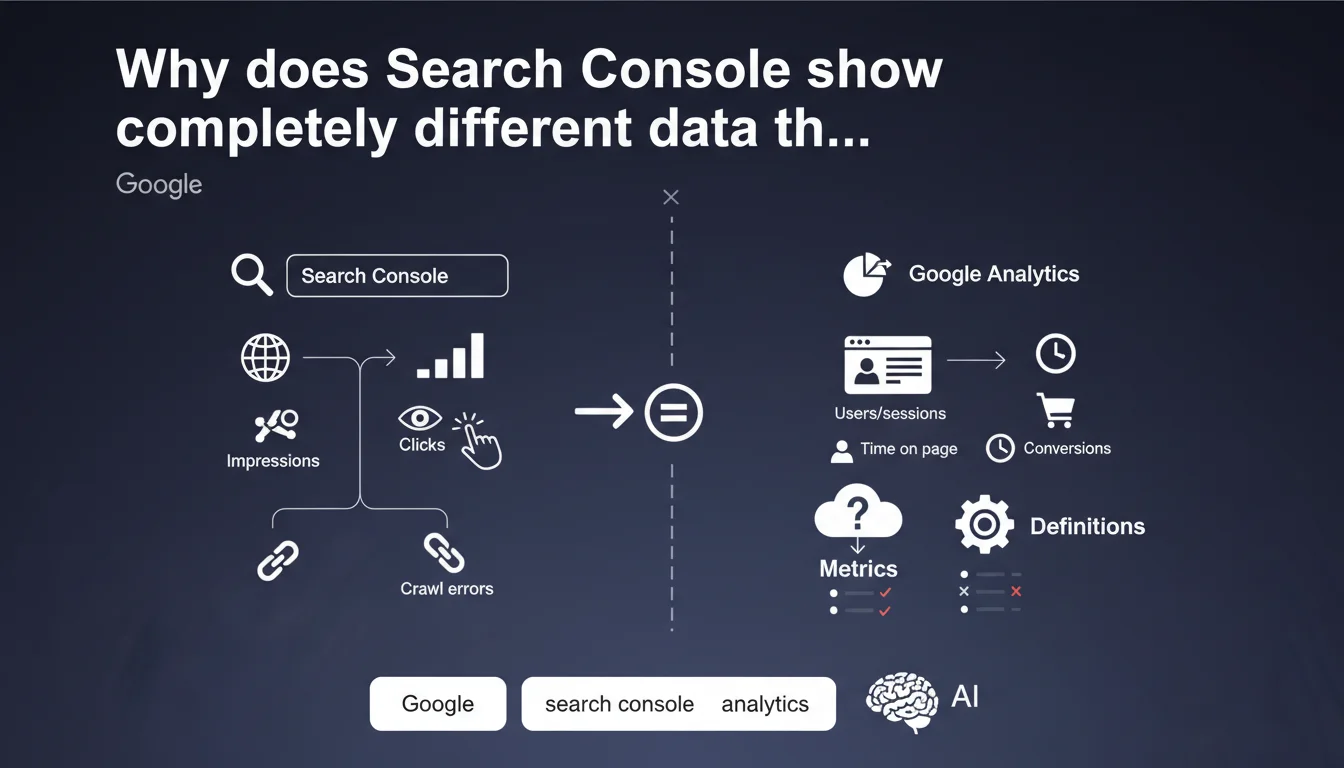
Search Console and Google Analytics use different metrics and definitions, which explains the data discrepancies between the two tools. Google officially confirms that these divergences are normal and documented. To correctly analyze your SEO performance, you need to understand the specifics of each tool rather than seeking perfect consistency.
What you need to understand
Why do these two tools speak different languages?
Search Console measures activity on Google's servers: impressions, clicks, average position in search results. Data comes directly from Google's indexing and ranking systems.
Google Analytics works on the client side: it collects data through JavaScript code executed in the user's browser. If the script doesn't load, if the user blocks trackers, or if the page closes before data is sent — nothing gets recorded.
What are the main sources of divergence?
Differences come from fundamentally opposing data collection methodologies. Search Console counts an impression as soon as a result appears in the SERPs, even if the user never scrolls to it. Analytics will only see this visitor if they click AND the tracking code triggers.
Filters and settings add another layer of complexity. A site can exclude internal traffic in Analytics, apply spam filters, or configure custom views — all elements that don't affect Search Console.
- Collection method: server (GSC) vs client (GA)
- Timing of measurement: display in SERPs vs actual page load
- Tracking blockers: don't affect GSC, impact GA
- Redirects and URL parameters: counted differently
- Processing delay: GSC updates more slowly than GA
- Sampling: GA can sample on large volumes, GSC doesn't
Does Google officially acknowledge these gaps?
Yes. This statement confirms that divergences are not bugs but deliberate methodological differences. Google maintains specific documentation on the subject, signaling that the issue is frequent enough to warrant an official explanation.
In practice? Stop trying to match numbers pixel-perfect. Use each tool for what it does best: GSC for search results performance, Analytics for post-click behavior.
SEO Expert opinion
Does this explanation really hold up in the real world?
In 80% of cases, yes. Gaps of 10-20% between Search Console and Analytics are indeed explainable by methodological differences. Ad blockers alone can mask 15-30% of traffic in Analytics depending on the industry.
But — and here's where it gets tricky — some gaps far exceed what can be attributed to technical differences alone. Sites can display 40-50% discrepancies with no clear explanation. [To verify] Google provides no threshold beyond which a gap becomes abnormal, leaving practitioners in the dark.
What gray areas does Google not mention?
Official documentation glosses over several problematic points. The (not provided) queries in Analytics while GSC displays them still cause attribution issues. Geolocation differences between the two tools can skew market analysis.
Another rarely mentioned limitation: GSC sometimes aggregates URL variants that you consider distinct. The same article accessible in HTTP and HTTPS, with or without www, can create duplicates in GSC but a single page in Analytics if redirects work properly.
When isn't this explanation sufficient?
When the trends themselves diverge. If GSC shows a 20% increase in organic clicks while Analytics displays a 10% drop, the problem is no longer methodological — it's technical or strategic.
Gaps on critical conversion pages also deserve deep investigation. An e-commerce landing page with 500 GSC clicks but 200 Analytics sessions could signal a tracking problem, load speed issue, or even misleading content causing immediate bounces.
Practical impact and recommendations
How to use these two tools without losing your mind?
Never try to reconcile raw numbers. Instead use relative trends: if GSC shows +15% and Analytics +12%, you're on a consistent trajectory even if absolute values differ.
Create segments in Analytics that filter only Google organic traffic, then compare monthly variations with GSC rather than volumes. It's the movement that matters, not the exact number.
What interpretation mistakes must you avoid?
Stop panicking if Analytics shows fewer sessions than GSC clicks. This is mathematically normal because of tracking blockers. On the other hand, if Analytics significantly exceeds GSC, you have a problem: either non-organic traffic is creeping into your reports, or your channel filter is misconfigured.
Another classic pitfall: comparing Analytics page views with GSC clicks. These are two different metrics — one click can generate multiple page views if the user navigates the site.
- Verify that Analytics code is present on all pages indexed in GSC
- Set up automatic alerts when the GSC/Analytics gap exceeds 30%
- Cross-check dates: GSC has 2-3 days lag, Analytics is near real-time
- Use secondary dimensions in Analytics to segment by landing page
- Export GSC and Analytics data into a spreadsheet to analyze gaps by page group
- Never make a strategic decision based on just one of the two tools
What analysis method should you prioritize daily?
Adopt a hybrid approach: GSC to identify visibility opportunities (high-volume queries with average position between 8-20), Analytics to measure traffic quality (conversion rate, session duration, pages per visit).
For complex sites, this dual analysis quickly becomes time-consuming. Tool gaps can mask critical technical issues or growth opportunities. If you're noticing unexplainable divergences or lack resources to fully leverage this data, guidance from a specialized SEO agency can save you precious time and prevent costly misinterpretations.
❓ Frequently Asked Questions
Quel écart entre Search Console et Analytics est considéré comme normal ?
Pourquoi Analytics affiche-t-il toujours moins de trafic que Search Console ?
Peut-on faire confiance aux données de Search Console pour mesurer le ROI SEO ?
Comment expliquer un écart inversé où Analytics dépasse Search Console ?
Les données Search Console sont-elles échantillonnées comme celles de Google Analytics ?
🎥 From the same video 17
Other SEO insights extracted from this same Google Search Central video · published on 27/03/2025
🎥 Watch the full video on YouTube →
💬 Comments (0)
Be the first to comment.